Lobelia erinus
L.
Edging blue lobelia
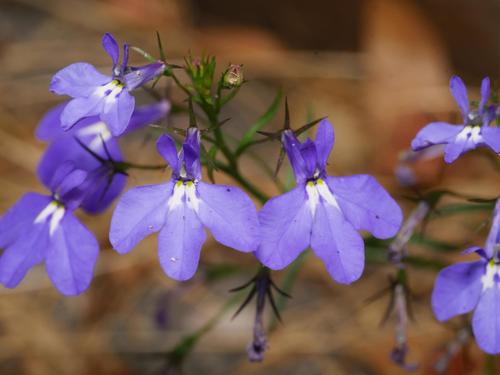
(c) Alexis Tinker-Tsavalas, some rights reserved (CC BY), uploaded by Alexis Tinker-Tsavalas

(c) Courtney Roark, some rights reserved (CC BY-NC)

no rights reserved
What to Eat
Edible parts: Leaves
The leaves are eaten as a vegetable.
Where to Find It
It is a subtropical plant. It grows in swamps and along river banks. In Zimbabwe it grows between 1.500-2.300 m above sea level.
Africa, Australia, Botswana, East Africa, Eswatini, Hawaii, Madagascar, Malawi, Mozambique, Pacific, South Africa, Southern Africa, Swaziland, Tasmania, Zambia, Zimbabwe,
How to Identify
A herb. It can be an annual or keep growing from year to year. It is a slender erect plant. It grows 30 cm high. The leaves are scattered. They are narrow and taper to both ends. There are a few teeth along the edge. The leaves are 6 cm long by 6 mm wide. The flowers are well spaced along stalks at the ends of branches. They are blue and white.
Wikipedia
Source ↗Lobelia erinus (edging lobelia, garden lobelia or trailing lobelia) is a species of flowering plant in the bellflower family Campanulaceae, native to southern Africa.
Notes
They have also been put in the family Lobeliaceae.
Names & Synonyms
Kimangamanga, Swilamphana
References (11)
- Baker, M. L. & de Salas, M. F., 2012, A Census of the Vascular Plants of Tasmania. (On line)
- Guillarmod, J., 1971,
- Jardin, C., 1970, List of Foods Used In Africa, FAO Nutrition Information Document Series No 2.p 87 (As Lobelia filiformis)
- Marker & Sheape, (As Lobelia filiformis)
- Martin, F.W. & Ruberte, R.M., 1979, Edible Leaves of the Tropics. Antillian College Press, Mayaguez, Puerto Rico. p 180 (As Lobelia filiformis)
- Okigbo, B.N., Vegetables in Tropical Africa, in Opena, R.T. & Kyomo, M.L., 1990, Vegetable Research and development in SADCC countries. Asian Vegetable Research and development Centre. Taiwan. p 38 (As Lobelia filiformis)
- Peters, C. R., O'Brien, E. M., and Drummond, R.B., 1992, Edible Wild plants of Sub-saharan Africa. Kew. p 141
- Ruiters-Welcome, A. K., 2019, Food plants of southern Africa. Ph.D. thesis. Univ. of Johannesburg p 73
- Shackleton, S. E., et al, 1998, Use and Trading of Wild Edible Herbs in the Central Lowveld Savanna Region, South Africa. Economic Botany, Vol. 52, No. 3, pp. 251-259
- Swaziland's Flora Database http://www.sntc.org.sz/flora
- Welcome, A. K. & Van Wyk, B.-E., 2019, An inventory and analysis of the food plants of southern Africa. South African Journal of Botany 122 (2019) 136–179


