Olea capensis
L.
Ironwood, Cape olive, East African olive

(c) Richard Adcock, some rights reserved (CC BY-NC), uploaded by Richard Adcock
no rights reserved

(c) Reuben Heydenrych, some rights reserved (CC BY-NC)
What to Eat
Edible parts: Fruit
Fruit - sometimes eaten. The ovoid, fleshy fruit is up to 2 x 1 cm - when ripe they are somewhat succulent purplish drupes.
Where to Find It
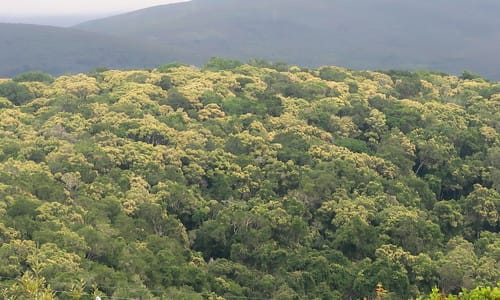
It is a tropical plant. It grows in mixed evergreen forest. In Nigeria it is common at 1,600 m above sea level.
Africa, Angola, Australia, Cameroon, Central Africa, Congo, Côte d'Ivoire, East Africa, Eswatini, Ethiopia, Guinea, Guinée, Ivory Coast, Kenya, Madagascar, Malawi, Mozambique, Nigeria, Sierra Leone, South Africa*, Southern Africa, Swaziland, Tanzania, West Africa, Zambia, Zimbabwe,
How to Identify
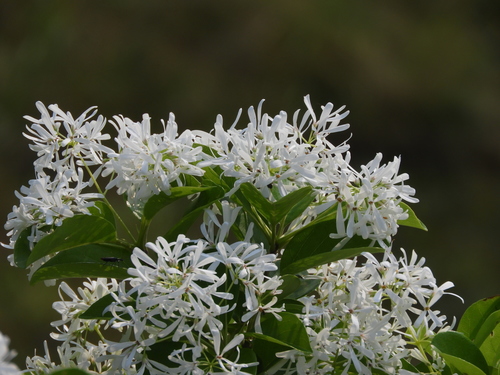
A tree. It grows 25-30 m high. Large trees have buttresses at the base. It can also be a bushy shrub. The bark is light grey but becomes dark and cracked. The leaves are green and shiny above and paler underneath. They are almost round and 3-10 cm long by 2-5 cm wide. The flowers are white or cream and have a sweet scent. They are in heads 3-15 cm long in the axils of leaves or at the ends of branches. The fruit are oval and 2 cm long by 1 cm wide. They are fleshy and purple when ripe. There are 3 subspecies.
How to Grow
A plant of tropical and subtropical areas, where it is found at elevations from 800 - 2,600 metres. It grows best in areas where the mean annual temperature falls within the range 14 - 18°c, but can tolerate 10 - 30°c. It prefers a mean annual rainfall of 800 - 1,200mm with a distinct dry season, tolerating a rainfall of 700 - 1,500mm. Requires a sunny position and a well-drained soil. Plants can tolerate some shade. Prefers a pH in the range 5.5 - 7, but tolerates 5 - 7.5. Growth is reported fast in young plants but much slower in older ones. Over the first 4 years a mean annual height of 1.1 metres has been reported. Flowering in profusion apparently takes place only at irregular intervals of up to 7 years in the late dry season. The fruits take about 6 months to ripen. This species has been divided into 3 subspecies:- Ssp. Macrocarpa. The fruits are oblong to elliptic, up to 2 x 1 cm; flowers in lax heads. Ssp. Capensis. The fruits are almost spherical to oblong elliptic, up to 1 cm long; flowers in dense heads and leaves very variable, apex often rounded; branchlets grey to greyish-brown. Ssp. Enervis. The leaves are usually broadly elliptic, apex tapering; branchlets grey to whitish.
Propagation: Seed - best sown as soon as it is ripe, otherwise there can be problems with dormancy. Fresh, mature, healthy seed usually germinates reasonably well, though the germination percentage tends to be low, at 30 - 40%, and uneven- it is usually extended over a period of 2 - 3 months but even in fresh seed can take as long as 2 years from sowing. He seed is collected and cleaned of all pulp - soaking in water for 2 days makes removal easier.
Medicinal Uses
The roots are used to treat infertility in women.
Other Uses
The wood of ssp capensis and ssp enervis is rarely used, but that of ssp macrocarpa is of high quality. The heartwood is pale brown with irregular dark gray-brown streaks; it is clearly demarcated from the up to 5cm wide band of pale yellow sapwood. The texture is fine and even; the grain straight or shallowly interlocked, figured; the surface slightly oily. The wood is hard and heavy; durability is low to moderate, being susceptible to termite attack. It dries very slowly, with a strong tendency to check and warp; honeycomb may develop in thick material if dried too rapidly. It is easy to saw when green; difficult to work by hand; a smooth clean finish is obtained in planing; it has excellent turning properties; steam-bending properties are moderate. An attractively figured wood, it is used for purposes such as quality furniture, decorative veneer, turnery, carving, decorative flooring, tool handles. The wood is used for fuel and to make charcoal. The tree is used for shade in coffee plantations. A natural pioneer species in its native range.
Wikipedia
Source ↗Olea capensis, the black ironwood, is an African tree species in the olive family Oleaceae. It is widespread in sub-Saharan Africa: from the east in Somalia, Ethiopia and Sudan, south to the tip of South Africa, and west to Cameroon, Sierra Leone and the islands of the Gulf of Guinea, as well as Madagascar and the Comoros. It occurs in bush, littoral scrub and evergreen forest. Other common names in English include ironwood, ironwood olive, East African olive and Elgon olive.
Notes
There are about 20 Olea species.
Names & Synonyms
Black Ironwood, Mushargi, Sinhletje, Sitimane, Umncuma, Ysterhout
References (13)
- Bodkin, F., 1991, Encyclopedia Botanica. Cornstalk publishing, p 737 (As Olea laurifolia)
- Dalziel, J. M., 1937, The Useful plants of west tropical Africa. Crown Agents for the Colonies London.(As Olea guineensis)
- Fox, F. W. & Young, M. E. N., 1982, Food from the Veld. Delta Books. p 283
- Jardin, C., 1970, List of Foods Used In Africa, FAO Nutrition Information Document Series No 2.p 150 (As Olea laurifolia)
- Long, C., 2005, Swaziland's Flora - siSwati names and Uses http://www.sntc.org.sz/flora/
- Mutie, F. G., 2020, Conservation of Wild Food Plants and Their Potential for Combatting Food Insecurity in Kenya as Exemplified by the Drylands of Kitui County. Plants 2020, 9, 1017
- Palmer & Pitman, 1972,
- Peters, C. R., O'Brien, E. M., and Drummond, R.B., 1992, Edible Wild plants of Sub-saharan Africa. Kew. p 157
- Ruiters-Welcome, A. K., 2019, Food plants of southern Africa. Ph.D. thesis. Univ. of Johannesburg p 82
- Swaziland's Flora Database http://www.sntc.org.sz/flora
- Tabl. encycl. 1:29. 1791 (As Olea laurifolia)
- Welcome, A. K. & Van Wyk, B.-E., 2019, An inventory and analysis of the food plants of southern Africa. South African Journal of Botany 122 (2019) 136–179
- World Checklist of Useful Plant Species 2020. Royal Botanic Gardens, Kew