Protea madiensis
Oliv.

(c) jordivanoort, some rights reserved (CC BY-NC), uploaded by jordivanoort
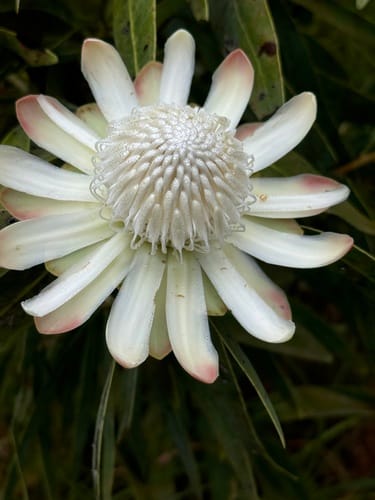
(c) Bethel Clement, some rights reserved (CC BY-NC)
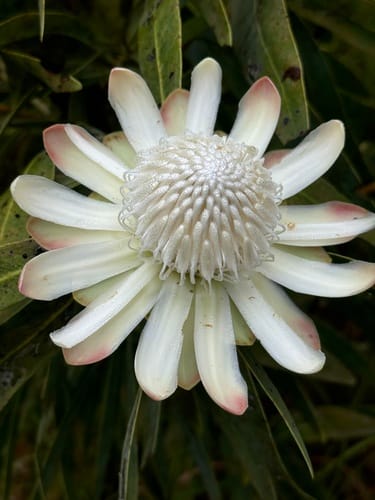
(c) Bethel Clement, some rights reserved (CC BY-NC)
What to Eat
Edible parts: Nectar, Leaves, Vegetable
The flower nectar is eaten. The leaves are used as a vegetable.
Where to Find It
It is a tropical plant. It grows in lowland and upland savannah in West Africa. In Nigeria it grows to 1,970 m above sea level.
Africa, Angola, Burkina Faso, Cameroon, Central Africa, Congo, East Africa, Ethiopia, Guinea, Guinée, Malawi, Mali, Mozambique, Nigeria, Southern Africa, West Africa, Zambia,
How to Identify
A shrub or small tree in the Proteaceae family growing to 3 m high with usually white flowers. It is a tropical plant found in lowland and upland savannah in West Africa, reaching 1,970 m elevation in Nigeria.
Medicinal Uses
The stem bark is used in the treatment of diarrhoea and dysentery.
Wikipedia
Source ↗Protea madiensis, commonly known as the tall woodland sugarbush, is a flowering shrub which belongs to the genus Protea. It is native to the montane grasslands of Sub-Saharan Africa.
Names & Synonyms
Chindjissi, Dague tulu, Katumbaga, Sinsi
References (8)
- Burkill, H. M., 1985, The useful plants of west tropical Africa, Vol. 4. Kew.
- Chapman, J. D. & Chapman, H. M., 2001, The Forest Flora of Taraba and Andamawa States, Nigeria. WWF & University of Canterbury. p 195
- East African Herbarium records, 1981,
- Grubben, G. J. H. and Denton, O. A. (eds), 2004, Plant Resources of Tropical Africa 2. Vegetables. PROTA, Wageningen, Netherlands. p 564
- Peters, C. R., O'Brien, E. M., and Drummond, R.B., 1992, Edible Wild plants of Sub-saharan Africa. Kew. p 164
- von Katja Rembold, 2011, Conservation status of the vascular plants in East African rain forests. Dissertation Universitat Koblenz-Landau p 178
- White, F., Dowsett-Lemaire, F. and Chapman, J. D., 2001, Evergreen Forest Flora of Malawi. Kew. p 439
- World Checklist of Useful Plant Species 2020. Royal Botanic Gardens, Kew
More from Proteaceae


