Ancylanthos rubiginosus
Desf.
(c) setlhare, some rights reserved (CC BY-NC)
(c) setlhare, some rights reserved (CC BY-NC)
(c) setlhare, some rights reserved (CC BY-NC)
What to Eat
Edible parts: Fruit
The fruit are eaten raw or used to make wine.
Where to Find It
It is a subtropical plant. In Namibia it grows in deep red sand. It grows between 900-1,400 m altitude. It can grow in arid places.
Africa, Angola, Botswana, Central Africa, East Africa, Namibia, South Africa, Southern Africa, Zambia, Zimbabwe,
How to Identify
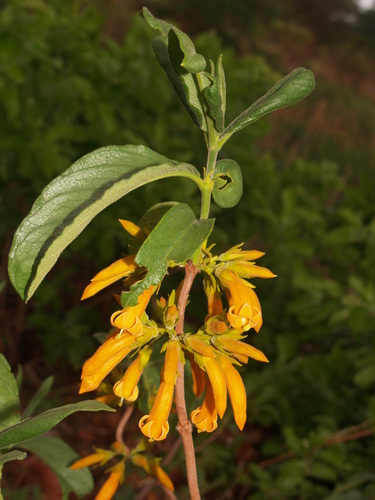
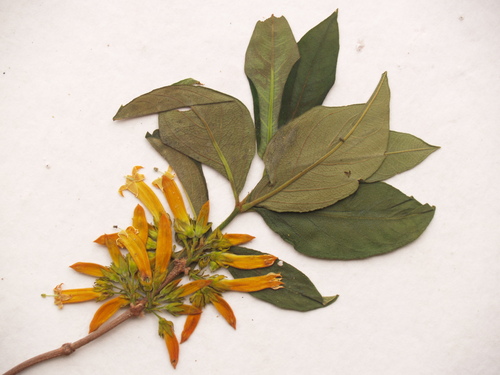
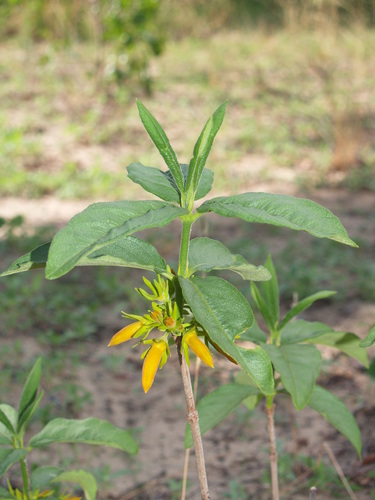
A shrub. It grows 1 m tall. The stems are erect. There can be one or several stems. They grow from a woody rootstock. Young plants have yellow hairs. The leaves are opposite or in rings. They are 3-15 cm long by 2-7 cm wide. The flowers are large. They are produced at nodes that have no leaves. The fruit is about 4 cm long. It is dark purple and turns light brown when ripe.
Notes
There is only one Ancylanthos species.
Names & Synonyms
Isya-matanda, Iyamba, Musyola, Omumbu, Yamba
References (11)
- Cheikhyoussef, A & Embashu, W., 2013, Ethnobotanical knowledge on Indigenous fruits in Ohangwena and Oshito regions in Northern Namibia. Journal of Ethnobiology and Ethnomedicine 9:34
- Flora Zambesiaca. http://apps.kew.org/efloras
- Fowler, D. G., 2007, Zambian Plants: Their Vernacular Names and Uses. Kew. p 55
- Fox, F. W. & Young, M. E. N., 1982, Food from the Veld. Delta Books. p 328 (As Ancylanthos bainesii)
- Global Plants JSTOR
- Leger, S., 1997, A Description of Today's Use of Plants in West Bushmanland (Namibia). German Development Service. PO Box 220035, 14061 Berlin, Germany. http://www.sigridleger.de/book/ (As Ancylanthos bainesii)
- Maguire, 1978, (As Ancylanthos bainesii)
- Peters, C. R., O'Brien, E. M., and Drummond, R.B., 1992, Edible Wild plants of Sub-saharan Africa. Kew. p 167 (As Ancylanthos bainesii)
- Royal Botanic Gardens, Kew (1999). Survey of Economic Plants for Arid and Semi-Arid Lands (SEPASAL) database. Published on the Internet; http://www.rbgkew.org.uk/ceb/sepasal/internet [Accessed 10th June 2011]
- Ruiters-Welcome, A. K., 2019, Food plants of southern Africa. Ph.D. thesis. Univ. of Johannesburg p 95
- Welcome, A. K. & Van Wyk, B.-E., 2019, An inventory and analysis of the food plants of southern Africa. South African Journal of Botany 122 (2019) 136–179


