Hyperacanthus amoenus
(Sims) Bridson
Kaffir cherry, Spiny Gardenia, Thorny Gardenia
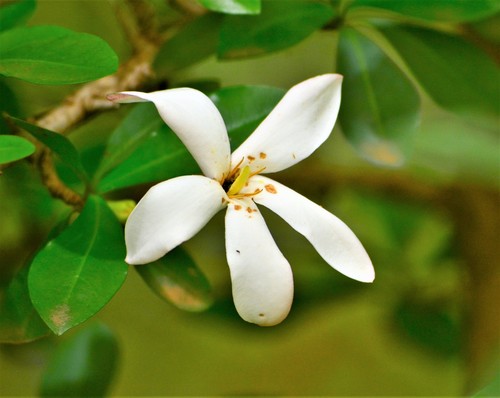
(c) rolandvl, some rights reserved (CC BY-NC)
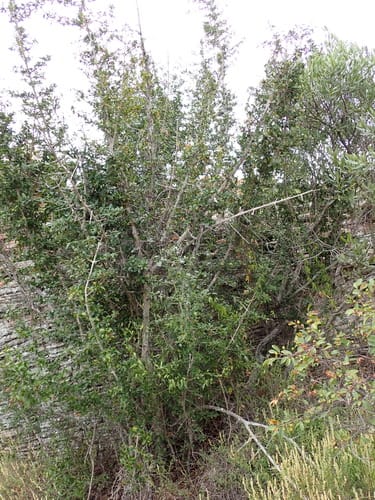
(c) Kevin Balkwill, some rights reserved (CC BY-NC)
What to Eat
Edible parts: Fruit
The ripe black fruits are edible.
Where to Find It
It is a subtropical plant. It grows in dry sandy soils. It grows between 100-330 m above sea level in Mozambique. It grows in both coastal and inland forests. It can grow in cold damp mountains and in dry hot plains. It can grow in arid places.
Open hillsides, in scrub bush; moist wooded kloofs and closed forests.
How to Identify
A small erect tree. It grows 3-6 m high. It often has short spines. The branches are stiff. It usually has many stems. The leaves are shiny and dark green. The leaves are in pairs or sometimes in threes. The leaf blade is narrow sword shaped. It tapers to a short stalk. The leaves are 7 cm long by 2 cm wide. There are a few flowers in clusters at the ends of branches. They are funnel shaped and white but sometimes with pink. They have a scent. The fruit is round and 2 cm across. They can be 3.5 cm across. They are black when ripe. The fruit are edible.
Medicinal Uses
The fruit and the roots are emetic.
Other Uses
The stems are used to make items such as fencing stakes and fishing baskets.
Names & Synonyms
Bembetfy, Bembethu, Doringkatjiering, Indzabulaluvalo, Isibembethu, Ithongoti, Lerogori, Lerogosi, Lu-pembetu, Murombe, Umhla-baba, Umtongoti
References (13)
- Cunningham, 1985, (As Gardenia amoena)
- Fox, F. W. & Young, M. E. N., 1982, Food from the Veld. Delta Books. p 320 (As Gardenia amoena)
- Long, C., 2005, Swaziland's Flora - siSwati names and Uses http://www.sntc.org.sz/flora/
- Magwede, K., van Wyk, B.-E., & van Wyk, A. E., 2019, An inventory of Vhavenḓa useful plants. South African Journal of Botany 122 (2019) 57–89
- Palgrave, K.C., 1996, Trees of Southern Africa. Struik Publishers. p 854 (As Gardenia amoena)
- Palmer, E and Pitman, N., 1972, Trees of Southern Africa. Vol. 2. A.A. Balkema, Cape Town p 2057 (As Gardenia amoena)
- Peters, C. R., O'Brien, E. M., and Drummond, R.B., 1992, Edible Wild plants of Sub-saharan Africa. Kew. p 170
- Royal Botanic Gardens, Kew (1999). Survey of Economic Plants for Arid and Semi-Arid Lands (SEPASAL) database. Published on the Internet; http://www.rbgkew.org.uk/ceb/sepasal/internet [Accessed 10th June 2011] (As Gardenia amoena)
- Ruiters-Welcome, A. K., 2019, Food plants of southern Africa. Ph.D. thesis. Univ. of Johannesburg p 96
- Shava, S., 2000, The Use of Indigenous Plants as Food by a Rural Community in the Eastern Cape: an Educational Exploration. Masters Thesis Rhodes University. p 65 (As Gardenia amoena)
- Swaziland's Flora Database http://www.sntc.org.sz/flora
- Welcome, A. K. & Van Wyk, B.-E., 2019, An inventory and analysis of the food plants of southern Africa. South African Journal of Botany 122 (2019) 136–179
- World Checklist of Useful Plant Species 2020. Royal Botanic Gardens, Kew


