Ammodaucus leucotrichus
(Coss. & Durand) Cosson
Cafoun

iNaturalist · cc-by
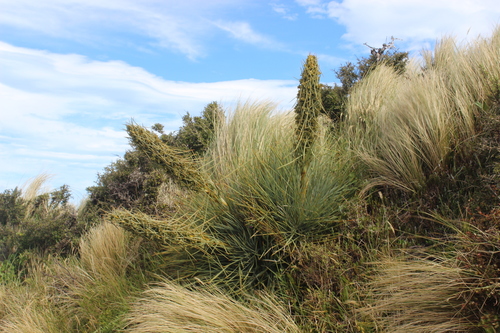
(c) Christian Berg, some rights reserved (CC BY), uploaded by Christian Berg
(c) Christian Berg, some rights reserved (CC BY), uploaded by Christian Berg
iNaturalist · cc-by
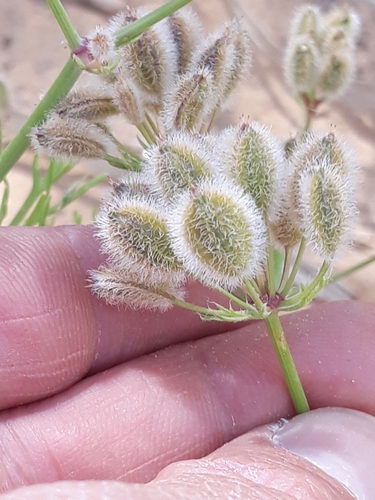
(c) Karim Haddad, some rights reserved (CC BY)
(c) Karim Haddad, some rights reserved (CC BY)
iNaturalist · cc-by
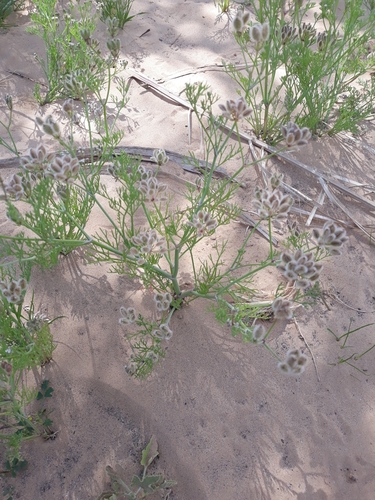
(c) Karim Haddad, some rights reserved (CC BY)
(c) Karim Haddad, some rights reserved (CC BY)
What to Eat
Edible parts: Seeds - flavour, Spice
The seeds are used as a spice in sauces and for flavouring, similar to caraway.
Where to Find It
It is a tropical plant. It grows in the Sahara in Africa. It grows as a part of the sand-dune vegetation. It can grow in arid places.
Africa, Algeria, Egypt, Libya, Mauritania, Mali, Mauritania, Mediterranean, Morocco, Niger, Nigeria, North Africa, Sahara, Sahel, Tunisia, West Africa,
Countries: Albania, Angola, Bosnia & Herzegovina, Burkina Faso, Burundi, Benin, Botswana, Congo (DRC), Central African Republic, Congo (Republic), Cote d'Ivoire, Cameroon, Cape Verde, Cyprus, Djibouti, Algeria, Egypt, Eritrea, Spain, Ethiopia, France, Gabon, Ghana, Gambia, Guinea, Equatorial Guinea, Greece, Guinea-Bissau, Croatia, Israel, Italy, Kenya, Comoros, Lebanon, Liberia, Lesotho, Libya, Morocco, Monaco, Montenegro, Madagascar, Mali, Mauritania, Malta, Mauritius, Malawi, Mozambique, Namibia, Niger, Nigeria, Rwanda, Seychelles, Sudan, Slovenia, Sierra Leone, Senegal, Somalia, South Sudan, Sao Tome & Principe, Syria, Eswatini, Chad, Togo, Tunisia, Turkey, Tanzania, Uganda, South Africa, Zambia, Zimbabwe
How to Identify
A small annual herb. It has a slender taproot. It has an anise scent. The leaves are strongly divided. The fruit are covered with soft silky hairs.
Other Information
It is a cultivated food plant.
Notes
There is only one Ammodaucus species.
Names & Synonyms
Cuminum maroccanum P. H. Davis & Hedge
References (10)
- Bircher, A. G. & Bircher, W. H., 2000, Encyclopedia of Fruit Trees and Edible Flowering Plants in Egypt and the Subtropics. AUC Press. p 23
- Burkill, H. M., 1985, The useful plants of west tropical Africa, Vol. 5. Kew.
- Dalziel, J. M., 1937, The Useful plants of west tropical Africa. Crown Agents for the Colonies London.
- Irvine, 1948,
- Nassif, F., & Tanji, A., 2013, Gathered food plants in Morocco: The long forgotten species in Ethnobotanical Research. Life Science Leaflets 3:17-54
- Peters, C. R., O'Brien, E. M., and Drummond, R.B., 1992, Edible Wild plants of Sub-saharan Africa. Kew. p 195
- Rivera, D. et al, 2006, Gathered Mediterranean Food Plants - Ethnobotanical Investigations and Historical Development, in Heinrich M, Müller WE, Galli C (eds): Local Mediterranean Food Plants and Nutraceuticals. Forum Nutr. Basel, Karger, 2006, vol 59, pp 18–74
- Royal Botanic Gardens, Kew (1999). Survey of Economic Plants for Arid and Semi-Arid Lands (SEPASAL) database. Published on the Internet; http://www.rbgkew.org.uk/ceb/sepasal/internet [Accessed 13th June 2011]
- Seidemann J., 2005, World Spice Plants. Economic Usage, Botany, Taxonomy. Springer. p 34
- World Checklist of Useful Plant Species 2020. Royal Botanic Gardens, Kew