Laportea peduncularis
(Wedd.) Chew
River nettle
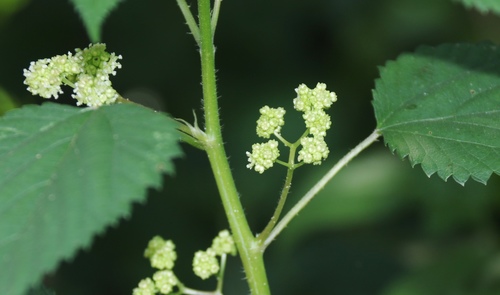
(c) Sharon Louw, some rights reserved (CC BY-NC), uploaded by Sharon Louw

(c) jean hirons, some rights reserved (CC BY-NC)

(c) Sandra Dell, some rights reserved (CC BY-NC)
What to Eat
Edible parts: Leaves, Flowers
The leaves and flowers are cooked as a vegetable.
Known Hazards
Where to Find It
It is a tropical plant. It grows in upland mountain forest. It grows between 1,100-1,700 m above sea level. It grows in dense shade and often near streams.
Africa, East Africa, Eswatini, Malawi, Mozambique, South Africa, Southern Africa, Swaziland, Tanzania, Zimbabwe,
How to Identify
A herb. It is slender and often grows as an annual. It grows 3 m high. It can be scrambling. It has a few stinging hairs. The leaves are alternate and widely spaced. The leaf blades are 12 cm long by 6 cm wide. The stalks can be 8 cm long. There are teeth along the edge and the leaf tapers to the tip. The leaves are pale underneath. The flowers are green. They are in small clusters.
Wikipedia
Source ↗Laportea peduncularis, the river nettle, is a herbaceous plant in the family Urticaceae. It is consumed for its anti-inflammatory effects.
Names & Synonyms
Bosbrandnetel, Bubati, Dzaluma, Lubati, Imbabazane, Imbathi, Inkwaze
References (8)
- Fox, F. W. & Young, M. E. N., 1982, Food from the Veld. Delta Books. p 358
- Long, C., 2005, Swaziland's Flora - siSwati names and Uses http://www.sntc.org.sz/flora/
- Magwede, K., van Wyk, B.-E., & van Wyk, A. E., 2019, An inventory of Vhavenḓa useful plants. South African Journal of Botany 122 (2019) 57–89
- Ogle, B. M. & Grivetti, L. E., 1984, Legacy of the Chameleon: Edible Wild Plants in the Kingdom of Swaziland, Southern Africa. A Cultural, Nutritional Study. Part 4 - Nutritional Analysis and Conclusions. Ecology of Food and Nutrition. Vol 17, pp 431-64
- Peters, C. R., O'Brien, E. M., and Drummond, R.B., 1992, Edible Wild plants of Sub-saharan Africa. Kew. p 196
- Ruiters-Welcome, A. K., 2019, Food plants of southern Africa. Ph.D. thesis. Univ. of Johannesburg p 106
- Swaziland's Flora Database http://www.sntc.org.sz/flora
- Welcome, A. K. & Van Wyk, B.-E., 2019, An inventory and analysis of the food plants of southern Africa. South African Journal of Botany 122 (2019) 136–179


