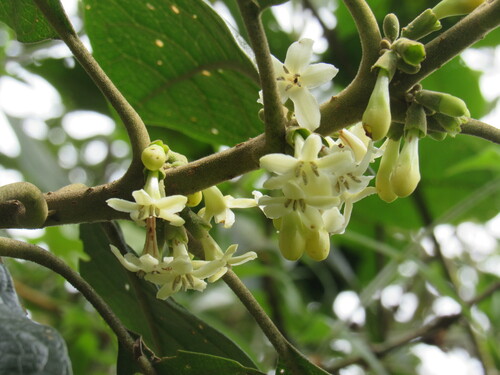
Clerodendrum capitatum
(Willd.) Schum & Thonn.
Pipe bush

(c) Georg Zizka, some rights reserved (CC BY-NC-SA)

(c) Marco Schmidt, some rights reserved (CC BY-NC-SA)

(c) Marco Schmidt, some rights reserved (CC BY-NC-SA)
What to Eat
Edible parts: Root
The root is used in soup broth.
Known Hazards
Where to Find It
It is a tropical plant. It grows in forests near rivers. It grows in savannah and closed forests. It grows from 475-1,420 m altitude. It can be up to 1,900 m above sea level.
Africa*, Angola, Burkina Faso, Central Africa, Central African Republic, CAR, Congo DR, East Africa, Guinea, Guinée, Guinea-Bissau, Kenya, Malawi, Mozambique, Nigeria, Rwanda, Senegal, Sudan, Tanzania, Uganda, West Africa, Zambia,
How to Identify
A climbing or scrambling shrub. It grows 6 m high. The leaf stalks 2.5 cm long can remain on old stems and branches. The young branches are densely hairy. The leaves are opposite. They are 2-17 cm long by 1-12 cm wide. They are broadly oval. They taper to the tip and are rounded or wedge shaped at the base. The flowering clusters ate 3-5 cm across. They are a half round shaped. There are large purple bracts around them. The fruit are 12 mm across. They are green when young and black and shiny when ripe.
How to Grow
Plants can be grown from seeds.
Propagation: Seed - Softwood cuttings Cuttings of half-ripe wood Root cuttings Division of suckers
Medicinal Uses
The leaves are febrifuge and considered to be generally healing. They are used in the treatment of arthritis, rheumatism, etc, and to help regulate the menstrual cycle. The leaves, together with the inflorescence, are used as a mouthwash and gargle to treat toothache. The leaves and root can relieve pain and are laxative. They are used in the treatment of a range of conditions including cutaneous, subcutaneous parasitic infection, venereal diseases, dropsy, swellings, oedema, gout, paralysis, epilepsy, convulsions, spasms. The root is used in treating naso-pharyngeal affections, stomach troubles and yaws. A root decoction is used as a treatment for hernia. The foliage is known to contain glycosides, saponims, steroids and alkaloids.
Notes
There are about 400 Clerodendrum species. Also as Lamiaceae
Names & Synonyms
Anaba, Enhela, Kasengasengwa, Kembang pipa, Kikululu, Kishihoshiho, Klerodendrum putih, Manabo, Mpapa, Mulepula, Ngwevula
References (7)
- Chapman, J. D. & Chapman, H. M., 2001, The Forest Flora of Taraba and Andamawa States, Nigeria. WWF & University of Canterbury. p 206
- Flora Zambesiaca. http://apps.kew.org/efloras
- Fowler, D. G., 2007, Zambian Plants: Their Vernacular Names and Uses. Kew. p 42
- Glover et al, 1969,
- Peters, C. R., O'Brien, E. M., and Drummond, R.B., 1992, Edible Wild plants of Sub-saharan Africa. Kew. p 197
- Sukarya, D. G., (Ed.) 2013, 3,500 Plant Species of the Botanic Gardens of Indonesia. LIPI p 611
- Terashima, H., et al, 1992, Ethnobotany of the Lega in the Tropical Rainforest of Eastern Zaire (Congo): Part Two, Zone de Walikale, African Study Monographs, Suppl. 19:1-60