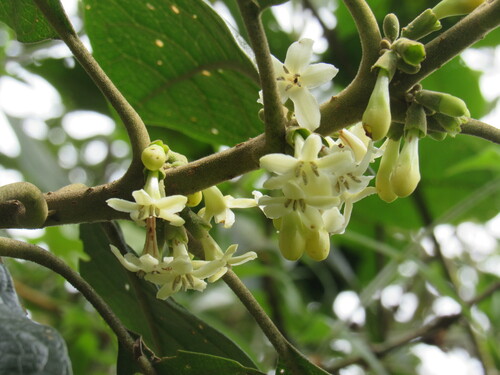
Premna resinosa
(Hochst.) Schauer

(c) Ateah Alfakih, some rights reserved (CC BY-NC-SA), uploaded by Ateah Alfakih
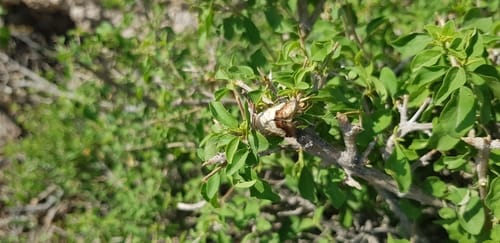
(c) Ateah Alfakih, some rights reserved (CC BY-NC-SA)
What to Eat
Edible parts: Fruit, Seeds, Leaves - flavouring
The ripe fruit are eaten raw, and the seeds are also eaten. The aromatic leaves are used to flavour tea.
Where to Find It
It is a tropical to Mediterranean plant. It grows in lowland shrub and grassland. It grows between sea level and 1,000 m altitude. It can grow in arid places.
Africa, Djibouti, East Africa, Eritrea, Ethiopia, Kenya, Middle East, Oman, Somalia, Sudan, Tanzania, Uganda,
How to Identify
A shrub. It grows 2-4 m tall. The branches are slender and white. The bark is thin and light brown and peels off in strips. The leaves have a smell. The leaves are 1-3 cm long. They are opposite and in groups of 4. Two are larger and two are smaller. The flowers are greenish-white. They are very small and in small groups. The fruit is black and fleshy. It is oval and 4-7 mm across.
How to Grow
Plants can be grown from seeds. Sometimes the seeds need to have the hard seed coat nicked to allow germination.
Production
There are 700-1,000 seeds per kg.
Notes
Also put in the family Verbenaceae.
Names & Synonyms
Boba'o, Dodoatteta, Kabout, Lomonera, Mermer, Mu-karakara, Saat, Sekeb, Tetwen, Urgecha, Urgesa
References (15)
- Addis, G., Asfaw, Z & Woldu, Z., 2013, Ethnobotany of Wild and Semi-wild Edible Plants of Konso Ethnic Community, South Ethiopia. Ethnobotany Research and Applications. 11:121-141
- Addis, G., et al, 2013, The Role of Wild and Semi-wild Edible Plants in Household Food Sovereignty in Hamer and Konso Communities, South Ethiopia. Ethnobotany Research & Applications. 11:251-271
- Bahru, T., et al, 2013, Wild Edible Plants: Sustainable Use and Management by Indigenous Communities in and the Buffer Area of Awah National Park, Ethiopia. Ethiop. J. Sci., 36(2): 93-108
- Dale, I. R. and Greenway, P. J., 1961, Kenya Trees and Shrubs. Nairobi. p 592
- East African Herbarium records, 1981,
- Feyssa, D. H., et al, 2011, Seasonal availability an consumption of wild edible plants in semiarid Ethiopia; Implications to food security and climate change adaptation. Journal of Horticulture and Forestry 3(5): 138-149
- Flora Somalia Vol. 1, 1993, http://plants.jstor.org
- Ichikawa, M., 1980, The Utilization of Wild Food Plants by the Suiei Dorobo in Northern Kenya. J. Anthrop. Soc. Nippon. 88(1): 25-48
- Lulekal, E., et al, 2011, Wild edible plants in Ethiopia: a review on their potential to combat food insecurity. Afrika Focus - Vol. 24, No 2. pp 71-121
- Miller, A. G., Morris, M. & Stuart-Smith, S., 1988, Plants of Dhofar. The Southern Region of Oman, Traditional, Economic and Medicinal Uses. Sultanate of Oman. p 284
- Mutie, F. G., 2020, Conservation of Wild Food Plants and Their Potential for Combatting Food Insecurity in Kenya as Exemplified by the Drylands of Kitui County. Plants 2020, 9, 1017
- Mutie, F. M., et al, 2023, Important Medicinal and Food Taxa (Orders and Families) in Kenya, Based on Three Quantitative Approaches. Plants 2023, 12, 1145
- Peters, C. R., O'Brien, E. M., and Drummond, R.B., 1992, Edible Wild plants of Sub-saharan Africa. Kew. p 198
- Royal Botanic Gardens, Kew (1999). Survey of Economic Plants for Arid and Semi-Arid Lands (SEPASAL) database. Published on the Internet; http://www.rbgkew.org.uk/ceb/sepasal/internet [Accessed 19th April 2011]
- World Checklist of Useful Plant Species 2020. Royal Botanic Gardens, Kew