Protium panamense
(Rose) I. M. Johnston
Alcanfor
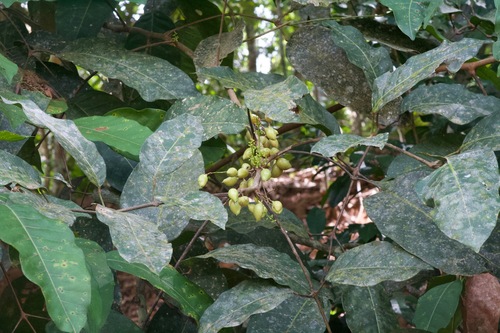
(c) Riley Fortier, some rights reserved (CC BY-NC), uploaded by Riley Fortier
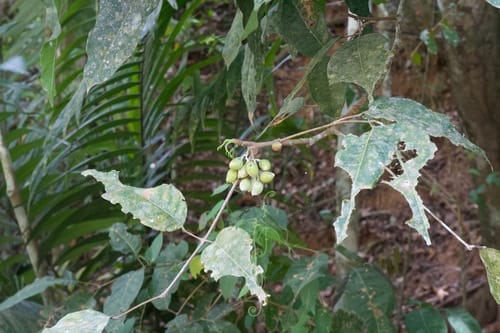
(c) Riley Fortier, some rights reserved (CC BY-NC)
What to Eat
Edible parts: Fruit
The aril (fleshy layer around the seeds) is edible.
Where to Find It
It is a tropical plant. It grows in wet or moist forests.
Central America, Colombia, Costa Rica, Panama, South America,
How to Identify
A shrub or tree. It grows 3-40 m high. It has stilt roots. The leaves are 23-60 cm long. The leaves have an odd number of leaflets. There are 3-7 leaflets 11-36 cm long and 4-12 cm wide. The flowers are in compact panicles in the axils of leaves. The flowers are yellow. The fruit are oval and yellow but become red when ripe. They are 2-3 cm long. They open by 2-4 valves.
How to Grow
A dioecious species, both male and female forms need to be grown if fruit and seed are required.
Propagation: Seed - best sown as soon as it is ripe. The seed usually germinates within two weeks.
Medicinal Uses
A resin obtained from the trunk is used to treat sores.
Other Uses
A clear resin is obtained from the incised bark. It has medicinal applications and is used as an incense in churches. The heartwood is brown; the rather thick band of sapwood is light brown. The wood is straight and close-grained; relatively soft and heavy; not strong. It is easily worked and takes a very good polish. It is little used. This tree is renown for its flammability: even the green wood ignites readily due to the highly combustible nature of its hydrocarbon-based sap. The flammable nature of the sap makes the green wood and bark of this species useful as kindling for starting campfires and the like.
Wikipedia
Source ↗Protium panamense is a species of plant in the Burseraceae family. It is found in Costa Rica and Panama. It is becoming rare due to habitat loss.
Names & Synonyms
Chutra, Copal, Judra tain, Mimonkawe, Witakewe
References (4)
- Castaneda, H., & Stepp, J. R., 2007, Ecosystems as Sources of Useful Plants for the Guaymi People of Costa Rica. Ethnobotany Journal. 5:249-257
- Langlois, H. C., 2004, Ethnobotanical analysis of different successional stages as sources of wild edible plants for the Guaymi people in Costa Rica. M. Sc. thesis University of Florida.
- Roa, J. A. G. & Boada, D. S. G., 2018, Fundación para el Fortalecimiento de la Fruticultura y Plantas Alimenticias no Convencionales en Colombia.
- Torre, de la, L., et al, 2008, Enciclopedia de las Plantas Útiles del Ecuador. Herbario QCA. Pontificia Universidad Católica del Ecuador. p 265


