Bellucia pentamera
Naudin
Five part bellucia, Coronilo
(c) Andrés Felipe SantoDomingo J., some rights reserved (CC BY-NC), uploaded by Andrés Felipe SantoDomingo J.
(c) Andrés Felipe SantoDomingo J., some rights reserved (CC BY-NC), uploaded by Andrés Felipe SantoDomingo J.

(c) Scamperdale, some rights reserved (CC BY-NC)
What to Eat
Edible parts: Fruit
The large juicy fruits are edible. Not very tasty. The pale yellow fruit is a depressed-globose berry around 25mm x 30 - 50mm, containing numerous small seeds.
Where to Find It
A tropical plant. It grows in semi-humid forests. It grows on the higher parts of the floodplain. It can grow to 1,600 m above sea level.
Africa, Amazon, Andes, Asia, Belize, Bolivia*, Brazil, Cameroon, Central Africa, Central America, Colombia*, Congo DR, Costa Rica, Ecuador*, El Salvador, Guadeloupe, Guatemala, Guyana, Honduras, Indonesia, Malaysia, Mexico*, Nicaragua, North America, Panama, Peru*, SE Asia, South America, Venezuela, West Indies,
How to Identify
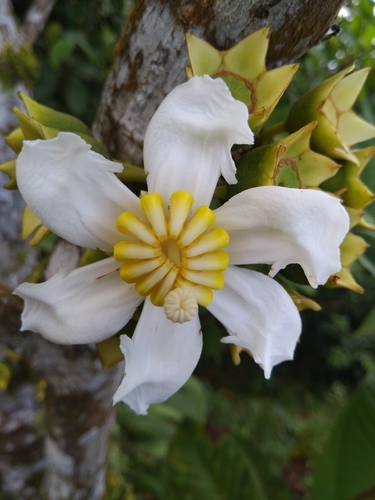
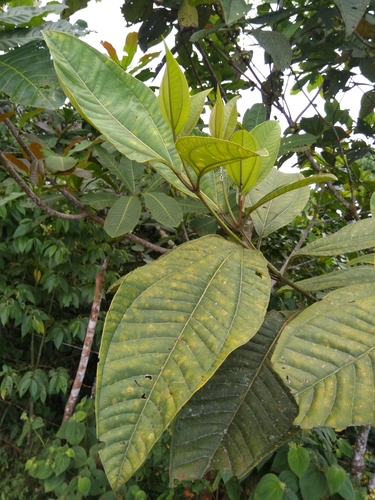
An erect shrub. It grows 3-5 m tall. It can grow to 20 m tall. The leaves are large, thick and rounded. They are lighter green underneath. Leaf stalks have grooves. The flowers and fruit can be in the axils of leaves or on the trunks. The flowers are pink. The fruit occur as 3-12 together. The fruit is a flattened berry. It is 2.5 cm long by 3-5 cm wide. The fruit are pale yellow.
How to Grow
Plants are grown from seed. Plants are spaced 3 m apart.
Propagation: Seed - due to its small size, it is best to place the fruits in plastic bags until the pulp has partially decomposed then mix them with water to make a suspension. Water the soil in a nursery seedbed with this suspension and do not cover the seed, but make sure the soil does not dry out.
Medicinal Uses
The juice from the bark is given to babies as a treatment for thrush. The fresh fruits are used as an anthelmintic.
Other Uses
The rasped stem is used to dye gourds.
Production
Fruit are produced in the rainy season.
Other Information
The fruit are popular.
Names & Synonyms
Capirote manzano, Cola de caballo, Coronel, Coronilla, Coronillo, Disper, Ekoti ya monseigneur, Estrella de monte, Ewegikabo, Eweyimo, Fruta estrella, Guayaba de pava, Guayabo de monte, Jambu kerak, Jambu tangkalak, Jepe, Kisa muyu yura, Manzanito, Manzano de montana, Neflier de Costa Rica, Nispero, Oluka dunnel, Oluka dummet, Payantsu, Payanzo, Pera de montana, Pohon jambu tangkalak, Quisa muyu yura, Sacha guayaba, Sacha nispero, Sacha payas, Sir-in, Tunguia, Tunkia, Tuunki
References (31)
- Altschul, S.V.R., 1973, Drugs and Foods from Little-known Plants. Notes in Harvard University Herbaria. Harvard Univ. Press. Massachusetts. no. 3094 (As Bellucia weberbaueri)
- Bircher, A. G. & Bircher, W. H., 2000, Encyclopedia of Fruit Trees and Edible Flowering Plants in Egypt and the Subtropics. AUC Press. p 56 (As Bellucia aricuaizensium, Bellucia, axinanthera, Bellucia costaricensis, Bellucia weberbaueri)
- Blake, S. F., Native Names and Uses of some Plants of Eastern Guatemala and Honduras. Contributions from the National Herbarium. p 89 (As Bellucia costaricensis)
- Condit, R., et al, 2011, Trees of Panama and Costa Rica. Princeton Field Guides. p 296
- de Polle, E., Plantas Silvestres Comestible de Guatemala. 1(1) Universidad de San Carlos de Guatemala. (As Bellucia costaricensis)
- Duchelle, A. E., 2007, Observations on Natural Resource use and Conservation by the Shuar In Ecuador's Cordillera del Condor. Ethnobotany Research & Applications 5:005-023
- Ferns, Useful Tropical Plants
- Grandtner, M. M., 2008, World Dictionary of Trees. Wood and Forest Science Department. Laval University, Quebec, Qc Canada. (Internet database http://www.WDT.QC.ca)
- Grandtner, M. M. & Chevrette, J., 2013, Dictionary of Trees, Volume 2: South America: Nomenclature, Taxonomy and Ecology. Academic Press p 63
- Jansen, P.C.M., J. Jukema., L.P.A Oyen and T.G. VanLingen. 1992. Minor edible fruits and nuts. Pp. 313-370 in Edible Fruits and nuts, No. 2 (Verheij, E.W.M. and R.E. Coronel, eds.). Plant Resources of South-East Asia (PROSEA), Bogor, Indonesia. (As Bellucia axinanthera)
- Kermath, B. M., et al, 2014, Food Plants in the Americas: A survey of the domesticated, cultivated and wild plants used for Human food in North, Central and South America and the Caribbean. On line draft. p 125 (Also as Bellucia costaricensis)
- Kew Plants of the World Online
- Latham, P., 2004, Useful Plants of Bas-Congo province. Latham & DFID p 49
- Latham, P. & Mbuta, A. K., 2014, Useful Plants of Bas-Congo Province, Democratic Republic of Congo. Volume 1. Salvation Army. p 73
- Lopez-Diago, D. & Garcia, N., 2021, Wild edible fruits of Colombia. Biota ColomBiana 22 (2) p 42
- NYBG herbarium "edible"
- Philips, O., 1992, The potential for harvesting fruits in tropical rainforests: new data from Amazonian Peru. Biodiversity and Conservation 2, 18-38
- Reis, S. V. and Lipp, F. L., 1982, New Plant Sources for Drugs and Foods from the New York Botanical Garden herbarium. Harvard. p 212 (As Bellucia weberbaueri)
- Roa, J. A. G. & Boada, D. S. G., 2018, Fundación para el Fortalecimiento de la Fruticultura y Plantas Alimenticias no Convencionales en Colombia.
- Segura, S., et al, 2018, The edible fruit species in Mexico. Genet Resour Crop Evol (2018) 65:1767–1793
- Siong, K. H., 2003, Indigenous Fruits of Sarawak. ITTO & Sarawak Forest Department. p 83
- Smith, N., et al, 2007, Amazon River Fruits. Flavors for Conservation. Missouri Botanical Gardens Press. p 168
- Sukarya, D. G., (Ed.) 2013, 3,500 Plant Species of the Botanic Gardens of Indonesia. LIPI p 156, 589
- Torre, de la, L., et al, 2008, Enciclopedia de las Plantas Útiles del Ecuador. Herbario QCA. Pontificia Universidad Católica del Ecuador. p 422
- Trans. Linn. Soc. London 28:142. 1871 - an illegitimate, superfluous name (ICBN Art. 52) (As Bellucia axinanthera)
- Van den Eynden, V., et al, 2003, Wild Foods from South Ecuador. Economic Botany 57(4): 576-603
- Van den Eynden, V., & Cueva, E., 2008, Lasplantas en la alimentacion. Enciclopedia de las Plantas Utiles del Ecuador. Herbario QCA & Herbario AAU. Quito & Aarhus. 2008: 62–66.
- Vasquez, R. and Gentry, A. H., 1989, Use and Misuse of Forest-harvested Fruits in the Iquitos Area. Conservation Biology 3(4): 350f
- Verheij, E. W. M. and Coronel, R.E., (Eds.), 1991, Plant Resources of South-East Asia. PROSEA No 2. Edible fruits and nuts. Pudoc Wageningen. p 320 (As Bellucia axinanthera)
- Wiersema, J. H. & Leon, B., 2013, World Economic Plants. A Standard Reference CRC Press. 2nd Ed. p 97
- World Checklist of Useful Plant Species 2020. Royal Botanic Gardens, Kew


