Iryanthera juruensis
Warb.
Jurua iryanthera

(c) Martin Acosta, some rights reserved (CC BY-NC), uploaded by Martin Acosta
(c) Riley Fortier, some rights reserved (CC BY-NC)
What to Eat
Edible parts: Fruit
The fruit is eaten.
Where to Find It
It is a tropical plant.
Amazon, Bolivia, Brazil, Colombia, Ecuador, French Guiana, Guianas, Guyana, Panama, Peru, South America, Suriname, Venezuela,
How to Identify
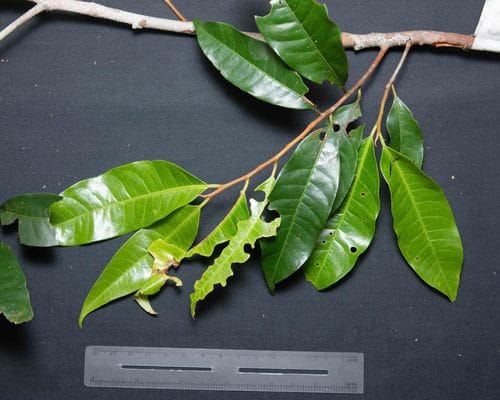
A tree. It grows 28 m tall. The trunk is 35 cm across. The leaves are alternate. They are 10-20 cm long by 5-7 cm across.
Medicinal Uses
The red sap is rubbed on mouth and skin sores, cuts, and the fungus-infected mouths of babies with thrush. The sap is diluted in water and given orally to treat thrush or used to gargle against tonsillitis. Thw stem exudate (resin) is used in the treatment of mouth sores, thrush, wounds and cuts.
Other Uses
Bark dark brown, smooth, and yields a small amount of thin, translucent resin when cut. The heartwood is a dark reddish brown; it is often not very clearly demarcated from the wide band of pale, pinkish-brown sapwood. The texture is fine to medium; the grain mostly straight; lustre is medium to fairly high; without distinctive odour or taste. The wood is heavy, hard, and tough. It can be air-dried with little or only moderate difficulty; slight to moderate checking and warp may develop. All of the species in this genus have very good machining properties and produce smooth surfaces on the normally straight-grained material. The wood is easily peeled for veneer. It is used for purposes such as millwork, turnery, furniture, boxes and crates, veneer and plywood, general construction, fiberboard, and particleboard. Traditionally, it is used for canoes, and music instruments (violins, banjos, and quattros), played in traditional Arawak Banshikili music.
Wikipedia
Source ↗Iryanthera juruensis is a species of tree in the Myristaceae family. It is native to Panama and South America.
Names & Synonyms
Awamonga, Awe, Bita, Cafetillo, Chikum, Cuajo negro, Cumula roja, Cumalilla, Cumalillo, Intidi cuna, Majagua, Masarico, Micha, Molleja muyu yura, Pucuna caspi, Sicu huapa, Tiguiribe, Ti'to, Tsempuik, Unt Wayakish, Wingimonkawe
References (8)
- Bendezu, Y. F., 2018, Arboles nativos de lad Region Ucayali. Instituto Nacional de Innovacion Agraria. p 237
- Duchelle, A. E., 2007, Observations on Natural Resource use and Conservation by the Shuar In Ecuador's Cordillera del Condor. Ethnobotany Research & Applications 5:005-023
- Grandtner, M. M. & Chevrette, J., 2013, Dictionary of Trees, Volume 2: South America: Nomenclature, Taxonomy and Ecology. Academic Press p 329
- Kermath, B. M., et al, 2014, Food Plants in the Americas: A survey of the domesticated, cultivated and wild plants used for Human food in North, Central and South America and the Caribbean. On line draft. p 451
- Lopez-Diago, D. & Garcia, N., 2021, Wild edible fruits of Colombia. Biota ColomBiana 22 (2) p 43
- Roa, J. A. G. & Boada, D. S. G., 2018, Fundación para el Fortalecimiento de la Fruticultura y Plantas Alimenticias no Convencionales en Colombia.
- Torre, de la, L., et al, 2008, Enciclopedia de las Plantas Útiles del Ecuador. Herbario QCA. Pontificia Universidad Católica del Ecuador. p 459
- Zambrana, P, et al, 2017, Traditional knowledge hiding in plain sight – twenty-first century ethnobotany of the Chácobo in Beni, Bolivia. Journal of Ethnobiology and Ethnomedicine (2017) 13:57


