Ardisia cornudentata
Mez
Jade mountain ardisia
PrimulaceaeFruit
iNaturalist · cc-by-nc
(c) 方伊琳(阿鈣), some rights reserved (CC BY-NC), uploaded by 方伊琳(阿鈣)
(c) 方伊琳(阿鈣), some rights reserved (CC BY-NC), uploaded by 方伊琳(阿鈣)

iNaturalist · cc-by-nc
(c) Ray Tsai, some rights reserved (CC BY-NC), uploaded by Ray Tsai
(c) Ray Tsai, some rights reserved (CC BY-NC), uploaded by Ray Tsai

iNaturalist · cc-by-nc
(c) snowtaurus, some rights reserved (CC BY-NC)
(c) snowtaurus, some rights reserved (CC BY-NC)
What to Eat
Edible parts: Fruit
The fruit are edible.
Where to Find It
It is native to Taiwan.
Asia, China, Taiwan,
Countries: United Arab Emirates, Afghanistan, Armenia, Azerbaijan, Bangladesh, Bahrain, Brunei, Bhutan, China, Georgia, Indonesia, Israel, India, Iraq, Iran, Jordan, Japan, Kyrgyzstan, Cambodia, North Korea, South Korea, Kuwait, Kazakhstan, Laos, Lebanon, Sri Lanka, Myanmar, Mongolia, Maldives, Malaysia, Nepal, Oman, Philippines, Pakistan, Qatar, Saudi Arabia, Singapore, Syria, Thailand, Tajikistan, Timor-Leste, Turkmenistan, Turkey, Taiwan, Uzbekistan, Vietnam, Yemen
How to Identify
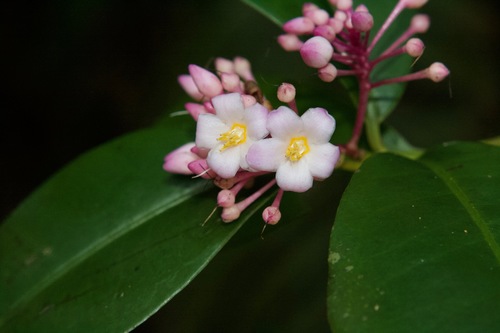
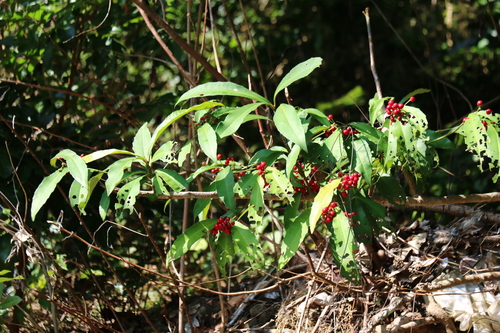
An evergreen shrub or small tree. It grows 3-6 m high. The young branches have rusty hairs. The leaves are alternate and fairly leathery. They are sword shaped and 7-18 cm long and 3-6 cm wide. They taper to the tip and are wedge shaped at the base. There are teeth around the edge. The flowers are pink-white. There are 8-14 flowers in a group. The fruit are round and black. They are 5 mm across.
Notes
Also put in the family Myrsinaceae.
Names & Synonyms
Ardisia morrisonensis Hayata
References (2)
- Hu, Shiu-ying, 2005, Food Plants of China. The Chinese University Press. p 613
- Kuo, W. H. J., (Ed.) Taiwan's Ethnobotanical Database (1900-2000), http://tk.agron.ntu.edu.tw/ethnobot/DB1.htm