Miscanthus sinensis
Andersson
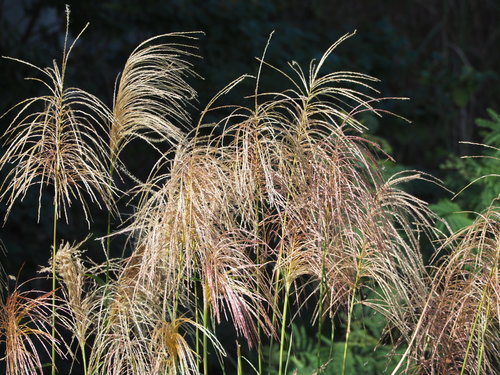
no rights reserved, uploaded by 葉子
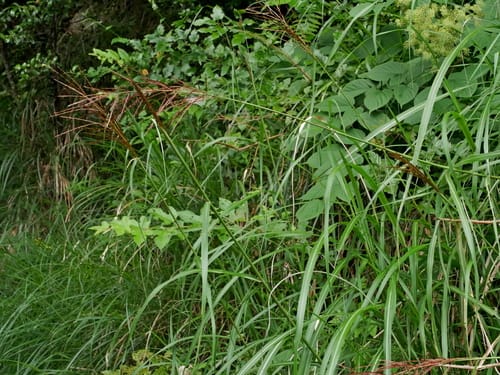
(c) Jacy Chen, some rights reserved (CC BY)
What to Eat
Edible parts: Stem, Flower
The immature flowering spikes are edible, though no further preparation details are given.
Where to Find It
It is a temperate plant. It grows along coasts and on mountain slopes below 2,000 m above sea level.
Asia, Canada, China, Japan, Korea, North America, Slovenia, Taiwan,
How to Identify
A grass that keeps growing from year to year. It can be in tufts or have short rhizomes. It grows 80-200 m tall. The stems are 3-10 mm across. The leaf blades are flat and 18-75 cm long by 1-2 cm wide.
How to Grow
Prefers a deep fertile loamy soil that does not dry out in summer but succeeds in any ordinary soil that is not too dry, in sun or light shade. Fully dormant plants are hardy to about -20°c, though the young growth in spring can be damaged by late frosts. Often grown as an ornamental plant, there are many named varieties. Many forms do not get enough summer heat to flower freely when they are grown in Britain, 'Silberfeder' (syn 'Silver Feather') is the most free-flowering in cooler climates. Plants can be grown as a focal point in lawns, they also succeed in quite coarse grass. The leaves have saw-toothed edges that can cut the unwary gardener, it is best to wear gloves when working with the plant. Plants seem to be immune to the predations of rabbits.
Propagation: Surface sow seed in spring in a greenhouse and keep moist; germination should occur within a couple of weeks. When large enough to handle, prick seedlings out into individual pots and grow on in the greenhouse through their first winter. Plant out in late spring or early summer after the last expected frosts. Alternatively, divide in spring or early autumn. Large divisions can be planted directly into permanent positions. Smaller divisions are best potted up and grown on in light shade in a cold frame until well established before planting out in late spring or early summer.
Medicinal Uses
The juice of young stems is used to disperse poisons, dissolve blood clots, dissipate extravasated blood, and reduce inflammation. The plant is also diuretic and refrigerant.
Other Uses
Miscanthus sinensis is increasingly being grown as a biomass crop; trials into its potential in Britain were underway as of 1992. Plants form impenetrably dense clumps and, when planted close together in drifts, make an excellent ground cover.
Wikipedia
Source ↗Miscanthus sinensis, also called eulalia grass, Chinese silver grass, or elephant grass, is a species of flowering plant in the grass family Poaceae, native to most of East Asia (China, Japan, Taiwan and Korea) and Southeast Asia (the Philippines, eastern Indonesia, Malaysia, Vietnam, Thailand, and Laos).
Notes
There are about 20 Miscanthus species.
Names & Synonyms
Eoksae, Eoksaekampugi, Kitajski prstasti trstikovec
References (4)
- http://www.botanic-gardens-ljubljana.com/en/plants
- Kuo, W. H. J., (Ed.) Taiwan's Ethnobotanical Database (1900-2000), http://tk.agron.ntu.edu.tw/ethnobot/DB1.htm (As var. condensatus)
- Ong, H. G., et al, 2015, Ethnobotany of the wild edible plants gathered in Ulleung Island, South Korea. Genet Resourc Crop Evol. Springer (As var. purpurascens)
- Song, M., et al, 2013, Traditional knowledge of wild edible plants in Jeju Island, Korea. Indian Journal of Traditional Knowledge. 12(2) pp 177-194 (As var. purpurascens)


