Tecoma stans
(L.) Juss. ex Kunth
Yellow trumpet flower, Kidney guava, Yellow elder
(c) lyndahicklin_05, some rights reserved (CC BY-NC), uploaded by lyndahicklin_05
(c) Robert Taylor, some rights reserved (CC BY), uploaded by Robert Taylor

(c) neemiasbarbosa, some rights reserved (CC BY-NC)
What to Eat
Edible parts: Probably not edible. Used in medicine.
The wood of Tecoma stans is used in rustic architecture like bahareque, for the construction of furniture and canoes, or as firewood or charcoal. It is a medicinal plant used against diabetes and against diseases of the digestive system, among other uses. The plant is desirable fodder when it grows in fields grazed by livestock. It is a very potent anti-venom against cobra venom, used by Pakistani old medicine. It is proved to be better than antiserum, the paste of this plant's leaves are applied topically on the cobra bite. Its bio-chemicals bind with the cobra venom enzymes thus effectively inhibiting the venom.
Where to Find It
It is a tropical plant. It grows in coastal areas and along roadsides in full sunlight. It can tolerate drought. In Argentina it grows from sea level to 1,700 m above sea level.
Africa, Andamans, Andes, Antigua and Barbuda, Argentina, Asia, Belize, Bolivia, Brazil, Burkina Faso, Cameroon, Caribbean, Cayman Islands, Central America, Christmas Island, Colombia, Costa Rica, Cuba, Dominica, Dominican Republic, East Africa, East Timor, Ecuador, El Salvador, French Guiana, Gabon, Ghana, Guadeloupe, Guatemala, Guyana, Haiti, Hawaii, Honduras, India, Indonesia, Kiribati, Madagascar, Maldives, Marquesas, Mexico, Mozambique, Nepal, Netherlands Antilles, Nicaragua, Niue, North America, Pacific, Panama, Paraguay, Puerto Rico, SE Asia, Slovenia, South America, Sri Lanka, St Helena, St. Kitts and Nevis, Tanzania, Timor-Leste, Trinidad and Tobago, Tuvalu, United Arab Emirates, UAE, USA, Venezuela, West Africa, West Indies, Zambia, Zimbabwe,
How to Identify
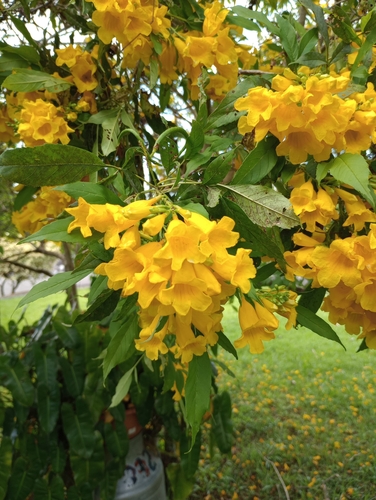
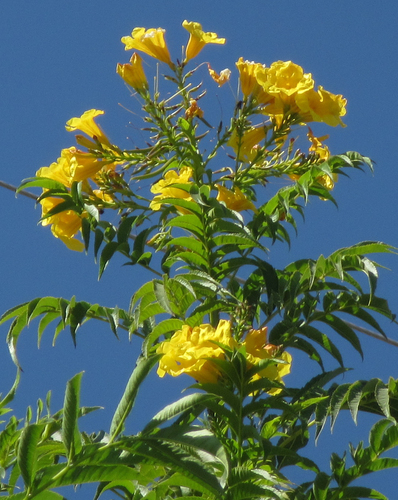
A tree. It grows 7 m all. It does not have spines. The bark flakes into vertical strips. It is pale brown. The leaves ahve sharp teeth. They are compound. The flowers are in large branched clusters. The flower tube is yellow with red lines in the throat. The fruit are 7-32 cm long.
How to Grow
Tecoma stans is a plant of drier areas in the tropics and subtropics, it can be found at elevations from sea level to around 2,000 metres. It grows best in areas where annual daytime temperatures are within the range 15 - 25°c, but can tolerate 10 - 35°c. The plant is intolerant of frost. It prefers a mean annual rainfall in the range 500 - 700mm, but tolerates 400 - 800mm. Trees can perform well in areas of less than the recommended rainfall but need to be irrigated; they can also grow at higher altitudes than recommended, but they are then said to be slow in flowering. Requires a sunny position. Prefers clay loams, but tolerates most types of fertile, well-drained soils and is particularly tolerant of alkaline conditions. Prefers a pH in the range 6 - 8.5, tolerating 5.5 - 9. Established plants are drought tolerant. The plant has escaped from cultivation and become naturalised in some areas. It is capable of forming dense thickets and crowding out native species. Plants can flower all year round. The flower buds pop when squeezed.
Propagation: Seed - does not require pre-treatment. The seed, which germinates easily, can be sown in nursery beds or in containers. Seedlings require 3 - 4 months in the nursery, after which they can be directly planted out. Seed storage behaviour is orthodox, and seeds can be stored for long periods under ideal conditions. Regeneration by cuttings is also possible.
Medicinal Uses
The roots are reported to be a powerful diuretic. A leaf infusion can be taken orally for treating diabetes and stomach pains. A strong leaf and root decoction is taken orally as a diuretic, and is also used to treat syphilis and intestinal worms. The flowers are diuretic. An infusion is used to promote good blood circulation, and also to treat yellow fever, hepatitis and inflammations. An infusion of the leaves and flowers is used to treat rheumatism, abscesses with pus, and colic. A decoction of the flowers and bark is used in the treatment of pains in the stomach. A decoction of the plant is used as a wash for women who have just given birth. Tonic, antisyphilitic, and vermifuge properties are also ascribed to the plant (part not specified) and in some parts of Mexico the plant has the reputation of alleviating and even curing diabetes.
Other Uses
The light brown wood is hard and very durable. It is used in cabinet making, turnery, to make tools, and in the construction of buildings. It was used traditionally to make bows. Trees provide firewood and charcoal. Trees can be planted as a live hedge and to 'protect the climate'. The flowers are slightly fragrant and are said to be a good source of nectar for bees.
Wikipedia
Source ↗Tecoma stans is a species of flowering perennial shrub in the trumpet vine family, Bignoniaceae, that is native to the Americas. Common names include yellow trumpetbush, yellow bells, yellow elder, ginger Thomas. Tecoma stans is the official flower of the United States Virgin Islands and the floral emblem of The Bahamas.
Notes
The leaves as a tea are used for diabetes and stomach pains. Probably in a hot house in Slovenia.
Names & Synonyms
Amarguito, Barreto, Bokarumaa, Borla de San Pedro, Campanilla amarilla, Candelillo, Candox, Canlol-che, Carnoncillo, Caroba-amarela, Chacte, Chante, Chevalye, Chicala, Chilca, Chirlobirlo, Cholan, Chorlin, Copete, Esperanza, Flor amarilla, Fresnillo, Fresno, Ghat puspa, Gloria, Guaran, Guaranguaran, Kelki heel, Marchucha, Mtalawanda, Nei karairai, Pohon lonceng kuning, Retama, Ruibarba, Rumena tekoma, Sauco amarillo, Tagualaiste tasto, Tecoma giallo, Tek, Timboco, Timboque, Tronadora, Vainilla, Zeb sennikola
References (13)
- Flora Zambesiaca. http://apps.kew.org/efloras
- Fowler, D. G., 2007, Zambian Plants: Their Vernacular Names and Uses. Kew. p 14
- Grandtner, M. M., 2008, World Dictionary of Trees. Wood and Forest Science Department. Laval University, Quebec, Qc Canada. (Internet database http://www.wdt.qc.ca)
- Grandtner, M. M. & Chevrette, J., 2013, Dictionary of Trees, Volume 2: South America: Nomenclature, Taxonomy and Ecology. Academic Press p 657
- Kermath, B. M., et al, 2014, Food Plants in the Americas: A survey of the domesticated, cultivated and wild plants used for Human food in North, Central and South America and the Caribbean. On line draft. p 858
- Piedra-Malagón, E. M. et al, 2022, Edible native plants of the Gulf of Mexico Province. Biodiversity Data Journal 10: e80565 p 14
- Plants of Haiti Smithsonian Institute http://botany.si.edu
- Sujanapal, P., & Sankaran, K. V., 2016, Common Plants of Maldives. FAO & Kerala FRI, p 267
- Sukarya, D. G., (Ed.) 2013, 3,500 Plant Species of the Botanic Gardens of Indonesia. LIPI p 543
- Swaziland's Flora Database http://www.sntc.org.sz/flora
- Thaman, R. R., 1987, Plants of Kiribati: A listing and analysis of vernacular names. Atoll Research Bulletin No. 296
- Thaman, R. R, 2016, The flora of Tuvalu. Atoll Research Bulletin No. 611. Smithsonian Institute p 71
- World Checklist of Useful Plant Species 2020. Royal Botanic Gardens, Kew


