Vitex divaricata
Swartz
Guiana chaste tree
(c) carlalvarez, some rights reserved (CC BY-NC), uploaded by carlalvarez
(c) Sara Bárrios, some rights reserved (CC BY-NC), uploaded by Sara Bárrios

(c) Omar Monzon Carmona, some rights reserved (CC BY-NC)
Where to Find It
It is a tropical plant. It grows from sea level to medium altitudes above sea level.
Antilles, Carribean, Colombia, Cuba, Dominican Republic, French Guiana, Guadeloupe, Guianas, Guyana, Haiti, Hispaniola, Leeward Is., Lesser Antilles, Martinique, Montserrat, Puerto Rico, South America, St Vincent, Suriname, Trinidad and Tobago, Venezuela, West Indies, Windward Is.,
How to Identify
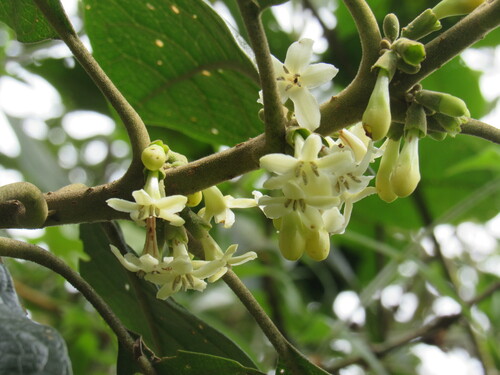
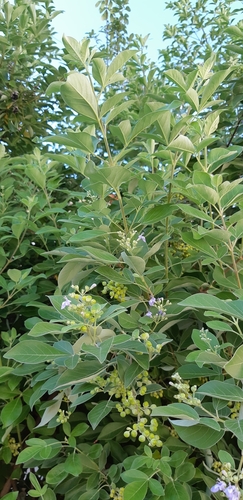
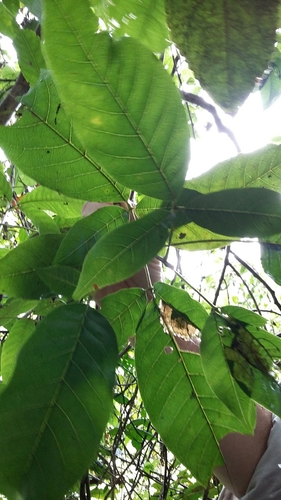
A shrub or tree. It can grow 20 m tall. The bark peels in long strips. It loses its leaves during the year. The leaves usually have 3 leaflets. They are oblong and 14 cm long. There can be a few hairs on the midrib. The flowers in long stalked groups in the axils of the leaves. These can be 15 cm long. The flowers have a scent. The fruit are black and oval and 1 cm long.
How to Grow
Requires nearly full sunlight, otherwise it can be very slow-growing.
Propagation: Seed - Cuttings.
Medicinal Uses
The powdered and burnt bark is applied topically to treat ulcers.
Other Uses
The leaves contain about 14% tannins. The heartwood, when freshly cut, is tan to brown, generally variegated with darker shades, and afterwards becomes gray brown to deep brown, often with indistinct, narrow, lighter or darker bands. The greyish sapwood turns light brown upon drying. The wood is hard, heavy, strong, tough, and fine-textured and has irregular, interlocked grain and well-defined growth rings. The wood works easily and takes a fine polish. It is moderately resistant to dry-wood termites and is durable in contact with the ground. It is used for the framework of houses, fence posts, construction, cabinetwork, and elsewhere for shingles. It should be suitable also for sporting goods, tool handles, boats, and flooring.
Wikipedia
Source ↗Vitex divaricata is a tree shrub of the Caribbean native to Puerto Rico and the US Virgin Islands. Its Spanish vernacular names include higüerillo and higuerillo. Its English vernacular name is white fiddlewood. It belongs to the order Lamiales. This tree is common in the Toro Negro State Forest.
Notes
Also put in the family Verbenaceae.
Names & Synonyms
Bois a agouti, Fiddlewood, Gattilier bois-lezard, Higuerillo, Ofon criollo
References (4)
- Grandtner, M. M., 2008, World Dictionary of Trees. Wood and Forest Science Department. Laval University, Quebec, Qc Canada. (Internet database http://www.wdt.qc.ca)
- Grandtner, M. M. & Chevrette, J., 2013, Dictionary of Trees, Volume 2: South America: Nomenclature, Taxonomy and Ecology. Academic Press p 694
- Kew Plants of the World On line
- Plants of Haiti Smithsonian Institute http://botany.si.edu/antilles/West Indies