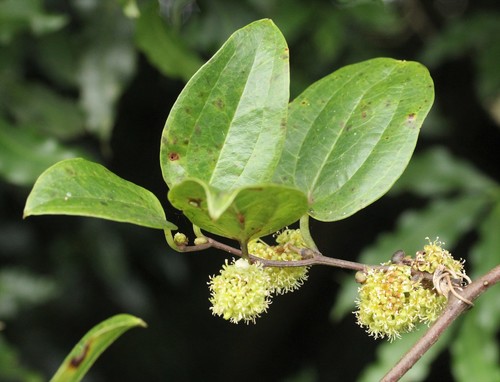
Smilax excelsa
L.
Melocan, Melvocan, Silean

iNaturalist · cc-by-nc
(c) m_renard, some rights reserved (CC BY-NC)
(c) m_renard, some rights reserved (CC BY-NC)
iNaturalist · cc-by-nc
(c) Evgeny Pervakov, some rights reserved (CC BY-NC)
(c) Evgeny Pervakov, some rights reserved (CC BY-NC)

iNaturalist · cc-by-nc
(c) josefwirth, some rights reserved (CC BY-NC)
(c) josefwirth, some rights reserved (CC BY-NC)
What to Eat
Edible parts: Shoots, Leaves, Fruit, Flowers, Leaf stalk
The leaves are used to make sarma in Turkey, rolled around fillings of rice or minced meat. Shoots, leaves, fruits, flowers, and leaf stalks are all edible; leaves are sold in local markets.
Where to Find It
It is a temperate plant. It grows in deciduous forests.
Asia, Caucasus, China, Europe, Georgia, Indochina, SE Asia, Thailand, Turkey, Türkiye,
Countries: Andorra, United Arab Emirates, Afghanistan, Albania, Armenia, Austria, Azerbaijan, Bosnia & Herzegovina, Bangladesh, Belgium, Bulgaria, Bahrain, Brunei, Bhutan, Belarus, Switzerland, China, Cyprus, Czechia, Germany, Denmark, Estonia, Spain, Finland, France, United Kingdom, Georgia, Greece, Croatia, Hungary, Indonesia, Ireland, Israel, India, Iraq, Iran, Iceland, Italy, Jordan, Japan, Kyrgyzstan, Cambodia, North Korea, South Korea, Kuwait, Kazakhstan, Laos, Lebanon, Liechtenstein, Sri Lanka, Lithuania, Luxembourg, Latvia, Monaco, Moldova, Montenegro, North Macedonia, Myanmar, Mongolia, Malta, Maldives, Malaysia, Netherlands, Norway, Nepal, Oman, Philippines, Pakistan, Poland, Portugal, Qatar, Romania, Serbia, Russia, Saudi Arabia, Sweden, Singapore, Slovenia, Slovakia, San Marino, Syria, Thailand, Tajikistan, Timor-Leste, Turkmenistan, Turkey, Taiwan, Ukraine, Uzbekistan, Vietnam, Yemen
How to Identify
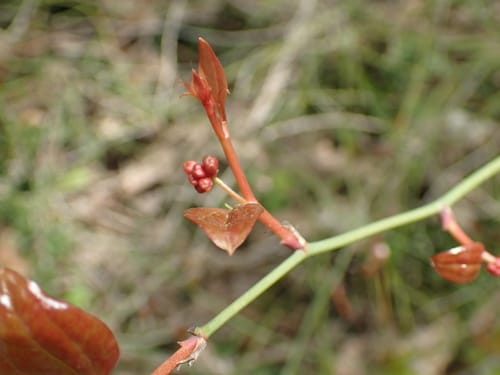
A climbing shrub. It can grow 20 m high. The leaves are arrow shaped with short leaf stalks.
Nutrition Score: 43/100
| Part | Moisture | kJ | kcal | Protein | Vit A | Vit C | Iron | Zinc |
|---|---|---|---|---|---|---|---|---|
| Shoots | 82.6 | 210 | 51.3 | 3.9 | — | 2 | 1.5 | 0.4 |
| Shoot | 74.8 | — | — | 7.3 | — | — | — | — |
| Leaves dry | — | — | 75.7 | — | — | — | — | — |
Other Information
Leaves are sold in local markets.
Names & Synonyms
Dikenucu, Ek'ala, Ek'alg'ich'i, Gicirdakdikeni, Kircan, Kusevin, Melevecen, Melocan, Zimilacidikeni
Smilax laevis Gueldenst. ex Ledeb.Smilax panduriformis Aliev
References (13)
- Bussman, R. W., et al, 2016, A comparative ethnobotany of Khevsureti, Samtskhe-Javakheti, Tusheti, Svaneti, and Racha-Lechkhumi, Republic of Georgia (Sakartvelo), Caucasus. Journal of Ethnobiology and Ethnomedicine.
- Bussman, R. W. et al, 2017, Ethnobotany of Samtskhe-Javakheti, Sakartvelo (Republic of Georgia), Caucasus. Indian Journal of Traditional Knowledge Vol. 16(1) pp 7-24
- Bussman, R. W., et al, 2021, Unity in diversity—food plants and fungi of Sakartvelo (Republic of Georgia), Caucasus. Journal of Ethnobiology and Ethnomedicine (2021) 17:72 p 14
- Demir, E., et al, 2020, Nutrient and bioactive substance contents of edible plants grown naturally in Salıpazarı (Samsun). Acta Sci. Pol. Hortorum Cultus, 19(1), 151–160
- Dogan, Y., et al, 2015, Of the importance of a leaf: the ethnobotany of sarma in Turkey and the Balkans. Journal of Ethnobiology and Ethnomedicine, 11:56
- Ertug, F, Yenen Bitkiler. Resimli Türkiye Florası -I- Flora of Turkey - Ethnobotany supplement
- INFOODSUpdatedFGU-list.xls
- Kizilarslan, C. & Ozhatay, N., 2012, An ethnobotanical study of the useful and edible plants of İzmit. Marmara Pharmaceutical Journal 16: 134-140, 2012.
- Koca, I., et al, 2015, Some Wild Edible Plants and Their Dietary Fiber Contents. Pakistan Journal of Nutrition. 14(4): 188-194
- Luczaj, L. et al, 2017, Comfrey and Buttercup Eaters: Wild Vegetables of the Imereti Region in Western Georgia, Caucasus. Economic Botany, 71(2), 2017, pp. 188–193
- Ozbucak, T. B., et al, 2007, Nutrition Content of Some Wild Edible Plants in the Central Black Sea Region of Turkey. International Journal of Natural and Engineering Sciences 1:11-13
- Reis, S. V. and Lipp, F. L., 1982, New Plant Sources for Drugs and Foods from the New York Botanical Garden herbarium. Harvard. p 26 (As Smilax laevis)
- Ulian, T., et al, 2020, Unlocking plant resources to support food security and promote sustainable agriculture. Plants, People, Planet. 2020;2:421–445.