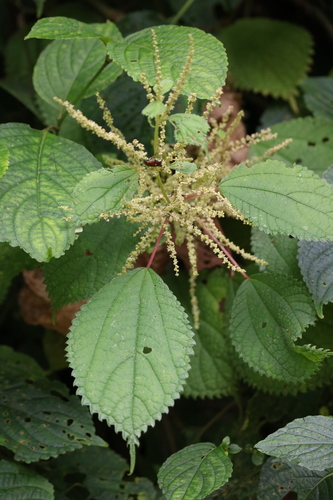
Urtica simensis
Hochst. ex Steud.
Samma

(c) M. A. Naturalist, some rights reserved (CC BY-NC), uploaded by M. A. Naturalist

(c) avocat, some rights reserved (CC BY-NC)
What to Eat
Edible parts: Leaves, Vegetable
The leaves are rubbed between cloth and boiled, then typically crushed and salted before eating alone or with other foods. It is a famine food with good nutritional value and commonly eaten in Ethiopia.
Known Hazards
Where to Find It
It is a tropical plant. In Ethiopia it grows between 2,500-3,500 m altitude.
Africa, East Africa, Ethiopia,
How to Identify
A nettle plant. It is an erect herb and does not branch. It grows 1 m tall. It has a creeping underground stem or rhizome. The leaves are oval and have coarse teeth. They are 5-12 cm long by 3-8 cm wide. It has stinging hairs. Plants are separately male and female.
How to Grow
The plant can be grown by seeds or runners.
Propagation: Seed - Division.
Medicinal Uses
Used in traditional medicine.
Production
The leaves need to be harvested without getting stung by the stinging hairs.
Other Information
It is a famine food. It has good food value and is commonly eaten in Ethiopia. Plants are sold in local markets.
Notes
It is also used in medicine.
Names & Synonyms
Gurgubee, Laaleessa, Laalesa, Sama
References (12)
- Alemneh, D., 2020, Ethnobotany of wild edible plants in Yilmana Densa and Quarit Districts of West Gojjam Zone, Amhara Region, Ethiopia. Ethnobotany Research & Applications. 20:47
- Asfaw, Z., Conservation and use of traditional vegetables in Ethiopia. FAO
- Asfaw, Z. and Tadesse, M., 2001, Prospects for Sustainable Use and Development of Wild Food Plants in Ethiopia. Economic Botany, Vol. 55, No. 1, pp. 47-62
- Bosch, C.H., 2004. Urtica simensis Hochst. ex A.Rich. [Internet] Record from Protabase. Grubben, G.J.H. & Denton, O.A. (Editors). PROTA (Plant Resources of Tropical Africa), Wageningen, Netherlands. < http://database.prota.org/search.htm>. Accessed 23 October 2009
- Demise, S. & Asfaw, Z., 2020, Ethno Botanical Study of Wild Edible Plants in Adola District, Southern, Ethiopia. International Journal of Research and Analytical Reviews (IJRAR) 7(2).
- Duguma, H. T., 2020, Wild Edible Plant Nutritional Contribution and Consumer Perception in Ethiopia. Hindawi International Journal of Food Science Volume 2020, Article ID 2958623, 16 pages
- Ethiopia: Famine Food Field Guide. http://www.africa.upenn.edu/faminefood/category1.htm
- Grubben, G. J. H. and Denton, O. A. (eds), 2004, Plant Resources of Tropical Africa 2. Vegetables. PROTA, Wageningen, Netherlands. p 540
- Lulekal, E., et al, 2011, Wild edible plants in Ethiopia: a review on their potential to combat food insecurity. Afrika Focus - Vol. 24, No 2. pp 71-121
- Regassa, T., et al, 2014, Ethnobotany of Wild and Semi-Wild Edible Plants of Chelia District, West-Central Ethiopia. Science, Technology and Arts Research Journal. 3(4): 122-134
- Seifu, T. et al, 2017, Polyphenolic content and Antioxidant Activity of leaves of Urtica simensis grown in Ethiopia. Latin American Applied Research. 47:35-40
- Sina, B. & Degu, H. D., 2015, Knowledge and use of Wild Edible Plants in the Hula District of the Sidama Zone. International Journal of Bio-resource and Stress Management 6(3):352-365