Bromus japonicus
Thunb.
Japanese Bromegrass
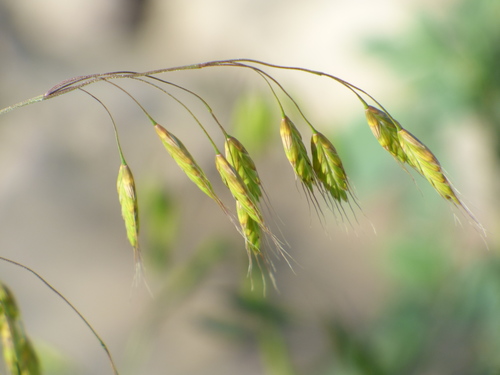
(c) Bill Crins, some rights reserved (CC BY-NC), uploaded by Bill Crins

(c) Martin A. Prinz, some rights reserved (CC BY-NC), uploaded by Martin A. Prinz

(c) Chuangzao, some rights reserved (CC BY-NC), uploaded by Chuangzao
What to Eat
Edible parts: Seeds, Cereal
Edible Parts: Leaves Seed Edible Uses: Leaves. No more details. Seed. No more details are given, but the seed is very small and fiddly to utilize.
Where to Find It
It grows in warm temperate arid areas. It grows on sandy soils. In China it grows from sea level to 2,500 m above sea level. It grows in wetlands. Tasmanian Herbarium.
Africa, Argentina, Asia, Australia, Central Asia, Chile, China, Europe, Himalayas, Iran, Iraq, Japan, Kazakhstan, Korea, Kyrgyzstan, Middle East, Mongolia, Nepal, North Africa, North America, Pakistan, Russia, South America, Taiwan, Tajikistan, Tasmania, Tibet, Turkmenistan, USA, Uzbekistan,
How to Identify
An annual grass. It grows 50-90 cm high. The leaf blades are 20 cm long by 2-5 mm wide. The flowers are green. The flower panicle is 6-20 cm long and open and spreading.
How to Grow
Succeeds in a sunny position in most well-drained soils.
Propagation: Seed - sow spring or autumn in situ and only just cover. Germination should take place within 2 weeks. If seed is in short supply it can be surface sown in a cold frame in early spring. When large enough to handle, prick out the seedlings into individual pots and plant them out in early summer.
Medicinal Uses
None known
Other Uses
None known Special Uses
Wikipedia
Source ↗Bromus japonicus, the Japanese brome, is an annual brome grass native to Eurasia. The grass has a diploid number of 14.
Notes
There are about 150 Bromus species. They are temperate.
Names & Synonyms
References (7)
- Duke, J.A., 1992, Handbook of Edible Weeds. CRC Press. p 52
- Flora of Pakistan. www.eFloras.org
- J. A. Murray, Syst. veg. ed. 14:119. 1784 May-Jun (Fl. jap. 52, t. 11. 1784 Aug)
- Paczkowska, G. & Chapman, A.R., 2000, The Western Australian Flora. A Descriptive Catalogue. Western Australian Herbarium. p 99
- Plants for a Future database, The Field, Penpol, Lostwithiel, Cornwall, PL22 0NG, UK. http://www.scs.leeds.ac.uk/pfaf/
- Tasmanian Herbarium Vascular Plants list p 82
- Zhang, Y., et al, 2014, Diversity of wetland plants used traditionally in China: a literature review. Journal of Ethnobiology and Ethnomedicine. 10:72


