Bromus marginatus
Nees. ex Steud.
Mountain brome
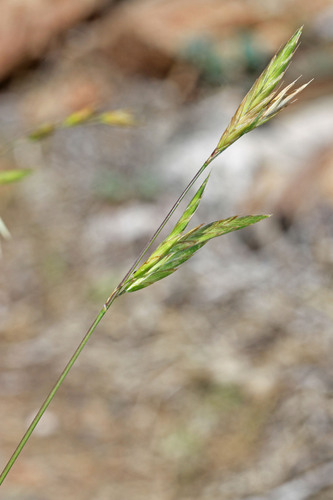
(c) Andrey Zharkikh, some rights reserved (CC BY-NC), uploaded by Andrey Zharkikh

(c) crothfels, some rights reserved (CC BY)
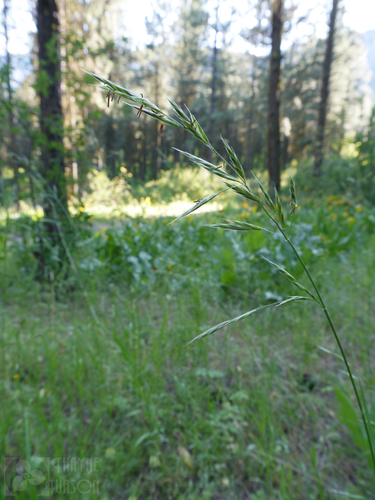
(c) Thayne Tuason, some rights reserved (CC BY-NC)
What to Eat
Edible parts: Seeds, Cereal
Edible Parts: Seed Edible Uses: Seed - cooked. Used as a piñole. The seed is heavy. The seed is rather small and fiddly to utilize. Edible Uses & Rating: The edible portion of mountain brome is the grain (caryopsis), which can be parched, boiled, or ground into meal. The grains are nutritious, mild in flavor, and comparable in food value to other native bromes. Indigenous groups such as the Mendocino Indians of California are recorded as having used the seeds for food, grinding them into meal for mush or bread-like mixtures. The plant’s edibility rating is 3/5—safe and nourishing, but with a low yield relative to effort and challenging processing due to tight husks and awns [2-3]. Taste, Processing & Kitchen Notes: Mountain brome seeds have a subtle, nutty flavor similar to barley or brown rice, with a slightly earthy aroma when toasted. The grains are small and encased in persistent husks that cling tightly, requiring toasting, rubbing, and winnowing to remove. Toasting also enhances flavor and helps break the husks, while boiling softens the texture into a coarse porridge. Because of the low seed-to-chaff ratio, mountain brome is best used in small quantities or as part of a mixed wild-grain collection. Foragers may find it easier to process the parched seed heads whole, then grind them into a meal with some chaff remaining—this traditional approach minimizes labor without compromising safety. Seasonality (Phenology): Mountain brome begins growth in early spring, producing leaves as soon as snow recedes in mountain meadows. It flowers from June through August, depending on elevation and latitude, with seed maturation occurring from July to September. Plants go dormant or die back by early autumn as conditions dry. Seed heads turn straw-brown when ripe and begin to shatter soon after. This species can persist for several years and reseeds naturally, maintaining local stands under natural disturbance regimes. Safety & Cautions (Food Use): Mountain brome is safe to consume when properly processed. The principal hazards are mechanical: sharp awns and tough hulls can irritate the mouth or throat if not removed. Moldy or discolored grains should be discarded to prevent exposure to fungal toxins. Like other cereal grasses, mountain brome contains gluten-type proteins and is not suitable for individuals with gluten intolerance. Harvest & Processing Workflow: Seeds should be harvested when the panicles turn golden brown and dry but before the spikelets begin to shatter. Seed heads can be stripped by hand or clipped and allowed to finish drying. Once crisp, the heads are rubbed or gently beaten to separate grains from the husks, then winnowed to remove the chaff. Toasting or parching improves flavor and makes dehusking easier. The grains can be boiled for 10–15 minutes into a coarse porridge, or ground into meal for use in baked or thickened dishes. Because the yield per plant is low, mountain brome is best harvested opportunistically alongside other native grasses. Look-Alikes & Confusion Risks: Mountain brome is often confused with California brome (Bromus carinatus) and occasionally with introduced smooth brome (Bromus inermis). It differs from California brome by its hairier leaves, slightly stouter form, and shorter awns. Smooth brome can be distinguished by its creeping rhizomes and strongly notched lemmas. As all these species are non-toxic, confusion poses no danger, but proper identification ensures ecological accuracy in restoration or seed collection. Traditional / Indigenous Use Summary: Mountain brome was used by Indigenous peoples of California and the Great Basin as part of a mixed wild-seed diet. Seeds were gathered by hand, parched to loosen the chaff, ground into meal, and cooked into mush or cakes. These traditional preparations provided carbohydrates and dietary variety during late summer and autumn. Ethnobotanical records indicate that the Mendocino and other groups made use of the species, though it likely contributed in small quantities compared to larger-seeded grasses [2-3].
Where to Find It
It is a temperate plant. It grows on the edges of forests and moist places in north China.
Asia, China, North America*, USA,
How to Identify
A grass. It keeps growing from year to year. The stems are 1.3 m high. The leaf sheaths are hairy. The leaf blades are 1.4 cm wide. The flower panicles are narrow and 20 cm long.
How to Grow
Identification & Habit: Mountain brome is a densely tufted, upright grass forming clumps 60 to 120 cm tall. The stems are erect or slightly arching, and the leaves are flat, 4 to 10 mm wide, and often softly hairy on both surfaces. The panicle is open, nodding, and drooping at maturity, with several-flowered, flattened spikelets 2 to 4 cm long. Lemmas are strongly keeled, usually with short awns up to 1 cm in length. Compared with California brome, the plant is generally taller, more robust, and more densely pubescent. Flowers are small and inconspicuous, typical of grasses, and the plant is pollinated by wind (anemophilous), producing abundant pollen but no nectar or color cues for insect visitors. Growing Conditions: Mountain brome prefers cool, moist environments but tolerates a wide range of soil types. It thrives in well-drained loams, clay loams, or sandy loams and benefits from moderate fertility. It prefers full sun to light shade and moderate to high spring moisture. Although not a true wetland species, it performs best in sites with consistent early-season moisture, such as mountain valleys or north-facing slopes. It is hardy to USDA Zones 3–8, making it adaptable from subalpine elevations to temperate lowlands. In cultivation, it tolerates periodic drought once established but loses vigor under prolonged dry conditions. Habitat & Range: Mountain brome is widely distributed throughout western North America, from British Columbia and Alberta south to New Mexico and California. It is common in montane meadows, open forests, streambanks, and high-elevation grasslands. The species thrives between 1,000 and 3,000 meters elevation and often occurs in association with fescues, sedges, and forbs in mixed native communities. It frequently appears in early- to mid-successional habitats following fire or disturbance, helping stabilize soil and prepare sites for slower-growing perennials. Size & Landscape Performance: Mountain brome typically reaches 60 to 120 cm (2–4 ft) in height and 30 to 60 cm (1–2 ft) in width. Its form is upright but softly arching, producing lush green growth that turns golden as it matures. In landscaping and restoration, it establishes quickly and provides a dense, fibrous root mass ideal for erosion control. It grows faster and taller than most native bunchgrasses, making it an excellent temporary cover crop or nurse species. It provides strong visual appeal with its graceful seed heads and can complement wildflowers and shrubs in meadow plantings. Cultivation (Horticulture): Mountain brome is a popular species for revegetation, forage, and wildlife habitat restoration. It establishes rapidly and produces abundant biomass in the first year, though it may be short-lived (three to five years) without reseeding. It grows best when seeded in fall or early spring, either broadcast or shallowly drilled. It does not require fertilizer under natural conditions and may suffer in over-fertilized soils. In gardens and restoration sites, it should be combined with slower-growing native perennials to maintain diversity. It withstands light to moderate grazing but benefits from periodic rest. Pests & Problems: Mountain brome is relatively free of serious pests or diseases. It may occasionally be affected by leaf rusts, smuts, or foliar spots under humid conditions. Overgrazing, excessive mowing, or nutrient enrichment can reduce stand vigor and allow weedy annuals to invade. For food use, the main problems are the presence of husks and awns, and potential fungal contamination if harvested in damp conditions. Proper drying and cleaning eliminate most risks. Cultivar/Selection Notes: Several regional cultivars and ecotypes of mountain brome have been developed for revegetation and rangeland use, offering improved vigor and disease tolerance. These cultivars do not differ significantly in food value but may vary in seed size or awn length. When restoring natural habitats or creating wild-food gardens, locally adapted native seed sources are strongly recommended.
Propagation: Seed - sow spring or autumn in situ and only just cover. Germination should take place within 2 weeks. If seed is in short supply it can be surface sown in a cold frame in early spring. When large enough to handle, prick out the seedlings into individual pots and plant them out in early summer. Division in spring. Large clumps can be planted out direct into their permanent positions whilst it is best to pot up smaller clumps and grow them on in a cold frame until they are ready to be planted out.
Medicinal Uses
None known
Other Uses
Broom Tied bunches of plants have been used as hair brushes and light brooms. As a restoration species, mountain brome is invaluable—quick to establish, effective at erosion control, and aesthetically pleasing in meadows and woodland edges. Ecology & Wildlife: Mountain brome plays an important ecological role in mountain ecosystems. Its fibrous roots stabilize soils on slopes and in disturbed areas, reducing erosion. The lush foliage provides palatable forage for livestock, elk, and deer, particularly in spring and early summer. Its seeds are consumed by birds and small mammals, and its dense tufts provide nesting cover for ground-dwelling species. The species contributes to biodiversity by occupying mid-successional niches between early colonizers and climax vegetation. Special Uses
Wikipedia
Source ↗Bromus marginatus is a species of grass known by the common name mountain brome. It is native to western North America, and it is used widely for grazing animals and revegetating landscapes. This short-lived perennial grass forms a large, shallow root network. The roots give it drought-tolerance, and they persist in the soil long after the plant has died, making it valuable for erosion control. The stems can usually reach one meter in height but are known to reach 1.5 meters. The hairy leaves are up to a centimeter wide. The inflorescence is a nodding panicle of spikelets, each with up to 10 flowers. In the wild in its native range this grass grows in moister areas in mountain sagebrush, scrub, and meadows into the subalpine climate. It can tolerate thin, dry soils and some shade. It establishes easily and can become weedy. It can be planted on slopes and uneven terrain using a broadcast seeding method. There are several cultivars of this grass, including 'Garnet', 'Bromar', and 'Tacit'. The latter has been known to produce 15 tons per hectare with 3 to 4 harvests per year.
Notes
There are about 150 Bromus species. They are temperate.
Names & Synonyms
References (4)
- Anderson, M. K., 2012, Edible Seeds and Grains of California Tribes and the Klamath Tribe of Oregon in the Phoebe Apperson Hearst Museum of Anthropology Collections, University of California, Berkeley. USDA p 82
- Beckstrom-Sternberg, Stephen M., and James A. Duke. "The Foodplant Database." http://probe.nalusda.gov:8300/cgi-bin/browse/foodplantdb.(ACEDB version 4.0 - data version July 1994)
- Plants for a Future database, The Field, Penpol, Lostwithiel, Cornwall, PL22 0NG, UK. http://www.scs.leeds.ac.uk/pfaf/
- Syn. pl. glumac. 1:322. 1854


