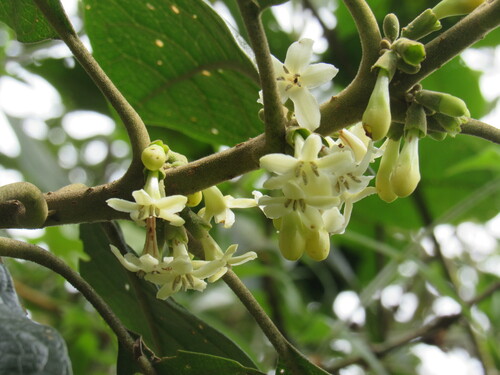
Phlomis fruticosa
L.
Jerusalem sage

(c) David Merrick, some rights reserved (CC BY-NC), uploaded by David Merrick

(c) Göran Frisk, some rights reserved (CC BY-NC), uploaded by Göran Frisk

(c) sara_sacci, some rights reserved (CC BY-NC)
What to Eat
Edible parts: Leaves - tea, Flowers - nectar, Leaves - flavouring
No edible uses are known for this plant.
Where to Find It
It is a temperate plant. It grows on dry cliffs and rocky places up to 1,000 m in the Mediterranean. It needs a well-drained soil and can grow in a nutritionally poor soil. It needs to be in a sunny position. It can tolerate drought. It suits hardiness zone 7.
Asia, Australia, Balkans, China, Croatia, Europe, Italy, Mediterranean, Russia, Sicily, Slovenia, Turkey, Türkiye, Tasmania,
How to Identify
An evergreen shrub. It grows 25 cm to 1.3 m tall. The leaves at the base have leaf stalks and those higher on the stem do not. The leaves are oval and have an uneven surface. The flowers are in spikes with 10-15 flowers in layers/ They are orange.
How to Grow
Requires a well-drained soil in full sun with shelter from cold winds. Grows well in poor gravelly soils and on hot dry banks. Grows better in the milder areas of Britain. Prefers very little water in the summer. Established plants are drought resistant. Plants are hardy to about -10°c when growing in a well-drained soil. Plants flower most freely on young wood so any pruning is best done in late spring. The leaves, when bruised, emit an aromatic sage-like perfume. Plants in this genus are notably resistant to honey fungus.
Propagation: Sow seed in spring in a greenhouse, barely covering it; it germinates quickly in warm conditions. Prick seedlings into individual pots when large enough to handle and grow on in a greenhouse for their first winter, then plant out in late spring of the following year. Cuttings of half-ripe wood can be taken in July or August in a frame. Layering is also suitable.
Medicinal Uses
No medicinal uses are known for this plant.
Other Uses
Can be grown as a low hedge and is very tolerant of trimming. It also works well as a dense ground cover for a sunny, sheltered position, though it will need weeding during the first year or so.
Wikipedia
Source ↗Phlomis fruticosa, the Jerusalem sage, is a species of flowering plant in the family Lamiaceae, native to Albania, Croatia, Cyprus, Greece, Italy, Montenegro and Turkey. It is a small evergreen shrub, up to 1 m (3 ft) tall by 1.5 m (5 ft) wide. The sage-like, aromatic leaves are oval, 5–10 cm (2-4ins) long, wrinkled, grey-green with white undersides, and covered with fine hairs. Deep yellow, tubular flowers, 3 cm in length, grow in whorls of 20 in short spikes in summer. The specific epithet fruticosa means "shrubby". It is popular as an ornamental plant, and has gained the Royal Horticultural Society's Award of Garden Merit. As a garden escape, it has naturalised in parts of South West England. It is listed as deer resistant, hardy in zones 7 to 11, and tolerant of a range of soil types.
Other Information
The nectar is sucked especially by children. It is cultivated.
Names & Synonyms
Grmasti flomis, Parsamba
References (9)
- Dolina, K. & Luczaj, L., 2014, Wild food plants used on the Dubrovnik coast (south-eastern Croatia) Acta Soc Bot Pol 83(3):175–181
- Ertug, F., 2004, Wild Edible Plants of the Bodrum Area. (Mugla, Turkey). Turk. J. Bot. 28 (2004): 161-174
- Ertug, F, Yenen Bitkiler. Resimli Türkiye Florası -I- Flora of Turkey - Ethnobotany supplement
- http://www.botanic-gardens-ljubljana.com/en/plants
- Lentini, F. and Venza, F., 2007, Wild food plants of popular use in Sicily. J Ethnobiol Ethnomedicine. 3: 15
- Licata, M., et al, 2016, A survey of wild plant species for food use in Sicily (Italy) – results of a 3-year study in four Regional Parks. Journal of Ethnobiology and Ethnomedicine 12:12
- Pasta, S., et al, 2020, An Updated Checklist of the Sicilian Native Edible Plants: Preserving the Traditional Ecological Knowledge of Century-Old Agro-Pastoral Landscapes. Frontiers in Plant Science. Volume 11|Article 388
- Wiersema, J. H. & Leon, B., 2013, World Economic Plants. A Standard Reference CRC Press. 2nd Ed. p 518
- World Checklist of Useful Plant Species 2020. Royal Botanic Gardens, Kew