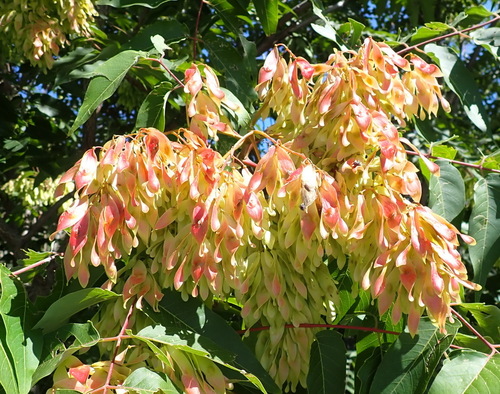
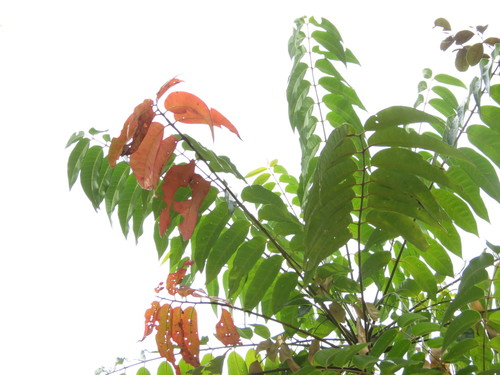
Brucea javanica
(L.) Merr.
Kusam seeds, Makassar kernel tree

(c) Ajahn, some rights reserved (CC BY-NC), uploaded by Ajahn
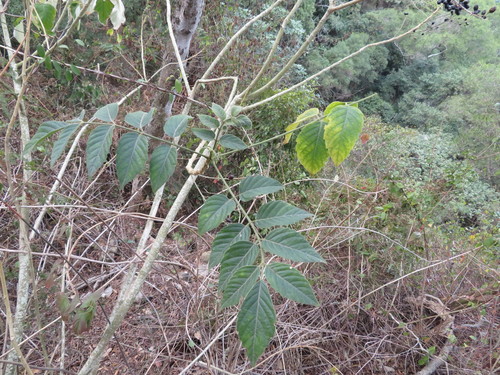
(c) mingun, some rights reserved (CC BY-NC)
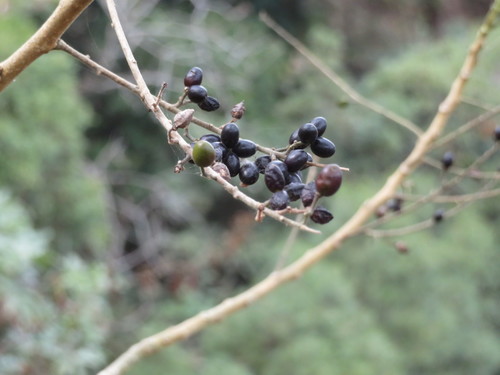
(c) mingun, some rights reserved (CC BY-NC)
What to Eat
Edible parts: CAUTION
The fruit is used to make chutney. The dried fruit are used in pickles. CAUTION: Fruit normally considered very poisonous. It is probably used in medicine. It is rich in alkaloids. They are used to reduce diarrhoea.
Known Hazards
Where to Find It
It is a tropical plant. It grows best in rich, moist, well drained soils in a sheltered partly shaded position. It commonly grows along creek banks. It needs a temperature above 15-18°C. It grows up to 1,000 m above sea level in Borneo. In Yunnan.
Africa, Asia, Australia, Central Africa, China, Congo DR, East Timor, Fiji, Himalayas, India, Indochina, Indonesia, Laos, Malaysia, Myanmar, Nepal, Pacific, Papua New Guinea, PNG, Philippines, SE Asia, Singapore, Sri Lanka, Taiwan, Thailand, Timor-Leste, Vietnam, West Timor,
How to Identify
An evergreen shrub. It grows to a height of 3-7 m and spreads to 3 m across. The stem is erect and branching. It is hairy when young. The leaves are compound leaves and produced alternately. They are 30-50 cm long and have 5 to 11 leaflets. These are oval but tapering to the tip and with coarse teeth around the edge. The leaflets are 5-8 cm long by 2-4 cm wide. The flowers are purple and small. The fruit are about 5 mm long.
How to Grow
It can be grown from seed. Seed should be sown when fresh.
Propagation: Seed - In a germination test the seed had a germination rate of about 35% within 11 - 273 days. The hard outer coat should be removed before the seed is sown. Cuttings of ripe wood in a sandy soil.
Medicinal Uses
The dried fruit are used in pickles and to make chutney. Used medicinally in Indonesia, particularly to reduce diarrhoea, treat dysentery, and for worm treatment. Has anticancer properties.
Other Uses
The bitter root is used against the attacks of insects. The seeds are used as an insecticide. They contain copious quantities of a terribly bitter oil.
Wikipedia
Source ↗Brucea javanica, commonly known as the Macassar kernels, is a plant in the family Simaroubaceae. The specific epithet javanica is from Latin, meaning "of Java". Other common names in English include Java brucea and kosam.
Notes
There are about 10 Brucea species. Probably used as medicine for treating worms not leaves eaten for food. It is used as medicine in Indonesia. The seeds are used to treat dysentery. It has anticancer properties.
Names & Synonyms
Bhakamilo, Bhakiamilo, Biji makasar, Brucea jawa, Buah Makasar, Hala, Perdu kuwalot, Pohon tongkat ali, Tiuru, Ya dan zi
References (29)
- Altschul, S.V.R., 1973, Drugs and Foods from Little-known Plants. Notes in Harvard University Herbaria. Harvard Univ. Press. Massachusetts. no. 1956 (Not as food)
- Ambasta S.P. (Ed.), 2000, The Useful Plants of India. CSIR India. p 88
- Beasley, J., 2011, Plants of Tropical North Queensland - the compact guide. Footloose publications. p 60
- Bodkin, F., 1991, Encyclopedia Botanica. Cornstalk publishing, p 172
- Brown, D., 2002, The Royal Horticultural Society encyclopedia of Herbs and their uses. DK Books. p 146
- Cooper, W. and Cooper, W., 2004, Fruits of the Australian Tropical Rainforest. Nokomis Editions, Victoria, Australia. p 514
- Cowie, I, 2006, A Survey of Flora and vegetation of the proposed Jaco-Tutuala-Lore National Park. Timor-Lests (East Timor) www.territorystories.nt/gov.au p 52
- Elliot, W.R., & Jones, D.L., 1982, Encyclopedia of Australian Plants suitable for cultivation. Vol 2. Lothian. p 382
- Gardner, S., et al, 2000, A Field Guide to Forest Trees of Northern Thailand, Kobfai Publishing Project. p 108
- Gautam, R. S., et al, 2020, Wild Edible Fruits of Nepal. Int. J. Appl. Sci. Biotechnol. Vol 8(3): 289-304
- Henty, E.E., 1980, Harmful Plants in Papua New Guinea. Botany Bulletin No 12. Division Botany, Lae, Papua New Guinea. p 124, Pl. 44
- Jackes, B.R., 2001, Plants of the Tropics. Rainforest to Heath. An Identification Guide. James Cook University. p 82
- J. Arnold Arbor. 9:3. 1928
- Khakurel, D., et al, 2021, Foods from the wild: Local knowledge, use pattern and distribution in Western Nepal. PLOS ONE.
- Kintzios, S. E., 2006, Terrestrial Plant-Derived Anticancer Agents and Plant Species Used in Anticancer research. Critical Reviews in Plant Sciences. 25: pp 79-113
- Latham, P. & Mbuta, A. K., 2014, Useful Plants of Bas-Congo Province, Democratic Republic of Congo. Volume 1. Salvation Army. p 91
- Masoodi, H. U. R. & Sundriyal, R. C., 2020, Richness of non-timber forest products in Himalayan communities—diversity, distribution, use pattern and conservation status. Journal of Ethnobiology and Ethnomedicine 16:56
- Morley, B.D., & Toelken, H.R., (Eds), 1983, Flowering Plants in Australia. Rigby. p 193
- Paczkowska, G . & Chapman, A.R., 2000, The Western Australian Flora. A Descriptive Catalogue. Western Australian Herbarium. p 534
- Peekel, P.G., 1984, (Translation E.E.Henty), Flora of the Bismarck Archipelago for Naturalists, Division of Botany, Lae, PNG. p 279, 280
- Rana, D., et al, 2019, Ethnobotanical knowledge among the semi-pastoral Gujjar tribe in the high altitude (Adhwari’s) of Churah subdivision, district Chamba, Western Himalaya. Journal of Ethnobiology and Ethnomedicine (2019) 15:10
- Samy, J., Sugumaran, M., Lee, K. L. W., 2009, Herbs of Malaysia, Marshall Cavendish. p 63
- Shah, S. K., 2014, Dietary contribution of underutilized minor crops and indigenous plants collected from uncultivated lands and forests in Nepal. in Promotion of Underutilized Indigenous Food Resources for Food Security and Nutrition in Asia and Pacific. FAO. Bangkok p 64 (As Rhus javanica)
- Slik, F., www.asianplant.net
- Smith, A.C., 1985, Flora Vitiensis Nova, Lawaii, Kuai, Hawaii, Volume 3 p 486
- Sukarya, D. G., (Ed.) 2013, 3,500 Plant Species of the Botanic Gardens of Indonesia. LIPI p 164, 593
- Wheeler, J.R.(ed.), 1992, Flora of the Kimberley Region. CALM, Western Australian Herbarium, p 660
- Wijayakusuma, H.M.H., et al, 1996, Tanaman Berkhasiat Obat Di Indonesia. Pustaka Kartini. p 34
- World Checklist of Useful Plant Species 2020. Royal Botanic Gardens, Kew