Cytinus hypocistis
(L.) L.
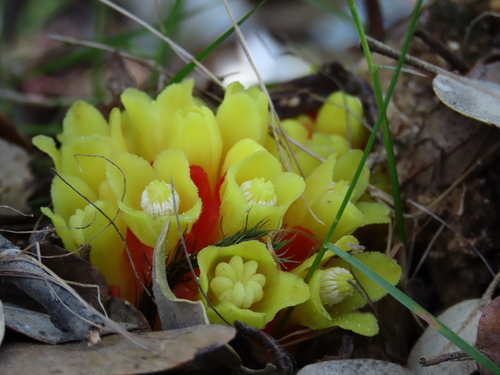
(c) josecosta1, some rights reserved (CC BY-NC)

(c) Li Jianong, some rights reserved (CC BY-NC), uploaded by Li Jianong

(c) Li Jianong, some rights reserved (CC BY-NC), uploaded by Li Jianong
What to Eat
Edible parts: Flowers - nectar, Flowers
The flowers are sucked for their nectar, and flower heads are eaten raw.
Where to Find It
It is a Mediterranean climate plant.
Canary Islands, Cyprus, Europe, Mediterranean, Portugal, Spain, Turkey, Türkiye,
How to Identify
A herb. It grows attached to other plants. It is a small plant up to 13 cm tall.
Medicinal Uses
Cytinus hypocistis has been used in traditional medicine to treat dysentery and tumors of the throat, and has been used for its astringent qualities.
Wikipedia
Source ↗Cytinus hypocistis is an ant-pollinated species of obligate parasitic plant in the family Cytinaceae having four subspecies, which is parasitic on Cistus (rock-rose) species. It is found primarily in locations that surround the Mediterranean Sea, and is the type for the genus Cytinus. The binomial has been conserved.
Notes
Also as Rafflesiaceae.
Names & Synonyms
Chupamieles, Chupera, Colmenita, Inekmemesi, Laden memesi, Mamelletes, Melera, Teticas, Vizira
References (7)
- Blanco-Salas, J., et al, 2019, Wild Plants Potentially Used in Human Food in the Protected Area “Sierra Grande de Hornachos” of Extremadura (Spain). Sustainability 2019, 11, 456
- Ciftcioglu, C. G., 2015, Sustainable wild-collection of medicinal and edible plants in Lefke region of North Cyprus. Agroforest Syst. Springer
- Ertug, F., 2004, Wild Edible Plants of the Bodrum Area. (Mugla, Turkey). Turk. J. Bot. 28 (2004): 161-174 (As subsp. orientalis)
- Ertug, F, Yenen Bitkiler. Resimli Türkiye Florası -I- Flora of Turkey - Ethnobotany supplement (As subsp. orientalis)
- Gonzalez, J. A., et al, 2011, The consumption of wild and semi-domesticated edible plants in the Arribes del Duero (Salamanca-Zamora, Spain): an ananalysis of traditional knowledge. Genetic Resources and Crop Evolution 58:991-1006
- Pardo-de-Santayana, M., et al, 2007, Traditional knowledge of wild edible plants used in the northwest of the Iberian Peninsula (Spain and Portugal): a comparative study. Journal of Ethnobiology and Ethnomedicine 2007, 3:27
- Tardio, J., et al, 2006, Ethnobotanical review of wild edible plants in Spain. Botanical J. Linnean Soc. 152, 27-71
