Cyclamen persicum
Miller
Persian violet
(c) Jens Søgaard Hansen, some rights reserved (CC BY-NC), uploaded by Jens Søgaard Hansen

(c) fotis-samaritakis, some rights reserved (CC BY-NC)

(c) fotis-samaritakis, some rights reserved (CC BY-NC)
What to Eat
Edible parts: Leaves, Soft seeds
This species probably arrived in Paris before its first mention in 1620. Certainly, it has been cultivated since 1731 in France. The start of the variety breeding is dated to the 1860s, starting from England. The different varieties of it were created exclusively by breeding with variants of the wild species. An introgression of other species has not occurred. Cyclamen persicum has a dark-brown tuberous root which is semi-poisonous. In some cultures, the tubers were used in making soap, as they generate a lather when mixed with water. The Bedouins of Mandate Palestine used to collect the root, and after grating it, would mix it with lime and sprinkle it over the surface of lakes or other large bodies of water known to contain fish. These poisonous mixtures would stun fish, which would then come to the surface and be collected by the fishermen. Such methods, as well as fishing with explosives, which came into use in the early 20th century, were banned by the British Mandate authorities. Palestinians use the leaves of the plant to make stuffed leaves. Cyclamen are propagated by seeds. The seeds are most likely to germinate when very fresh, as they do not remain viable for long. Cyclamen are dark germs, so the seed is covered with soil and placed in near or total darkness. The best germination temperature is 18 °C (64 °F). The germination period is 20 to 30 days. After germination, the seed boxes are highlighted. With good care, the plants can live to about 20 to 30 years old.
Where to Find It
It is a Mediterranean climate plant. In Lebanon it grows in open scrub and rocky hillsides. It grows from sea level to 1,200 m altitude. It is best in humus-rich soils. It needs a protected shaded position. It is damaged by drought and frost.
Asia, Australia, Europe, Jordan, Lebanon, Mediterranean*, Middle East, Myanmar, Palestine, SE Asia, Slovenia, Turkey, Türkiye,
How to Identify
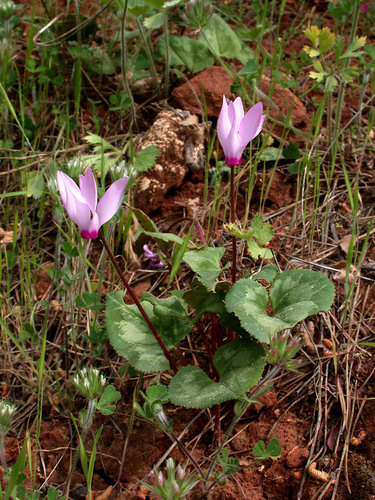
A plant that keeps growing from year to year. It grows 25 cm high and spreads 15 cm wide. The stems are erect and flowering. The leaves grow directly from the corm. The leaves are oval or heart shaped and have teeth around the edge. The flowers are pink to violet. They have a dark blotch near the base. They hang down. The petals curl back.
How to Grow
Plants can be grown from seed or from the corm.
Wikipedia
Source ↗Cyclamen persicum, the Persian cyclamen, is a species of flowering herbaceous perennial plant growing from a tuber, native to rocky hillsides, shrubland, and woodland up to 1,200 m (3,900 ft) above sea level, from south-central Turkey to the Levant. Cultivars of this species are the commonly seen florist's cyclamen.
Names & Synonyms
Alayaprak, Duwayk el Jabal, Sobna ciklama, Za'matoot, Za'matut
References (9)
- Al-Ismail, A. et al, 2007, Antioxidant Activities of some Edible Wild Mediterranean Plants. Ital. J. Food Sci. n. 3, vol. 19 - 2007 287
- Al-Qura'n, S. A., 2010, Ethnobotanical and Ecological Studies of Wild Edible Plants in Jordan. Libyan Agriculture Research Center Journal International 1(4):231-243
- Bodkin, F., 1991, Encyclopedia Botanica. Cornstalk publishing, p 312
- Ertug, F, Yenen Bitkiler. Resimli Türkiye Florası -I- Flora of Turkey - Ethnobotany supplement
- Hinnawi, N. S. A., 2010, An ethnobotanical study of wild edible plants in the Northern West Bank "Palestine". An-Najah National University. p 95
- Oran, S. A. S., 2015, Selected wild plant species with exotic flowers from Jordan. International Journal of Bioversity and Conservation. Vol. 7(5), pp 308-320
- Oran, S. A. S., 2015, Selected Wild Aromatic Plants in Jordan. International Journal of Medicinal Plants. Photon 108 (2015) 686-699
- Tukan, S. K., et al, 1998, The use of wild edible plants in the Jordanian diet. International Journal of Food Sciences and Nutrition. 49:225-235
- Wild Edible Plants in Lebanon. Promoting dietary diversity in poor communities in Lebanon. http://www.wildedibleplants.org/