Phyllostachys edulis
(Carriere) J. Houz.
Moso bamboo, Tortoise-shell bamboo, Hairy bamboo
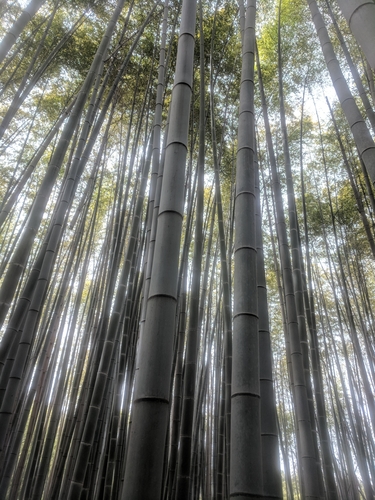
(c) Eric Knight, some rights reserved (CC BY), uploaded by Eric Knight

(c) daiya, some rights reserved (CC BY-NC)

(c) shikigami2011, some rights reserved (CC BY-NC-SA)
What to Eat
Edible parts: Shoots, Vegetable
The young shoots are cooked and are very palatable once prepared, though acrid when raw. While not of the absolute highest quality, their large size makes them widely popular. They are extensively eaten in China, typically cooked in one change of water. Shoots are harvested in spring when about 8cm above ground, cut around 5cm below soil level. Dormant young shoots dug in winter before they emerge above ground are especially prized as a delicacy.
Where to Find It
It is a temperate or subtropical plant. It grows on mountain slopes below 1,600 m above sea level. It is a temperate plant. It suits hardiness zones 6-10. Melbourne Botanical Gardens. Arboretum Tasmania. In Sichuan and Yunnan.
Asia, Australia, Bangladesh, Brazil, Cambodia, China*, Himalayas, Indochina, Japan, Korea, Nepal, North America, Philippines, SE Asia, South America, Taiwan, Tasmania, Vietnam,
How to Identify
A running bamboo. It grows 12-22 m high and spreads 9-30 m wide. The culms can be 8-18 cm thick. The stems are velvety grey when young. They become green or yellow with age. The internodes are 40 cm long. There are 2-4 leaves on the last branch. The leaves are 5-12 cm long by 0.5-2 cm wide. The young shoots are edible.
Nutrition Score: 24/100
| Part | Moisture | kJ | kcal | Protein | Vit A | Vit C | Iron | Zinc |
|---|---|---|---|---|---|---|---|---|
| Shoots raw | 91 | 113 | 27 | 2.6 | 2 | 4 | 0.5 | 1.1 |
| Shoot boiled | — | — | 1.5 | — | — | 0.2 | — | — |
How to Grow
Plants are grown by division.
Propagation: Surface sow fresh seed in a greenhouse at around 20°C, keeping the compost consistently moist. Germination is usually fairly quick with good-quality seed, though it may take 3–6 months. Grow seedlings in light shade under glass until large enough to plant out. Seed is rarely available. Divide clumps in spring as new growth begins — divisions from open ground transplant poorly and should be potted and kept under cover until at least late spring. Carry out division during wet weather; small divisions establish more reliably than large clumps. Alternatively, large divisions can be lifted and moved directly to their permanent positions if misted or drenched frequently until established. Basal cane cuttings can also be taken in spring.
Medicinal Uses
The leaves are used in the treatment of arthritic inflammations. The stem sheaths are used in the treatment of nausea and sour stomach.
Other Uses
The plant is used for erosion control, as a windbreak, and as a timber source for construction and crafts, and can be integrated into agroforestry systems as a shade provider and ground cover. The canes make good water pipes and are also shaped into household utensils. Short internodes at the base of the cane are fashioned into flasks and vases. Although the wood is relatively soft, the canes are widely used for heavy construction, weaving handicrafts, and papermaking. The rhizomes are used as walking sticks and umbrella handles. The plant is also grown as an industrial biomass crop and used as fodder.
Wikipedia
Source ↗Phyllostachys edulis, the mōsō bamboo, or tortoise-shell bamboo, or mao zhu (Chinese: 毛竹; pinyin: máozhú), (Japanese: モウソウチク), (Chinese: 孟宗竹) is a temperate species of giant timber bamboo native to China and Taiwan and naturalised elsewhere, including Japan where it is widely distributed from south of Hokkaido to Kagoshima. The edulis part of the Latin name refers to its edible shoots. This bamboo can reach heights of up to 28 m (92 ft). This particular species of bamboo is the most common species used in the bamboo textile industry of China and other countries, for the production of rayon. Moso is less cold-hardy than many Phyllostachys, surviving at a reduced height down to −15 °C (5 °F).
Other Information
The shoots are enjoyed. It is sold in local markets. It is a commercially cultivated vegetable. It is a cultivated food plant and also canned and exported. It is an important edible bamboo and canned in large amounts.
Names & Synonyms
Chiang-nan-chu, Chi chieh chu, Juksundae, Kattabans, Lo han chu, Mao tsoh, Moso, Mosochiku, Russey
References (38)
- BARC, 2016, State of Biodiversity for Food and Agriculture in Bangladesh. Bangladesh Agricultural Research Council.
- Bambou (Mons) 1:7. 1906
- Bambou (Mons) 1:39. 1906 (As Phyllostachys edulis)
- Cheifetz, A., (ed), 1999, 500 popular vegetables, herbs, fruits and nuts for Australian Gardeners. Random House p 89 (As Phyllostachys edulis)
- Chew, M. & Morgan, W., 1999, Access to Asian Foods Newsletter Issue 5
- Crawford, M., 2012, How to grow Perennial Vegetables. Green Books. p 75
- Creasy, R., 2000, The Edible Asian Garden. Periplus p 22 (As Phyllostachys edulis)
- Cundall, P., (ed.), 2004, Gardening Australia: flora: the gardener's bible. ABC Books. p 1036 (As Phyllostachys edulis)
- Dransfield, S. & Widjaja, EA., 1995, Plant Resources of South East Asia. PROSEA No. 7 Bamboos. Leiden. p 21
- Dangol, D. R. et al, 2017, Wild Edible Plants in Nepal. Proceedings of 2nd National Workshop on CUAOGR, 2017.
- Facciola, S., 1998, Cornucopia 2: a Source Book of Edible Plants. Kampong Publications, p 47
- Ghimeray, A. K., Lamsal, K., et al, 2010, Wild edible angiospermic plants of the Illam Hills (Eastern Nepal) and their mode of use by local community. Korean J. Pl. Taxon. 40(1)
- http://www.plantnames.unimelb.edu.au/sorting/Bamboos_Edible.html (As Phyllostachys edulis var. heterocycla)
- Hibbert, M., 2002, The Aussie Plant Finder 2002, Florilegium. p 232
- Hibbert, M., 2002, The Aussie Plant Finder 2002, Florilegium. p 232 (As Phyllostachys edulis)
- http://www.plantnames.unimelb.edu.au/sorting/Bamboos_Edible.html
- Hu, Shiu-ying, 2005, Food Plants of China. The Chinese University Press. p 295
- Kays, S. J., and Dias, J. C. S., 1995, Common Names of Commercially Cultivated Vegetables of the World in 15 languages. Economic Botany, Vol. 49, No. 2, pp. 115-152
- Kim, H. & Song, M., 2013, Ethnobotanical analysis for traditional knowledge of wild edible plants in North Jeolla Province (Korea). Genetic. Resour. Crop Evol. (2013) 60:1571-1585
- Kermath, B. M., et al, 2014, Food Plants in the Americas: A survey of the domesticated, cultivated and wild plants used for Human food in North, Central and South America and the Caribbean. On line draft. p 647
- Lee, Y. M., 2014, Important Plants of East Asia II: Endemic Plant Stories. East Asia Biodiversity Conservation Network p 66
- Levy-Yamamori, R., & Taaffe, G., 2004, Garden Plants of Japan. Timber Press. p 369 (As Phyllostachys edulis)
- Lu, B., et al, 2009, Effects of genetic variability, parts and seasons on the sterol content and composition in bamboo shoots. Food Chemistry 112: 1016-1021
- Marinelli, J. (Ed), 2004, Plant. DK. p 274
- Menninger, E.A., 1977, Edible Nuts of the World. Horticultural Books. Florida p 150 (As Phyllostachys edulis)
- Recher, P, 2001, Fruit Spirit Botanical Gardens Plant Index. www.nrg.com.au/~recher/ seedlist.html p 3
- Solomon, C., 2001, Encyclopedia of Asian Food. New Holland. p 17
- Solomon, C., 2001, Encyclopedia of Asian Food. New Holland. p 17 (As Phyllostachys edulis)
- Thomson, G. & Morgan, W., (Ed.) 2000, Access to Asian Foods Newsletter, Vic Govt., Australia Issue 28
- Thorng, R., et al, 2015, Roles of Wild Food Plants in Ethnic Group Communities in Mondulkiri Province, Northeastern Cambodia. Journal of Mekong Societies Vol.11 No.2 May-August 2015 pp. 1-17
- Ulian, T., et al, 2020, Unlocking plant resources to support food security and promote sustainable agriculture. Plants, People, Planet. 2020;2:421–445.
- USDA, ARS, National Genetic Resources Program. Germplasm Resources Information Network - (GRIN). [Online Database] National Germplasm Resources Laboratory, Beltsville, Maryland. Available: www.ars-grin.gov/cgi-bin/npgs/html/econ.pl (10 April 2000) (As Phyllostachys edulis)
- Valder, P., 1999, The Garden Plants of China. Florilegium. p 89, 99 (As Phyllostachys edulis)
- van Wyk, B., 2005, Food Plants of the World. An illustrated guide. Timber press. p 174 (As Phyllostachys edulis)
- Wiersema, J. H. & Leon, B., 2013, World Economic Plants. A Standard Reference CRC Press. 2nd Ed. p 522
- World Checklist of Useful Plant Species 2020. Royal Botanic Gardens, Kew
- Yang, Y., et al, A review of bamboo resources in Yunnan, China www.bioversityinternational.org
- Zeven, A. C. & de West, J. M. J., 1982, Dictionary of cultivated plants and their regions of diversity. Wageningen. p 38


