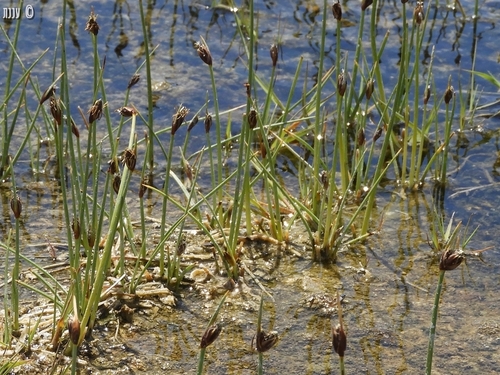
Cyperus congestus
Vahl
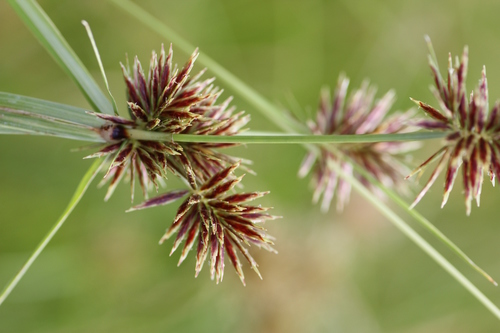
(c) Marco Schmidt, some rights reserved (CC BY-NC-SA), uploaded by Marco Schmidt

(c) Dewald du Plessis, some rights reserved (CC BY-NC)
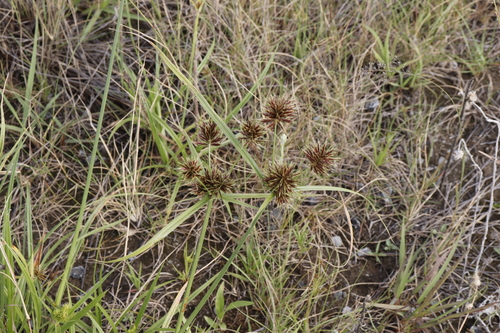
(c) Dewald du Plessis, some rights reserved (CC BY-NC)
What to Eat
Edible parts: Tubers, Bulb, Root, Leaves
The round tubers are eaten both raw and lightly roasted, when they are sweet and crisp. The leaves are also eaten as a vegetable.
Where to Find It
It is a subtropical plant. It grows near the edges of streams and swamps. It suits hot arid places with a marked dry season. It needs well-drained soil. In South Africa it grows between 2-2,425 m altitude. It can grow in arid places.
Africa, Australia, Botswana, East Africa, Eswatini, Europe, Mozambique, Namibia, New Zealand, South Africa, Southern Africa, Swaziland, Tasmania, Turkey, Türkiye, Zambia, Zimbabwe,
How to Identify
A sedge. It is an erect herb. These grow in clumps and have grass like leaves and solid stalks. It has underground stems or runners. It keeps growing from year to year. It can grow to 90 cm high. The stems are 3 sided at the top. The leaves can be as long as the stem. They are broad, tough and smooth. The flowers are in an open group at the top of the plant. The bulbs are round and 25 mm across. They have a sharp point at the top. They are covered with papery scales.
How to Grow
It can be grown from bulbs.
Other Uses
The culms are used for making ropes and for weaving mats.
Wikipedia
Source ↗Cyperus congestus, commonly known as dense flat-sedge or clustered flat-sedge, is a sedge of the family Cyperaceae that is native to southern Africa mostly in South Africa, Lesotho and Namibia.
Other Information
It is an important food of Kung bushmen.
Names & Synonyms
Musyinga-nsebe
References (14)
- Conspect. fl. afr. 5:533. 1894 (As Mariscus congestus)
- Fowler, D. G., 2007, Zambian Plants: Their Vernacular Names and Uses. Kew. p 66
- Fox, F. W. & Young, M. E. N., 1982, Food from the Veld. Delta Books. p 179 (As Mariscus congestus)
- Jardin, C., 1970, List of Foods Used In Africa, FAO Nutrition Information Document Series No 2.p 89 (As Mariscus congestus)
- Long, C., 2005, Swaziland's Flora - siSwati names and Uses http://www.sntc.org.sz/flora/
- Marshall, 1976, (As Mariscus congestus)
- Peters, C. R., O'Brien, E. M., and Drummond, R.B., 1992, Edible Wild plants of Sub-saharan Africa. Kew. p 16 (As Mariscus congestus)
- Royal Botanic Gardens, Kew (1999). Survey of Economic Plants for Arid and Semi-Arid Lands (SEPASAL) database. Published on the Internet; http://www.rbgkew.org.uk/ceb/sepasal/internet [Accessed 16th April 2011]
- Ruiters-Welcome, A. K., 2019, Food plants of southern Africa. Ph.D. thesis. Univ. of Johannesburg p 51
- Simpson, D. A. & Inglis, C. A., 2001, Cyperaceae of Economic, Ethnobotanical and Horticultural Importance: A checklist. Kew Bulletin Vol. 56, No. 2 (2001), pp. 257-360
- Story, 1958, (As Mariscus congestus)
- Tasmanian Herbarium Vascular Plants list p 61
- Welcome, A. K. & Van Wyk, B.-E., 2019, An inventory and analysis of the food plants of southern Africa. South African Journal of Botany 122 (2019) 136–179
- World Checklist of Useful Plant Species 2020. Royal Botanic Gardens, Kew
More from Cyperaceae