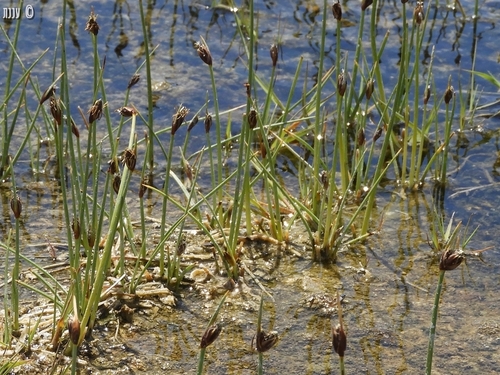
Kyllinga squamulata
Thonn.

(c) Larry Chen, some rights reserved (CC BY-NC)

(c) Larry Chen, some rights reserved (CC BY-NC)

(c) Larry Chen, some rights reserved (CC BY-NC)
What to Eat
Edible parts: Culms - flavouring
The swollen culm base is chewed and added to food as a flavouring.
Where to Find It
It is a tropical plant. It grows in waste places and often these are sandy. In Pakistan it grows in moist vales between 1,300 -2,000 m altitude.
Africa, Angola, Burkina Faso, Central Africa, East Africa, Ghana, Guinea, Guinée, Guinea-Bissau, India, Indochina, Madagascar, Mozambique, North America, Pakistan, Senegal, Sierra Leone, Southern Africa, Tanzania, Uganda, West Africa, West Indies,
How to Identify
A sedge. It is a herb that grows each year from seed. It grows 5-18 cm high. The stem is 1 mm across. It is sharply triangle shaped but smooth. The leaves are the same length as the stem. The leaf blade is 13 cm long and 3 mm wide. It is soft and flexible. The flowers are in a round compact cluster of 50-100 spikes. The nut is 3-4 mm long.
Names & Synonyms
References (5)
- Burkill, H. M., 1985, The useful plants of west tropical Africa, Vol. 1. Kew.
- Flora of Pakistan. www.eFloras.org
- Gallagher, D. E., 2010, Farming beyond the escarpment: Society, Environment, and Mobility in Precolonial Southeastern Burkina Faso. PhD University of Michigan.
- Seidemann J., 2005, World Spice Plants. Economic Usage, Botany, Taxonomy. Springer. p 193
- Simpson, D. A. & Inglis, C. A., 2001, Cyperaceae of Economic, Ethnobotanical and Horticultural Importance: A checklist. Kew Bulletin Vol. 56, No. 2 (2001), p. 325
More from Cyperaceae