Nepeta floccosa
Benth.
Woolly catmint

(c) Jennifer Chandler, some rights reserved (CC BY-NC), uploaded by Jennifer Chandler
(c) Curren Frasch, some rights reserved (CC BY-NC)
(c) Curren Frasch, some rights reserved (CC BY-NC)
What to Eat
Edible parts: Flowers - spice
The flowers are used as a spice. The leaves are traditionally powdered and mixed with curd, imparting a chilli-like flavor.
Where to Find It
It is a subtropical plant. It grows on stony slopes. It grows between 2,700-4,400 m above sea level.
Asia, Central Asia, Himalayas, India, NW India, Pakistan, Tajikistan,
How to Identify
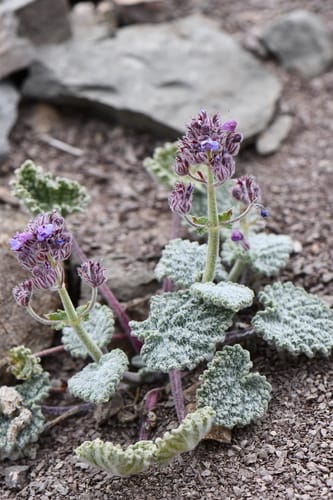
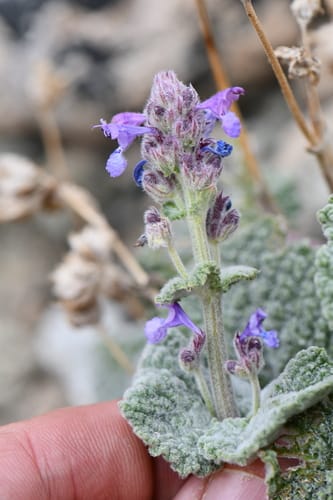
A herb. It forms clumps. It keeps growing from year to year. It grows 50 cm tall. The leaves are greyish and have a lemon scent. They are densely covered with white woolly hairs. The leaves are 1-5 cm long. They are rounded to heart shaped and have obscure teeth. The flowers are pink to blue. They are in dense rings. These are woolly and 2 cm across. The flowers are 8 mm long with a slender flower tube.
Production
In north India it flowers June to September.
Names & Synonyms
Changmagog, Shamalolo, Shangukaram
References (1)
- Battacharyya, A., 1991, Ethnobotanical Observations in the Ladakh Region of Northern Jammu and Kashmir State, India. Economic Botany, Vol. 45, No. 3, pp. 305-308 (As Nepeta vakhanica)