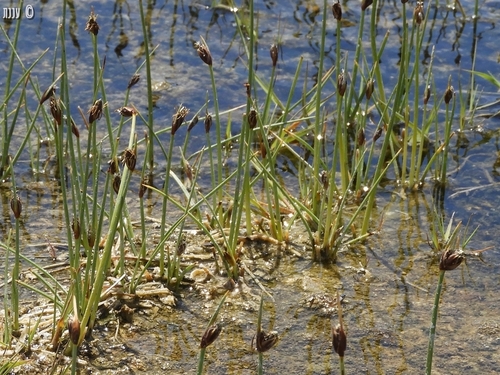
Bulbostylis barbata
(Rottb.) C.B. Clarke
Water grass
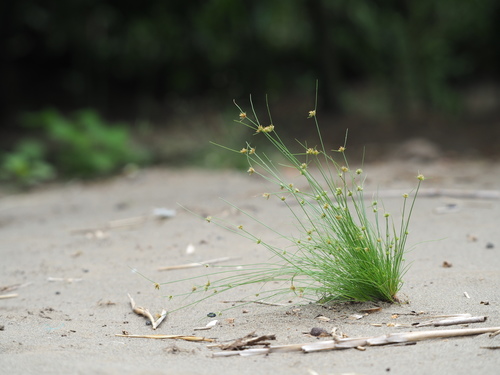
no rights reserved, uploaded by 葉子
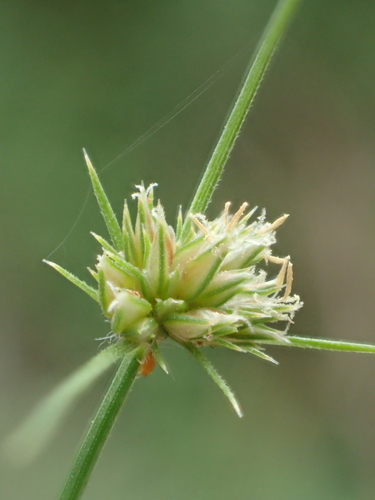
no rights reserved, uploaded by 葉子
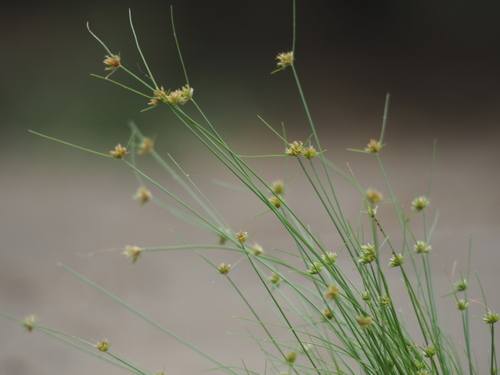
no rights reserved, uploaded by 葉子
What to Eat
Edible parts: Seeds, Cereal, Root
The seeds are eaten as a cereal.
Where to Find It
It is a tropical and subtropical plant. It grows in sand and loam as well as on sandstone and in rocky crevices. In China it grows on sandy beaches between 100-2,000 m above sea level.
Africa, Asia, Australia, Bhutan, Burkina Faso, Cambodia, Central America, China, East Africa, Guatemala, Guianas, Guinea, Guinée, Guinea-Bissau, Himalayas, India, Indochina, Indonesia, Japan, Korea, Laos, Malaysia, Maldives, Martinique, Mozambique, Nepal, North Africa, North America, Pakistan, Papua New Guinea, PNG, Philippines, SE Asia, South America, Sri Lanka, Suriname, Taiwan, Thailand, USA, Vietnam, West Africa, Zambia,
How to Identify
A tufted annual sedge. It grows 2-35 cm high. The stems are 4-6 angled and grooved. The leaves are about half the length of the stem. The leaves roll inward and look like stems. There can be a few or many flowering stalks. They are in a head. The flowers are brown. The nuts are about 0.6 mm. They are triangle shaped.
Wikipedia
Source ↗Bulbostylis barbata is a flowering plant in the sedge family, Cyperaceae, that is native to Western Australia. The annual grass-like plant has a tufted habit and typically grows to a height of 2 to 35 centimetres (1 to 14 in). It blooms between February and September, producing brown flowers. It is rarely solitary and is found in rock crevices and along creek and rivers and on low-lying flats throughout a large area of the Kimberley, Pilbara, Mid West and Goldfields-Esperance regions, where it grows in sandy-loamy alluvium over sandstone and granite.
Notes
There are about 50-100 Bulbostylis species. They grow in the tropics and subtropics.
Names & Synonyms
Kaafaru hui, Masa, Mukkutikorei, Mulyaka-lulu, Musadadhi, Piaza
References (14)
- Ambasta S.P. (Ed.), 2000, The Useful Plants of India. CSIR India. p 90
- Cancilla, D., 2018, Ethnobotanical and Ethnozoological Values Desktop Assessment - Eliwana Project. p 10
- Cherikoff V. & Isaacs, J., The Bush Food Handbook. How to gather, grow, process and cook Australian Wild Foods. Ti Tree Press, Australia p 189, 194
- Fowler, D. G., 2007, Zambian Plants: Their Vernacular Names and Uses. Kew. p 65
- J. D. Hooker, Fl. Brit. India 6:651. 1893
- Flora of Pakistan. www.eFloras.org
- Hunter, J., 2012, Vegetation and Floristics of Gilwarny and Wingadee Nature Reserves. A Report to the New South Wales National Parks and Wildlife Service p 110
- Kenneally, K.E., Edinger, D. C., and Willing T., 1996, Broome and Beyond, Plants and People of the Dampier Peninsula, Kimberley, Western Australia. Department of Conservation and Land Management. p 204
- Lazarides, M. & Hince, B., 1993, Handbook of Economic Plants of Australia, CSIRO. p 41
- Paczkowska, G. & Chapman, A.R., 2000, The Western Australian Flora. A Descriptive Catalogue. Western Australian Herbarium. p 42
- Simpson, D. A. & Inglis, C. A., 2001, Cyperaceae of Economic, Ethnobotanical and Horticultural Importance: A checklist. Kew Bulletin Vol. 56, No. 2 (2001), pp. 257-360
- Standley, P. & Steyermark, J., 1958, Flora of Guatemala. Fieldiana: Botany, Volume 24 part 1 p 94
- Sujanapal, P., & Sankaran, K. V., 2016, Common Plants of Maldives. FAO & Kerala FRI, p 62
- Wheeler, J.R.(ed.), 1992, Flora of the Kimberley Region. CALM, Western Australian Herbarium, p 1041
More from Cyperaceae