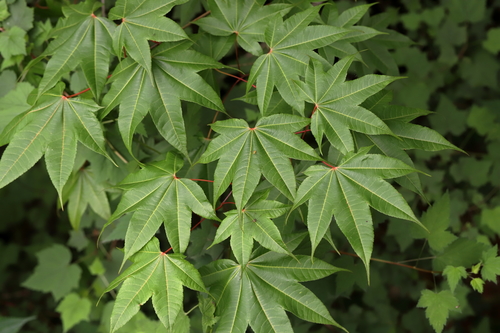
Acer glabrum
Torrey
Rocky Mountain Maple

(c) Caleb Catto, some rights reserved (CC BY), uploaded by Caleb Catto

(c) Denver Billing, some rights reserved (CC BY-NC), uploaded by Denver Billing
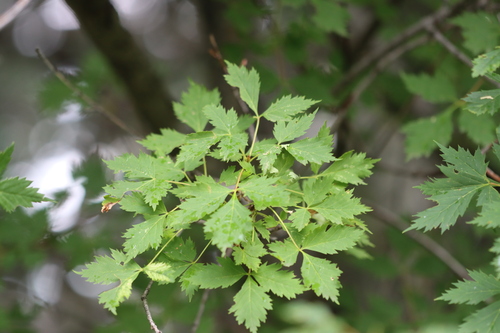
(c) Rich Sommer, some rights reserved (CC BY), uploaded by Rich Sommer
What to Eat
Edible parts: Seeds, Leaves, Bark
Young shoots are edible cooked and used like asparagus. Seedlings gathered in early spring can be eaten fresh or dried for later use. Dried, crushed leaves have been used as a spice. The seeds — about 6mm long — are cooked by removing the wings and boiling them, then eaten hot. Inner bark can be dried, ground into a powder, and used as a thickening agent in soups or mixed with cereals when making bread, though it is considered an emergency food used only when other options are exhausted. The sap can be tapped in late winter and boiled down into a sweet syrup or nourishing drink rich in minerals; raw sap is watery and lacks sweetness. Young leaves are edible when cooked — raw leaves are bitter and astringent, but boiling reduces this; this species tends to have less hairy leaves than other western maples, making them more pleasant as a cooked vegetable.
Where to Find It
It is a temperate plant. It occurs in mountains from 1500-2000 m altitude in the Rocky Mountains in the USA. They need a moist well drained soil. They prefer a sunny position but can tolerate some shade. They can grow in a range of soils and soil pH's. They can tolerate cold to - 25°C. It needs cold conditions to thrive. They often grow along stream banks. It suits hardiness zones 4-7.
Alaska, Britain, Canada, Europe, North America, USA,
How to Identify
A shrub or small tree. It grows 5 m tall. There are prickles along the stem. The leaves are twice divided and there are 8-18 pairs of pinnae. There are up to 50 pairs of pinnules on each pinnae. The flowers are yellow. They are in large clusters at the ends of branches. The pods are flattened.
How to Grow
Plants are easily grown from seed. Seed should be pre-soaked for 24 hours then kept cold at 0-8°C for 2-4 months to assist them to grown. Seed can be sown fresh if green seeds are used. Seed should be grown in a nursery then transplanted. Cuttings or layering can be used.
Propagation: Sow seed as soon as ripe in a cold frame; germination typically occurs the following spring. Stored seed should be pre-soaked for 24 hours, then stratified for 2–4 months at 1–8°C. The hard seed coat means germination can be slow, often taking 2 years. Seed can also be harvested green — fully developed but before drying and germination inhibitors form — and sown immediately for late-winter germination. Seed harvested too early produces very weak or no plants. Prick seedlings into individual pots once large enough to handle and grow on to 20cm or more before planting out permanently. Layering is successful with most species in this genus and takes about 12 months. Take cuttings of young shoots in June or July with 2–3 pairs of leaves plus one pair of buds at the base; remove a thin slice of bark at the base and use a rooting hormone for best results. Rooted cuttings must show new growth during summer before potting, otherwise they are unlikely to survive winter. Suitable cutting wood is very difficult to find for this species.
Medicinal Uses
A decoction of the wood and bark is said to cure nausea — one report specifies this is nausea caused by smelling a corpse. An infusion of the bark has been used as a cathartic. A decoction of the branches, combined with branches of Amelanchier sp., was used to heal a woman's insides after childbirth and to promote lactation.
Other Uses
Leaves packed around apples, root crops, and similar produce help preserve them. Fibre from the inner bark is used for making mats and rope. The bark has been used to make spoons and paint containers. The wood is tough, hard, heavy, close-grained, and pliable, weighing 37lb per cubic foot. It can be used as friction sticks, and green wood can be moulded. Too small for commercial exploitation, the wood makes a good fuel and was commonly used by Native North American tribes for snowshoes, drum hoops, bows, and pegs.
Wikipedia
Source ↗Acer glabrum is a species of maple native to western North America, from southeastern Alaska, British Columbia and western Alberta, east to western Nebraska, and south through Washington, Oregon, Idaho, Montana and Colorado to California, Arizona, Utah, and New Mexico.
Other Information
The bark is an emergency food only.
Notes
There are about 120-150 Acer species.
Names & Synonyms
California mountain maple, Douglas maple, Rock maple
References (5)
- Ann. Lyceum Nat. Hist. New York 2:172. 1828
- Etherington, K., & Imwold, D., (Eds), 2001, Botanica's Trees & Shrubs. The illustrated A-Z of over 8500 trees and shrubs. Random House, Australia. p 62
- Farrar, J.L., 1995, Trees of the Northern United States and Canada. Iowa State University press/Ames p 152
- Plants for a Future database, The Field, Penpol, Lostwithiel, Cornwall, PL22 0NG, UK. http://www.scs.leeds.ac.uk/pfaf/
- MacKinnon, A., et al, 2009, Edible & Medicinal Plants of Canada. Lone Pine. p 66