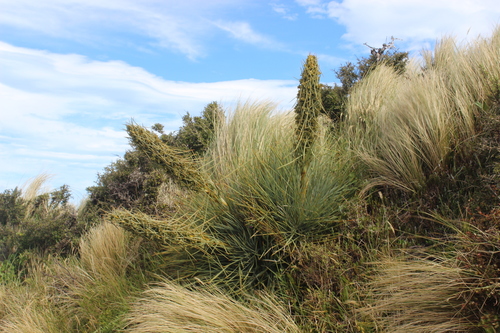
Bupleurum falcatum
L.
Thorow-wax, Hare's ear, Sickle Hare's Ear, Sickle-leaved hare's-ear

(c) jltasset, some rights reserved (CC BY-NC), uploaded by jltasset

(c) Nicolas Schwab, some rights reserved (CC BY-NC)

(c) Kutushev Radik, some rights reserved (CC BY-NC), uploaded by Kutushev Radik
What to Eat
Edible parts: Roots, Leaves
Edible Parts: Leaves Shoots Edible Uses: Rutin Leaves and young shoots - cooked.The new growth in spring and autumn is used. It is a good source of rutin.
Where to Find It
It is a temperate plant. It grows on stony and grassy locations. It needs a well-drained soil and full sun.
Asia, Bhutan, Britain, China, Europe, France, Himalayas, India, Italy, Japan, Korea, Luxembourg, Mediterranean, Myanmar, Nepal, Pakistan, SE Asia,
How to Identify
A variable perennial herb. It has hollow stems. The leaves at the base are oblong and have stalks. There are 5-7 veins. The leaves on the stem are narrow and often sickle shaped and do not have stalks but clasp the stem. The flower umbels are yellow. There are 3-15 rays. The fruit are oblong and 3-4 mm long. They have narrow ridges.
How to Grow
Plants can be grown from seed or division of the plant.
Propagation: Seed - sow spring in a cold frame. The seed usually germinates in 2 - 8 weeks at 15°c. Prick out the seedlings into individual pots when they are large enough to handle and plant them out in the summer or following spring. Division in spring. Very easy, larger clumps can be planted direct into their permanent positions. It is best to pot up smaller clumps and grow them on in a cold frame until they are well rooted before planting them out in the summer.
Medicinal Uses
Alterative Analgesic Antibacterial Antiinflammatory Antiperiodic Antipyretic Antiviral Carminative Diaphoretic Emmenagogue Haemolytic Hepatic Malaria Pectoral Poultice Sedative A paste of the plant is applied to boils. The juice of the roots, mixed with the juice of Centella asiatica, is used in the treatment of liver diseases. This species is closely related to B. chinense and quite possibly has the same uses. It is certainly worthy of some research. The uses of B. chinense are as follows:- Bei chai hu root has been used in traditional Chinese medicine for at least 2,000 years. It is a bitter herb that is used to harmonize the body, balancing the different organs and energies within the body. It strengthens the digestive tract, acts as a tonic for the liver and circulatory system, lowers fevers and has anti-viral effects. The root is alterative, analgesic, antibacterial, anti-inflammatory, antiperiodic, antipyretic, antiviral, carminative, diaphoretic, emmenagogue, haemolytic, hepatic, pectoral, sedative[116, 147, 174. 176, 178, 218, 238, 254]. It is taken internally in the treatment of malaria, blackwater fever, uterine and rectal prolapse, haemorrhoids, sluggish liver, menstrual disorders, abdominal bloating etc. The roots are harvested in the autumn and can be used fresh or dried. The root contains saikosides. These saponin-like substances have been shown to protect the liver from toxicity whilst also strengthening its function, even in people with immune system disorders. These saikosides also stimulate the body's production of corticosteroids and increase their anti-inflammatory affect. The plant is often used in preparations with other herbs to treat the side effects of steroids.
Other Uses
Fuel The old plant is used as a fuel. Special Uses
Wikipedia
Source ↗Bupleurum falcatum, the sickle-leaved hare's-ear, sickle hare's ear or sickle-leaf hare's ear, is a species of flowering plant in the family Apiaceae. It is found in Europe and the Caucasus. In East Asia, the scientific name Bupleurum falcatum is often misapplied to another species, Bupleurum stenophyllum. Bupleurum falcatum has been found to possess antidepressant properties, mediated through the serotonergic and noradrenergic systems (although the precise mechanism remains to be found).
Notes
It is used as medicine in Nepal. There are about 100 Bupleurum species. The stem and the leaves contain the glucoside rutin.
Names & Synonyms
Chai hu, Kalizewar
References (12)
- Ambasta S.P. (Ed.), 2000, The Useful Plants of India. CSIR India. p 91
- Bircher, A. G. & Bircher, W. H., 2000, Encyclopedia of Fruit Trees and Edible Flowering Plants in Egypt and the Subtropics. AUC Press. p 69
- Blamey, M and Grey-Wilson, C., 2005, Wild flowers of the Mediterranean. A & C Black London. p 159
- Bremness, L., 1994, Herbs. Collins Eyewitness Handbooks. Harper Collins. p 155
- Brown, D., 2002, The Royal Horticultural Society encyclopedia of Herbs and their uses. DK Books. p 148
- Hedrick, U.P., 1919, (Ed.), Sturtevant's edible plants of the world. p 139
- Lim, T. K., 2015, Edible Medicinal and Non Medicinal Plants. Volume 9, Modified Stems, Roots, Bulbs. Springer p 19
- Manandhar, N.P., 2002, Plants and People of Nepal. Timber Press. Portland, Oregon. p 124
- Plants for a Future database, The Field, Penpol, Lostwithiel, Cornwall, PL22 0NG, UK. http://www.scs.leeds.ac.uk/pfaf/
- READ, 1946,
- Singh, H.B., Arora R.K.,1978, Wild edible Plants of India. Indian Council of Agricultural Research, New Delhi. p11
- Sp. pl. 1:237. 1753