Bupleurum rotundifolium
L.
Hare’s ear, Thorough wax, Thorowax, Thorow-wax
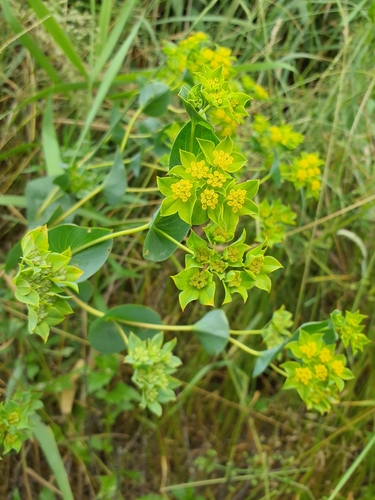
(c) Sebastian J. Dunkl, some rights reserved (CC BY-NC), uploaded by Sebastian J. Dunkl
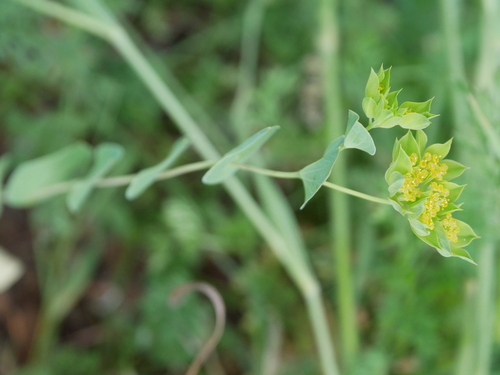
(c) blaeld, some rights reserved (CC BY-NC)

(c) Nicolas Van Vooren, some rights reserved (CC BY-NC), uploaded by Nicolas Van Vooren
What to Eat
Edible parts: Leaves
Edible Parts: Leaves Edible Uses: Leaves - raw or cooked. Added to salads or used as a pot-herb. The leaves are also used as a spice.
Where to Find It
It grows in dry open habitats. It grows best in well-drained alkaline soils. It needs an open sunny position. It is resistant to drought and frost. It suits hardiness zones 5-9.
Africa, Armenia, Australia, Azerbaijan, Britain, Caucasus, Europe*, France, Georgia, Germany, Greece, Iran, Italy, Luxembourg, Mediterranean, Middle East, Netherlands, North Africa, North America, Russia, Spain, Turkey, Türkiye, USA,
How to Identify
It is an annual or short lived perennial shrub. It grows 60 cm high and spreads 60 cm wide. The leaves are round and bluish-green. They wrap around the stem. The lower leaves have stalks. The flowers are small and bluish green. There are large bracts around the flower groups. The fruit is oblong and 3-3.5 mm long and smooth.
How to Grow
It can be grown from seed. The seed should be planted where the plants are to grow.
Propagation: Seed - sow spring in situ.
Medicinal Uses
None known
Other Uses
None known Special Uses
Wikipedia
Source ↗Bupleurum rotundifolium, hare's ear or hound's ear, is a species of flowering plant in the genus Bupleurum, it is native to Morocco, Algeria, southern, central and eastern Europe, Turkey, Iran, Turkmenistan, and Kyrgyzstan. Successful in disturbed areas, it is now an established weed in the eastern United States, and in South Africa, and is introduced elsewhere.
Notes
There are about 100 Bupleurum species.
Names & Synonyms
Hare’s ear, Thorough wax, Thorowax, Thorow-wax, Denmark: Rundbladet hare're. Estonia: maralehine j'nesekärv. Latvia: Apskritalapis gaivenis. Lithuania: apallapu bupleire. Norway: Hare're. Poland: Przewiercien okraglolistny. Sweden: Har'rt.
References (9)
- Bircher, A. G. & Bircher, W. H., 2000, Encyclopedia of Fruit Trees and Edible Flowering Plants in Egypt and the Subtropics. AUC Press. p 69
- Blamey, M and Grey-Wilson, C., 2005, Wild flowers of the Mediterranean. A & C Black London. p 158
- Bodkin, F., 1991, Encyclopedia Botanica. Cornstalk publishing, p 177
- Cundall, P., (ed.), 2004, Gardening Australia: flora: the gardener's bible. ABC Books. p 269
- Facciola, S., 1998, Cornucopia 2: a Source Book of Edible Plants. Kampong Publications, p 16
- Hedrick, U.P., 1919, (Ed.), Sturtevant's edible plants of the world. p 139
- Plants for a Future database, The Field, Penpol, Lostwithiel, Cornwall, PL22 0NG, UK. http://www.scs.leeds.ac.uk/pfaf/
- Sp. pl. 1:236. 1753
- Tanaka,