Ribes pulchellum
Turczaninow
Beautiful currant, Small-leaved currant, Ijirgana, Uhanai
GrossulariaceaeFruit
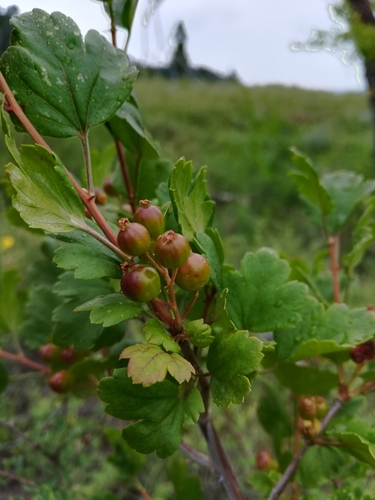
iNaturalist · cc-by-nc
(c) kholboevas, some rights reserved (CC BY-NC)
(c) kholboevas, some rights reserved (CC BY-NC)

iNaturalist · cc-by-nc
(c) Pyak Andrei, some rights reserved (CC BY-NC)
(c) Pyak Andrei, some rights reserved (CC BY-NC)
What to Eat
Edible parts: Fruit
The mature red berries are eaten fresh.
Where to Find It
It is a cool temperate plant. It is native to north China. It grows between 300-3,800 m above sea level.
Asia, China, Mongolia, Russia, Siberia,
Countries: United Arab Emirates, Afghanistan, Armenia, Azerbaijan, Bangladesh, Bahrain, Brunei, Bhutan, China, Georgia, Indonesia, Israel, India, Iraq, Iran, Jordan, Japan, Kyrgyzstan, Cambodia, North Korea, South Korea, Kuwait, Kazakhstan, Laos, Lebanon, Sri Lanka, Myanmar, Mongolia, Maldives, Malaysia, Nepal, Oman, Philippines, Pakistan, Qatar, Russia, Saudi Arabia, Singapore, Syria, Thailand, Tajikistan, Timor-Leste, Turkmenistan, Turkey, Taiwan, Uzbekistan, Vietnam, Yemen
How to Identify
A shrub. It loses its leaves during the year. It grows 1-2 m high. The young branches are brown. There are pairs of prickles at the nodes. The leaves are oval or heart shaped and 1-4 cm long. There are 3 deep lobes. The flowers are red. Male and female flowers are separate on separate plants. The flowers are saucer shaped. The fruit are red berries. They are round and 5-6 mm across. They are in clusters 3 cm long.
References (3)
- Flora of China @ efloras.org Volume 8
- Hu, Shiu-ying, 2005, Food Plants of China. The Chinese University Press. p 427
- Khasbagan, Hu-Yin Huai, and Sheng-Ji pei, 2000, Wild Plants in the Diet of Athorchin Mongol Herdsmen in Inner Mongolia. Economic Botany 54(4): 528-536
More from Grossulariaceae
No photo
Coreosma prostrata
Fetid currant

Grossularia californica
Hillside gooseberry

Grossularia cynosbati
Dogberry, Eastern Prickly Gooseberry, American wild gooseberry

Grossularia lobbii
Gummy gooseberry, Canyon Gooseberry, Sticky gooseberry

Grossularia missouriensis
Missouri gooseberry

Grossularia oxyacanthoides
American mountain gooseberry, Canadian Gooseberry, Smooth Gooseberry, Northern gooseberry