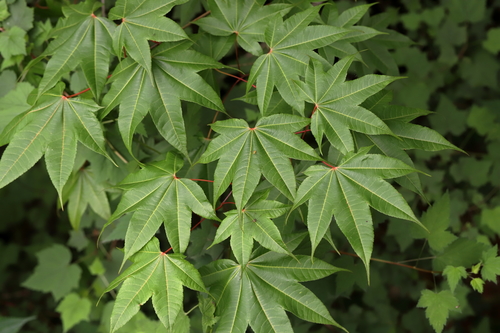
Acer macrophyllum
Pursh
Oregon maple, Broadleaf maple
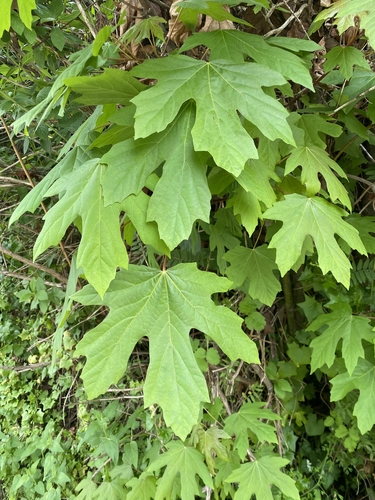
(c) Donna Pomeroy, some rights reserved (CC BY-NC), uploaded by Donna Pomeroy
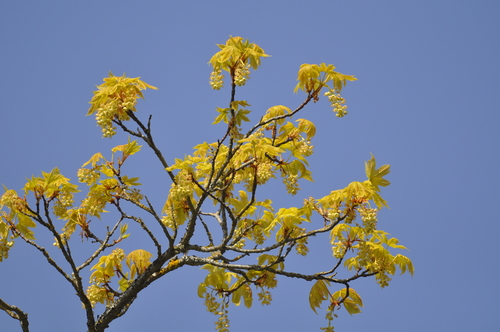
(c) Andrew Simon, some rights reserved (CC BY-NC), uploaded by Andrew Simon

(c) Ian Rhodes, some rights reserved (CC BY-NC), uploaded by Ian Rhodes
What to Eat
Edible parts: Sap, Seeds, Flowers, Leaves
The sap contains sugar and can be drunk fresh or boiled down into a syrup used as a sweetener, though its sugar concentration is somewhat lower than in sugar maples (A. saccharum). Tap the trunk in early spring — sap flows best on warm, sunny days following a frost, and trees in cold-winter continental climates produce the best yields. The inner bark can be eaten in small quantities with oil; it is often dried, ground into a powder, and used as a soup thickener or mixed with cereal flour when making bread. Leaves wrapped around food during baking impart a pleasant flavour. The yellow flower clusters are edible raw and taste sweet with nectar. Seeds, about 6mm long and produced in small clusters, can be sprouted and then boiled — the sprouted seeds tend to be bitter, but the young shoots are quite sweet and juicy.
Known Hazards
Where to Find It
It is a temperate plant. It needs a moderately sunny moist but well drained soil. It can tolerate some shade. It is frost resistant but sensitive to drought. It suits hardiness zones 6-8. Arboretum Tasmania.
Australia, Canada, North America, Tasmania, USA*,
How to Identify
A shrub or small tree. It grows 5 m tall. There are prickles along the stem. The leaves are twice divided and there are 8-18 pairs of pinnae. There are up to 50 pairs of pinnules on each pinnae. The flowers are yellow. They are in large clusters at the ends of branches. The pods are flattened.
How to Grow
Plants are easily grown from seed. Seed should be pre-soaked for 24 hours then kept cold at 0-8°C for 2-4 months to assist them to grown. Seed can be sown fresh if green seeds are used. Seed should be grown in a nursery then transplanted. Cuttings or layering can be used.
Propagation: Seed is best sown as soon as it is ripe in a cold frame, where it usually germinates the following spring. Stored seed should be pre-soaked for 24 hours and then stratified for 2–4 months at 1–8°C, though germination can still be slow. Seed can also be harvested green — fully developed but before it has dried and produced germination inhibitors — and sown immediately for late-winter germination. Seed harvested too early will produce very weak plants or none at all. Prick seedlings out into individual pots once large enough to handle, and grow them on until they reach 20cm or more before planting out permanently. Layering is successful with most species in this genus and takes about 12 months. Cuttings of young shoots taken in June or July should have 2–3 pairs of leaves plus one pair of buds at the base; remove a thin slice of bark at the base and use a rooting hormone to improve success. Rooted cuttings must put on new growth during the summer before being potted up, or they are unlikely to survive the winter.
Medicinal Uses
A bark infusion has been used in the treatment of TB. The raw sap has been used as a tonic.
Other Uses
Leaves packed around apples, root crops, and similar produce help preserve them. A sticky gum collected from the buds in spring can be mixed with oil and applied as a hair tonic. The inner bark yields a fibre used to make scouring pads, rope, and crude clothing; harvested in spring, it was also woven into baskets, with young stems serving as coarse twine for warp and weft. The wood is light, soft, not particularly strong, and close-grained, but is highly valued for timber, furniture, indoor use, carving bowls, and veneer. It also makes excellent fuel, burning with a hot, smokeless flame.
Wikipedia
Source ↗Acer macrophyllum, the bigleaf maple or Oregon maple, is a large deciduous tree in the genus Acer. It is native to western North America. In addition to uses by animals, it is of some culinary and woodworking interest.
Production
Trees live for over 200 years. Trees are tapped in spring and sap flow is better on sunny days after a frost.
Notes
There are about 120-150 Acer species.
Names & Synonyms
Bigleaf Maple, Torote
References (17)
- Bocek, B. R., 1984, Ethnobotany of Costanoan Indians, California, Based on Collections by John P. Harrington. Economic Botany 38(2): 240-255
- Bodkin, F., 1991, Encyclopedia Botanica. Cornstalk publishing, p 40
- Brickell, C. (Ed.), 1999, The Royal Horticultural Society A-Z Encyclopedia of Garden Plants. Convent Garden Books. p 65
- Coombes, A.J., 2000, Trees. Dorling Kindersley Handbooks. p 91
- Cundall, P., (ed.), 2004, Gardening Australia: flora: the gardener's bible. ABC Books. p 85
- Duke, J.A., 1992, Handbook of Edible Weeds. CRC Press. p 16
- Etherington, K., & Imwold, D., (Eds), 2001, Botanica's Trees & Shrubs. The illustrated A-Z of over 8500 trees and shrubs. Random House, Australia. p 63
- Facciola, S., 1998, Cornucopia 2: a Source Book of Edible Plants. Kampong Publications. p 1
- Farrar, J.L., 1995, Trees of the Northern United States and Canada. Iowa State University press/Ames p 140
- Fl. Amer. sept. 1:267. 1813-1814
- Grandtner, M. M., 2008, World Dictionary of Trees. Wood and Forest Science Department. Laval University, Quebec, Qc Canada. (Internet database http://www.WDT.QC.ca)
- Lyle, S., 2006, Discovering fruit and nuts. Land Links. p 47
- MacKinnon, A., et al, 2009, Edible & Medicinal Plants of Canada. Lone Pine. p 66
- Plants for a Future database, The Field, Penpol, Lostwithiel, Cornwall, PL22 0NG, UK. http://www.scs.leeds.ac.uk/pfaf/
- Ryan, S., 2008, Dicksonia. Rare Plants Manual. Hyland House. p 3
- Seidemann J., 2005, World Spice Plants. Economic Usage, Botany, Taxonomy. Springer. p 2
- Turner, N., 1995, Food Plants of Coastal First Peoples. Royal BC Museum Handbook p 55