Arthrostemma ciliatum
Ruiz & Pavon
Churunch, Pink fringe

(c) John, some rights reserved (CC BY-NC), uploaded by John
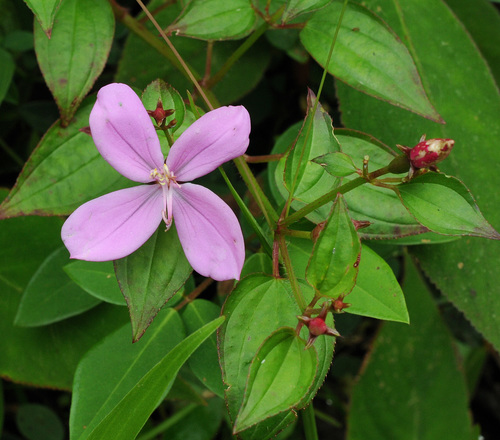
(c) Todd Boland, some rights reserved (CC BY), uploaded by Todd Boland
What to Eat
Edible parts: Fruit, Leaves
The fruit are eaten raw, and the young leaves are eaten with salt.
Where to Find It
It is a tropical plant.
Andes, Bolivia, Brazil, Central America, Colombia, Costa Rica, Ecuador*, Greater Antilles, Guatemala, Hawaii, Honduras, Jamaica, Mexico, Nicaragua, Panama, Peru, South America, Trinidad-Tobago, USA, Venezuela,
How to Identify
A climbing herb growing 1-4 m tall with pink flowers, found in tropical regions.
Medicinal Uses
The pinkfringe is a popular ornamental plant. It also has tender, edible stems, which can be used for food. Medicinally, it has been used to treat a variety of conditions, from diabetesto urinary tract infections and sexually transmitted infections.
Wikipedia
Source ↗Arthrostemma ciliatum, commonly known as pinkfringe, is a species of flowering plant native to the tropical Americas.
Names & Synonyms
Acedillo, Agro viro, Churunch, Sacha wiru, Shiimuijku, Xocoyocillo, Xohxoko istak
References (8)
- Barfod, A. S. & Kvist, L. P., 1996, Comparative Ethnobotanical Studies of the Amerindian Groups in Coastal Ecuador. The Danish Academy of Sciences and Letters. p 81
- Diaz-Jose, J., et al, 2019, Traditional Knowledge of Edible Wild Plants Used by Indigenous Communities in Zongolica, Mexico. Ecology of Food and Nutrition.
- Kew Plants of the World Online
- Pena, F. B., et al, 1998, Los quelites de la Sierra Norte de Puebla, Mexico: Inventory Y Formas de Preparacion. Bol. Soc. Bot. Mexico 62:49-62
- Torre, de la, L., et al, 2008, Enciclopedia de las Plantas Útiles del Ecuador. Herbario QCA. Pontificia Universidad Católica del Ecuador. p 420
- Van den Eynden, V., et al, 2003, Wild Foods from South Ecuador. Economic Botany 57(4): 576-603
- Van den Eynden, V., 2004, Use and Management of edible non-crop plants in southern Ecuador. Ph. D. dissertation Faculty of Agricultural and Applied Biological Sciences, Belgium, 246pp
- Van den Eynden, V., & Cueva, E., 2008, Las plantas en la alimentacion. Enciclopedia de las Plantas Utiles del Ecuador. Herbario QCA & Herbario AAU. Quito & Aarhus. 2008: 62–66.


