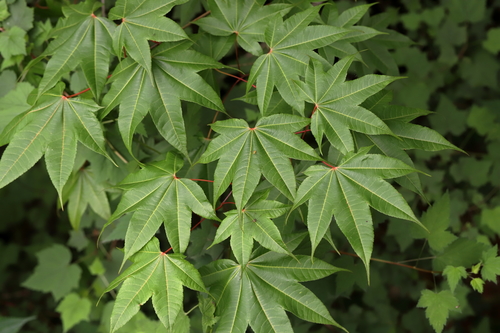
Acer negundo
L.
Box elder, Black Maple

(c) thewindcriesmary, some rights reserved (CC BY-NC)

(c) bjnicholls, some rights reserved (CC BY-NC), uploaded by bjnicholls
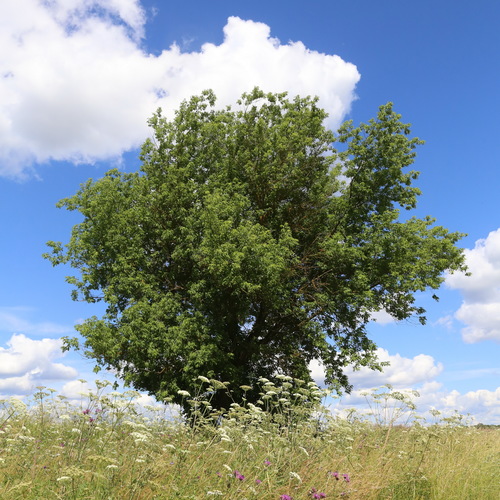
(c) ocanire, some rights reserved (CC BY-NC), uploaded by ocanire
What to Eat
Edible parts: Bark, Sap, Seeds
The sap contains a reasonable amount of sugar and can be drunk as a refreshing beverage or boiled down into a syrup for use as a sweetener. One source considers it inferior to A. saccharum, while another rates it highly; notably, the sugar it yields is said to be whiter than that from other maples. To tap the sap, bore a hole on the sunny side of the trunk into the sapwood about 1 metre above the ground, from around January 1st until the leaves appear. Flow is best on a warm day following a frost, and trees in cold-winter continental climates are the most productive. The inner bark can be eaten raw or cooked — dried and ground into a powder, it works as a soup thickener or can be added to cereal flours for bread and cakes. It can also be boiled until its sugar crystallises out. Self-sown seedlings gathered in early spring are eaten fresh or dried for later use. The seeds, up to 12mm long and produced in small clusters, are cooked: the wings are removed, and the seeds are boiled and eaten hot.
Known Hazards
Where to Find It
It is a temperate plant. A plant native to north America. It prefers well drained alkaline soils. It does best in a protected sunny position. It is frost resistant but damaged by drought. It often grows on lake shores and stream banks. It can stand occasional flooding. It can grow in arid places. It suits hardiness zones 5-9. At Anvers Chocolate factory. Arboretum Tasmania.
Africa, Argentina, Asia, Australia, Britain, Canada*, Central America, Central Asia, China, East Africa, Europe, France, Greece, Guatemala, India, Italy, Japan, Korea, Mediterranean, Mexico, Middle East, North America*, Slovenia, South America, Spain, Tajikistan, Tasmania, Turkey, Türkiye, USA, Zimbabwe,
How to Identify
A shrub or small tree. It grows 5 m tall. There are prickles along the stem. The leaves are twice divided and there are 8-18 pairs of pinnae. There are up to 50 pairs of pinnules on each pinnae. The flowers are yellow. They are in large clusters at the ends of branches. The pods are flattened.
How to Grow
Of easy cultivation, succeeding in most soils but preferring a rich moist well-drained soil and a sunny position. Grows well in heavy clay soils and in sandy soils. Plants often become chlorotic on very alkaline soils. Plants are hardy to about -18°c. A fast growing but short-lived tree in the wild, living for 75 - 100 years. It is fairly wind-tolerant, but the branches have a tendency to break in strong winds. This species is cultivated commercially in Illinois for its sap. Another report says that this is one of the least productive species for sugar. A very ornamental plant, there are several named varieties. This tree is a bad companion plant that is said to inhibit the growth of neighbouring plants. This species is notably resistant to honey fungus. Very tolerant of pruning, it can regenerate from old wood if it is cut back hard. Dioecious. Male and female plants must be grown if seed is required.
Propagation: Seed is best sown as soon as it is ripe in a cold frame, where it usually germinates the following spring. Stored seed should be pre-soaked for 24 hours and then stratified for 2–4 months at 1–8°C, though germination can be slow. Seed can be harvested green — fully developed but before drying and producing germination inhibitors — and sown immediately for late-winter germination. Seed harvested too early will produce very weak plants or none at all. Prick seedlings into individual pots once large enough to handle and grow on until 20cm or more tall before planting out permanently. Layering takes about 12 months and works well with most species in this genus. Cuttings of young shoots taken in June or July should carry 2–3 pairs of leaves plus one pair of buds at the base; remove a thin slice of bark at the base and use a rooting hormone. Rooted cuttings must produce new growth during the summer before being potted up, or they are unlikely to survive the winter. Cuttings of this species tend to root easily. Budding onto A. negundo in early summer is usually successful, but the bud should develop a small shoot in the same summer or it is unlikely to make it through winter.
Medicinal Uses
A tea made from the inner bark is used as an emetic.
Other Uses
Leaves packed around apples, root crops, and similar produce help preserve them. The tree is fairly wind-tolerant and can be included in mixed shelterbelt plantings. The wood is soft, weak, light, and close-grained, weighing 27lb per cubic foot; it has little commercial value but is used for boxes, cheap furniture, pulp, and fuel. Large trunk burls and knots have traditionally been used to make drums.
Wikipedia
Source ↗Acer negundo, also known as the box elder, boxelder maple, Manitoba maple or ash-leaved maple, is a species of maple native to North America from Canada to Honduras. It is a fast-growing, short-lived tree with opposite, ash-like compound leaves. It is sometimes considered a weedy or invasive species, and has been naturalized throughout much of the world, including South America, Australia, New Zealand, South Africa, much of Europe, and parts of Asia.
Production
It is a fast growing tree. Trees live for 60 years.
Notes
There are about 120-150 Acer species. This one can become invasive.
Names & Synonyms
Amerikanski javor, Ash-leaved Maple, Manitoba maple, Three-leaved maple
References (27)
- Ambasta S.P. (Ed.), 2000, The Useful Plants of India. CSIR India. p 9
- Beckstrom-Sternberg, Stephen M., and James A. Duke. "The Foodplant Database." http://probe.nalusda.gov:8300/cgi-bin/browse/foodplantdb.(ACEDB version 4.0 - data version July 1994)
- Bircher, A. G. & Bircher, W. H., 2000, Encyclopedia of Fruit Trees and Edible Flowering Plants in Egypt and the Subtropics. AUC Press. p 6
- Bodkin, F., 1991, Encyclopedia Botanica. Cornstalk publishing, p 42
- Brickell, C. (Ed.), 1999, The Royal Horticultural Society A-Z Encyclopedia of Garden Plants. Convent Garden Books. p 66
- Coombes, A.J., 2000, Trees. Dorling Kindersley Handbooks. p 93
- Cundall, P., (ed.), 2004, Gardening Australia: flora: the gardener's bible. ABC Books. p 86
- Etherington, K., & Imwold, D., (Eds), 2001, Botanica's Trees & Shrubs. The illustrated A-Z of over 8500 trees and shrubs. Random House, Australia. p 64
- Facciola, S., 1998, Cornucopia 2: a Source Book of Edible Plants. Kampong Publications. p 1
- Farrar, J.L., 1995, Trees of the Northern United States and Canada. Iowa State University press/Ames p 144
- Harter, J.(Ed.), 1988, Plants. 2400 copyright free illustrations. Dover p 3.5, 3.10
- HARRINGTON 1967in
- Harris, E & J., 1983, Field Guide to the Trees and Shrubs of Britain. Reader's Digest. p 177
- Hedrick, U.P., 1919, (Ed.), Sturtevant's edible plants of the world. p 434
- Joyce, D., 1998, The Garden Plant Selector. Ryland, Peters and Small. p 106
- Lazarides, M. & Hince, B., 1993, Handbook of Economic Plants of Australia, CSIRO. p 8
- Little, E.L., 1980, National Audubon Society Field Guide to North American Trees. Alfred A. Knopf. p 572
- Lord, E.E., & Willis, J.H., 1999, Shrubs and Trees for Australian gardens. Lothian. p 44
- Lyle, S., 2006, Discovering fruit and nuts. Land Links. p 47
- MacKinnon, A., et al, 2009, Edible & Medicinal Plants of Canada. Lone Pine. p 66
- Marinelli, J. (Ed), 2004, Plant. DK. p 443
- PARKHURST.
- Plants for a Future database, The Field, Penpol, Lostwithiel, Cornwall, PL22 0NG, UK. http://www.scs.leeds.ac.uk/pfaf/
- Sp. pl. 2:1056. 1753
- Royal Botanic Gardens, Kew (1999). Survey of Economic Plants for Arid and Semi-Arid Lands (SEPASAL) database. Published on the Internet; http://www.rbgkew.org.uk/ceb/sepasal/internet [Accessed 24th March 2011]
- Toupal, R. S. & Hollenback, K., 2009, An Ethnobotany of Indiana Dunes National Lakeshore: Plant Uses of the Ojibwa People. Bureau of Applied research in Anthropology. University of Arizona
- Usher, G., 1974, A Dictionary of Plants Used by Man. Constable. p 16