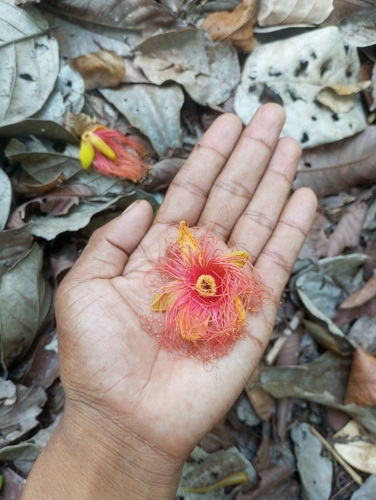
Caryocar cuneatum
Wittmack
Piquiziero
CaryocaraceaeFruit
What to Eat
Edible parts: Fruit
The fruit is edible. It is cultivated as a food plant.
Where to Find It
It is a tropical plant.
Asia, Brazil*, Indonesia, SE Asia, South America,
Countries: United Arab Emirates, Afghanistan, Armenia, Argentina, Azerbaijan, Bangladesh, Bahrain, Brunei, Bolivia, Brazil, Bhutan, Chile, China, Colombia, Ecuador, Georgia, French Guiana, Guyana, Indonesia, Israel, India, Iraq, Iran, Jordan, Japan, Kyrgyzstan, Cambodia, North Korea, South Korea, Kuwait, Kazakhstan, Laos, Lebanon, Sri Lanka, Myanmar, Mongolia, Maldives, Malaysia, Nepal, Oman, Peru, Philippines, Pakistan, Paraguay, Qatar, Saudi Arabia, Singapore, Suriname, Syria, Thailand, Tajikistan, Timor-Leste, Turkmenistan, Turkey, Taiwan, Uruguay, Uzbekistan, Venezuela, Vietnam, Yemen
How to Identify
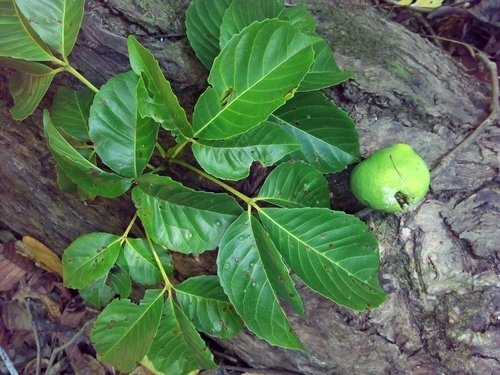
A tree. It grows 15 m tall. The trunk is 35 cm across. The leaves have 3 leaflets. The leaf stalks are 4-7 cm long. The end leaflet is 8-12 cm long by 5-9 cm wide. The fruit are oval and 5 cm long.
Other Information
It is a cultivate food plant.
Notes
The Caryocaraceae occur in tropical America. There are 16 Caryocar species.
Names & Synonyms
Piqui
Caryocar brasiliense var planifolium Wittmack
References (3)
- Grandtner, M. M. & Chevrette, J., 2013, Dictionary of Trees, Volume 2: South America: Nomenclature, Taxonomy and Ecology. Academic Press p 103
- Kermath, B. M., et al, 2014, Food Plants in the Americas: A survey of the domesticated, cultivated and wild plants used for Human food in North, Central and South America and the Caribbean. On line draft. p 182
- Prance, G. T. and Marlene Freitas da Silva, 1973, Caryocaraceae, Flora Neotropica, Vol. 12, Caryocaraceae p 35