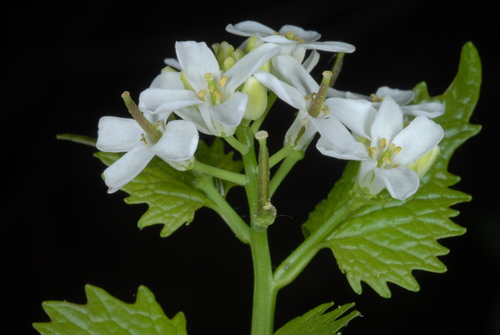
Cakile maritima
Scop.
European sea rocket, Purple Sea Rocket

(c) Bryce Ryals, some rights reserved (CC BY-NC), uploaded by Bryce Ryals
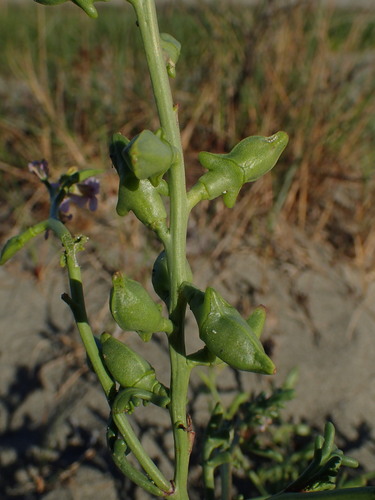
(c) Matthieu Gauvain, some rights reserved (CC BY-NC), uploaded by Matthieu Gauvain

(c) Jackson Corzato, some rights reserved (CC BY-NC), uploaded by Jackson Corzato
What to Eat
Edible parts: Leaves, Seeds, Root, Flowers
Edible Parts: Flowers Leaves Oil Root Seedpod Stem Edible Uses: Condiment Oil Leaves, stems, flower buds and immature seedpods - raw or cooked. They are rich in vitamin C but have a very bitter taste. Used mainly as a flavouring. Very young leaves can be added to salads whilst older leaves can be mixed with milder tasting leaves and used as a potherb[183, K]. Root - dried and ground into a powder, then mixed with cereal flours and used to make bread. A famine food, it is only used in times of scarcity. The seed contains a fatty oil. No more details are given.
Where to Find It
It is a Mediterranean climate plant. The grow near beaches. They grow close to the high water mark. Tasmania Herbarium.
Africa, Argentina, Australia, Canada, Europe*, France, Greece, Italy, Mediterranean, New Zealand, North Africa, North America, Norway, Portugal, Scandinavia, Sicily, Slovenia, South America, Spain, Sweden, Tasmania, Turkey, Türkiye, Uruguay, USA,
How to Identify
A cabbage family herb. It is an annual herb. The stems lie along the ground or bend upwards. It is 15-45 cm long. It has a white taproot. The lower leaves are 3-12 cm long. They normally have lobes arranged like along the stalk. These are oblong. They can have fine teeth along the edge. The flowers are pink to purple and have 4 petals. The fruit are fleshy and green and oval with a point at the end. (Like a rocket!) It has 2 bumps near the tip.
Nutrition Score: 32/100
| Part | Moisture | kJ | kcal | Protein | Vit A | Vit C | Iron | Zinc |
|---|---|---|---|---|---|---|---|---|
| Leaves | 81 | 209 | 51 | 5.3 | — | — | — | — |
| Seed | — | — | — | — | — | — | — | — |
| Root | — | — | — | — | — | — | — | — |
How to Grow
Prefers a light well-drained soil and a sunny position. Plants are easily grown in a garden situation and can self-sow if the ground is disturbed by hoeing etc. This species is closely related to C. edentula, which is native to N. America. The seed is often dispersed by floating in sea water.
Propagation: Seed - sow late spring or early autumn in situ. Germination is usually rapid.
Medicinal Uses
Vitamin C None known
Other Uses
Oil None known Special Uses
Wikipedia
Source ↗Cakile maritima, sea rocket (Britain and Ireland) or European searocket (North America), is a common plant in the mustard family Brassicaceae. It is widespread in Europe, North Africa and western Asia, especially on coastlines. It can now be found in many other areas of the world where it has been introduced. It is present on the west and east coasts of North America, where it has the potential to become an invasive species. This is an annual plant which grows in clumps or mounds in the sand on beaches and bluffs. The shiny leaves are fleshy, green and tinted with purple or magenta, and long-lobed. It has white to light purple flowers and sculpted, segmented, corky brown fruits one to three centimetres long. The fruits float and are water-dispersed.
Production
The young tender shoots are picked and used as flavouring.
Other Information
The leaves and flowers are foraged and eaten in restaurants in Sweden.
Notes
There are 7 Cakile species. The mostly grow near the sea.
Names & Synonyms
Aruca, marina, Arucula di mari, Horned sea rocket, Leaf sea rocket, Strandreddik. Two-horned Sea-rocket
References (30)
- Bianchini, F., Corbetta, F., and Pistoia, M., 1975, Fruits of the Earth. Cassell. p 58
- Biscotti, N. et al, 2018, The traditional food use of wild vegetables in Apulia (Italy) in the light of Italian ethnobotanical literature. Italian Botanist 5:1-24
- Blamey, M and Grey-Wilson, C., 2005, Wild flowers of the Mediterranean. A & C Black London. p 68
- Bodkin, F., 1991, Encyclopedia Botanica. Cornstalk publishing, p 182
- Breidahl H., 1997, Australian Southern Shores. Lothian. p 80
- Cerne, M., 1992, Wild Plants from Slovenia used as Vegetables. Acta Horticulturae 318
- Dashorst, G.R.M., and Jessop, J.P., 1998, Plants of the Adelaide Plains & Hills. Botanic Gardens of Adelaide and State Herbarium. p 68
- Facciola, S., 1998, Cornucopia 2: a Source Book of Edible Plants. Kampong Publications, p 57
- Flora carniolica ed. 2. 2:35. (based on Bunias cakile L.). 1772
- Flora of Australia, Volume 8, Lecythidales to Batales, Australian Government Publishing Service, Canberra (1982) p 251
- Geraci, A., et al, 2018, The wild taxa utilized as vegetables in Sicily (Italy): a traditional component of the Mediterranean diet. Journal of Ethnobiology and Ethnomedicine (2018) 14:14
- Girard, N. J., 2020, Sustainable Foraging of Wild Edible Plants in Norway. A Biocultural Approach. M. Sc. thesis Norwegian University. p 129
- Guil-Guerrero, J. L., et al, 2001, Edible Wild Plants. in Recent Progress in Medicinal Plants Vol. 8 Sci. Tech publishing, Texas
- Harris, S., Buchanan, A., Connolly, A., 2001, One Hundred Islands: The Flora of the Outer Furneaux. Tas Govt. p 125
- Hedrick, U.P., 1919, (Ed.), Sturtevant's edible plants of the world. p 141
- Howells, C & Gulline, H., 2003, Coastal Plants of Tasmania. Plant Identikit. Australian Plant Society, Tasmania. p 39
- http://nordicfood lab/org/blog/2102/9/wild-edible-plants-an-overview
- Hussey, B.M.J., Keighery, G.J., Cousens, R.D., Dodd, J., Lloyd, S.G., 1997, Western Weeds. A guide to the weeds of Western Australia. Plant Protection Society of Western Australia. p 116
- King Island Natural Resource Management Group, 2002, King Island Flora: A Field Guide.
- Lim, T. K., 2015, Edible Medicinal and Non Medicinal Plants. Volume 9, Modified Stems, Roots, Bulbs. Springer p 19
- Low, T., 1991, Wild Herbs of Australia and New Zealand. Angus & Robertson. p 61
- Low, T., 1992, Bush Tucker. Australia’s Wild Food Harvest. Angus & Robertson. p 147
- Luczaj, L. et al, 2012, Wild food plant use in 21st century Europe: the disappearance of old traditions and the search for new cuisines involving wild edibles. Acta Soc Bot Pol 81(4):359–370
- Paczkowska, G. & Chapman, A.R., 2000, The Western Australian Flora. A Descriptive Catalogue. Western Australian Herbarium. p 185
- Pasta, S., et al, 2020, An Updated Checklist of the Sicilian Native Edible Plants: Preserving the Traditional Ecological Knowledge of Century-Old Agro-Pastoral Landscapes. Frontiers in Plant Science. Volume 11|Article 388
- Plants for a Future database, The Field, Penpol, Lostwithiel, Cornwall, PL22 0NG, UK. http://www.scs.leeds.ac.uk/pfaf/
- Seidemann J., 2005, World Spice Plants. Economic Usage, Botany, Taxonomy. Springer. p 72
- Tasmanian Herbarium Vascular Plants list p 16
- Tozer, F., 2007, The Uses of Wild Plants. Green Man Publishing. p 50
- Woolmore, E et al, 2002, King Island Flora: A Field Guide. p 34