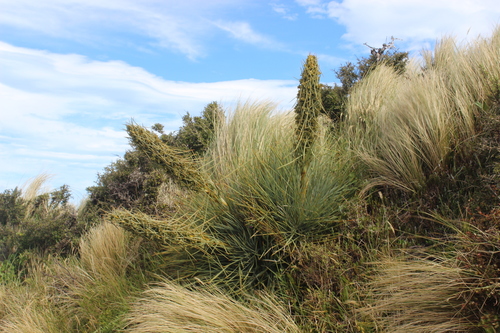
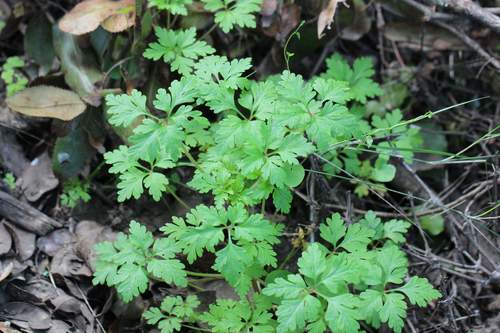
Apium panul
(Bertero ex DC.) Reiche
Panul
iNaturalist · cc-by
(c) Cesar Ormazabal, some rights reserved (CC BY), uploaded by Cesar Ormazabal
(c) Cesar Ormazabal, some rights reserved (CC BY), uploaded by Cesar Ormazabal

wikimedia · cc-by
Wikimedia Commons - Pato Novoa from Valparaíso, Chile
Wikimedia Commons - Pato Novoa from Valparaíso, Chile
What to Eat
Edible parts: Leaves, Roots
Both the leaves and roots are eaten.
Where to Find It
It is a temperate plant. In Argentina it grows from sea level to 2,600 m above sea level.
Argentina, Chile, South America,
How to Identify
A herb. It grows 1 m tall. The lower leaves are twice divided. The leaves on the stem do not have stalks and have leaflets along the leaf.
Names & Synonyms
Apium andinum Phil.Apium angustilobum (Phil.) ReicheApium apioides (Phil.) ReicheApium peucedanoides (C. Presl. ex DC.) ReicheApium philippii H. WolffApium pimpinellifolium (Phil.) ReicheCarum pansii (DC.) Griseb.Ligusticum landbeckii Phil.Ligusticum nemorosum Phil.
References (3)
- Cordero, S. E., Abello, L. A., & Galvez, F. L., 2017, Plantas silvestres comestibles y medicinales de Chile y otras partes del mundo. CORMA p 145
- Ladio, A. H. & Lozada, M., 2000, Edible Plant Use in a Mapuche Community of North-western Patagonia, Human Ecology. Vol. 28, No. 1. pp. 53-71
- Leon-Lobos, P., et al, 2022, Patterns of Traditional and Modern Uses of Wild Edible Native Plants of Chile: Challenges and Future Perspectives. Plants (Basel) v 11 (6) Table S1