Caladium bicolor
(Aiton) Ventenat
Fancy-leaf caladium
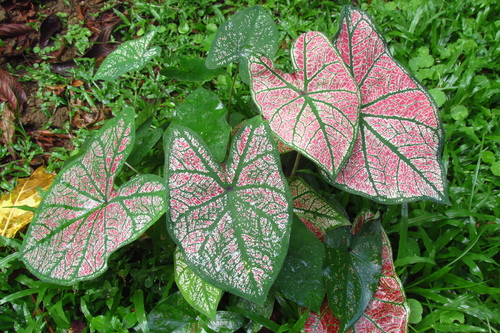
(c) valeria_scura, some rights reserved (CC BY-NC), uploaded by valeria_scura
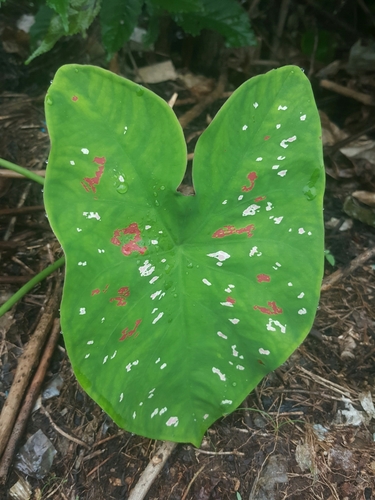
(c) Maxwell C. Obiakara, some rights reserved (CC BY-NC), uploaded by Maxwell C. Obiakara
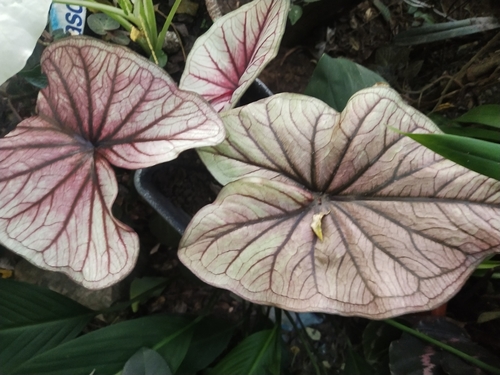
(c) Greg III Espera, some rights reserved (CC BY), uploaded by Greg III Espera
What to Eat
Edible parts: Leaves, Tubers, Root, Seeds, Caution
The leaves are boiled and eaten, particularly in the West Indies. Some varieties (var. poecile and var. velloziana) have edible tubers.
Known Hazards
Where to Find It
A tropical plant. It does best in rich moist soils. It can grow in light shade. It is drought and frost tender. Plants will not grow with temperatures less than 13°C and should have temperatures of 21°C or above. It suits hardiness zones 10-12.
Africa, Amazon, Asia, Australia, Brazil, Burkina Faso, Central Africa, Central America, Colombia, Congo DR, Ecuador, Guatemala, Guianas, Guyana, India, Indonesia, Kiribati, Korea, Marquesas, Marshall Islands, Micronesia, Myanmar, Nauru, Nepal, Niue, Pacific, Pan tropical, Papua New Guinea, PNG, Peru, Philippines, Samoa, Sao Tome and Principe, SE Asia, Sierra Leone, South America, Suriname, Tuvalu, Venezuela, West Africa, West Indies,
How to Identify
A perennial plant. It grows to 50 cm tall and spreads to 1 m wide. The roots form round tubers. The stem is slender and erect and produces a flower at the top. The leaves arise directly from the base and are large and arrow shaped. The leaf stalk joins to the middle of the leaf underneath. (Not the edge). Leaves are 15-30 cm long. They have patterns of pink and green. The flower is creamy white and lily like.
How to Grow
Plants are grown by dividing the tubers. They are planted 5 cm deep. Plants are spaced 30 cm apart.
Propagation: Seed - Division.
Medicinal Uses
The powdered tuber is used to treat facial skin blemishes. All parts of the leaf are macerated in fresh water for an external bath to remedy numerous maladies of children. Crushed leaves are used in veterinary medicine to destroy vermin on sores of cattle. The juice of the stems is used in the form of an enema to expel roundworms. When applied to the skin, the juice destroys maggots.
Wikipedia
Source ↗Caladium bicolor, called Heart of Jesus, is a species in the genus Caladium from Latin America. It is grown as a houseplant for its large, heart or lance-shaped leaves with striking green, white, pink, and red blotching. Hundreds of cultivars are available. (See List of Caladium cultivars.) It can be planted outside in USDA Hardiness Zone 10 as an ornamental. It is a problematic invasive species in Trinidad and Tobago, Guam, Micronesia, Palau, Hawaii and the Philippines, and naturalized populations can be found in most of the rest of the world's tropics, including Africa, the Indian subcontinent, southeast Asia and Malesia.
Other Information
It is not known if they are used for food in Papua New Guinea.
Notes
It is mostly grown as an ornamental plant. There are (7) 12-17 Caladium species.
Names & Synonyms
Angel's wings, Elephant Ears, Karkala phul, Keladi warna-warni, Machakuy manti, Manchup, Maru papachini, Talotalo, Tuka, Ushu
References (24)
- Bennett, B. C., 1990, Useful Plants of Amazonian Ecuador. US Agency for International Development. Fifth Progress Report. New York Botanical Gardens. p 40
- Bircher, A. G. & Bircher, W. H., 2000, Encyclopedia of Fruit Trees and Edible Flowering Plants in Egypt and the Subtropics. AUC Press. p 72 (Also as Caladium sororium)
- Bodkin, F., 1991, Encyclopedia Botanica. Cornstalk publishing, p 187
- Borrell, O.W., 1989, An Annotated Checklist of the Flora of Kairiru Island, New Guinea. Marcellin College, Victoria Australia. p 15
- Brickell, C. (Ed.), 1999, The Royal Horticultural Society A-Z Encyclopedia of Garden Plants. Convent Garden Books. p 200
- Burnie, G.(Ed.), 2003, Annuals and Bulbs. The Gardener's Handbooks. Fog City Press. p 248
- Cundall, P., (ed.), 2004, Gardening Australia: flora: the gardener's bible. ABC Books. p 277
- Henty, E.E., 1980, Harmful Plants in Papua New Guinea. Botany Bulletin No 12. Division Botany, Lae, Papua New Guinea. p 23
- Hibbert, M., 2002, The Aussie Plant Finder 2002, Florilegium. p 48
- Katz, E., et al, 2012, No greens in the forest? Note on the limited consumption of greens in the Amazon. Acta Soc Bot Pol 81(4):283–293
- Kermath, B. M., et al, 2014, Food Plants in the Americas: A survey of the domesticated, cultivated and wild plants used for Human food in North, Central and South America and the Caribbean. On line draft. p 159
- Kuhnlein, H. V., et al, 2009, Indigenous Peoples' food systems. FAO Rome p 82
- Latham, P. & Mbuta, A. K., 2014, Useful Plants of Bas-Congo Province, Democratic Republic of Congo. Volume 1. Salvation Army. p 94
- Mag. Encycl. 4(16):464. [22 Dec 1800-21 Jan] 1801 (Descr. pl. nouv. ad t. 30. 1801 Mar)
- Martin, F.W. & Ruberte, R.M., 1979, Edible Leaves of the Tropics. Antillian College Press, Mayaguez, Puerto Rico. p 176
- Parham, B. E. V., 1972, Plants of Samoa. New Zealand Department of Scientific and Industrial Research. Information Series. No. 85 p 120
- Peekel, P.G., 1984, (Translation E.E.Henty), Flora of the Bismarck Archipelago for Naturalists, Division of Botany, Lae, PNG. p 75, 73
- Sukarya, D. G., (Ed.) 2013, 3,500 Plant Species of the Botanic Gardens of Indonesia. LIPI p 1085
- Terra, G.J.A., 1973, Tropical Vegetables. Communication 54e Royal Tropical Institute, Amsterdam, p 34
- Thaman, R. R., et al, 1994, The Flora of Nauru. Atoll Research Bulletin No. 392. Smithsonian Institute p 40
- Thaman, R. R, 2016, The flora of Tuvalu. Atoll Research Bulletin No. 611. Smithsonian Institute p 38
- Torre, de la L., et al, 2008, Enciclopedia de las Plantas Útiles del Ecuador. Herbario QCA. Pontificia Universidad Católica del Ecuador. p 183
- Vander Velde, N, 2003, The Vascular Plants of Majuro Atoll, Republic of the Marshall Islands. Atoll research Bulletin. No. 503. Smithsonian Institute. p 16
- World Checklist of Useful Plant Species 2020. Royal Botanic Gardens, Kew


