Bromus inermis
Leyss
Smooth brome
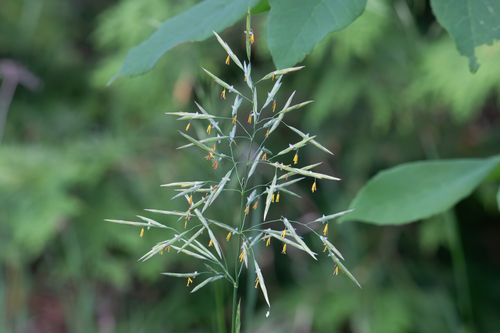
(c) Jeremy Graves, some rights reserved (CC BY-NC), uploaded by Jeremy Graves
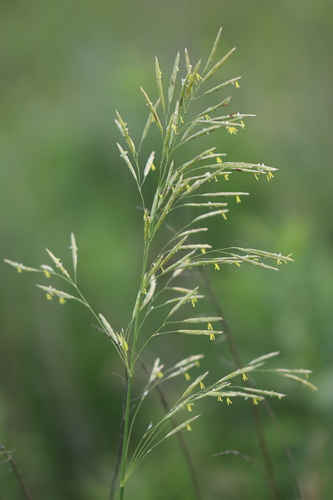
(c) Johnny Baakliny, some rights reserved (CC BY-NC), uploaded by Johnny Baakliny
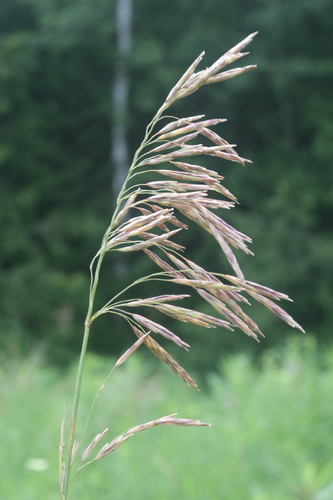
(c) Don Sutherland, some rights reserved (CC BY-NC), uploaded by Don Sutherland
What to Eat
Edible parts: Seeds, Cereal
None known
Where to Find It
It is a temperate plant. It grows on mountain meadows between 1,000-3,500 m above sea level in China. It grows in wetlands.
Argentina, Asia, Balkans, Britain, Caucasus, Central Asia, China, East Africa, Europe, Japan, Kazakhstan, Korea, Kyrgyzstan, Luxembourg, Macedonia, Mongolia, North America, Pakistan, Russia, Siberia, South America, Tajikistan, Tibet, Uruguay, USA, Uzbekistan, Zimbabwe,
How to Identify
A grass that keeps growing from year to year. It has underground stem or rhizomes. It can be in loose tufts. It grows 120 cm high. The leaf blades are 35 cm long by 4-8 mm wide. The flowers are usually dense and 10-20 cm long. The spiklets are narrow and oblong.
How to Grow
Best adapted to regions with moderate rainfall and moderate cool summer temperatures, it is suited to silt or clay soils and deep loams, but also does well on light sandy soils and on well-drained soils. Plants are less drought resistant than crested wheatgrass and they do not tolerate temperature extremes. Smooth brome is suited for irrigated areas but is not recommended for saline or alkali soils. Smooth brome is reported to tolerate an annual precipitation of 32 to 176cm, an annual average temperature range of 4.3 to 19.9°C and a pH in the range of 4.9 to 8.2. Smooth brome is also reported to tolerate alkali conditions, disease, drought, frost, fungi, grazing, mycobacterium, salt, viruses, and weeds.. There are a number of named varieties, selected mainly as hay and pasture crops. These cultivars are divided into two groups, northern and southern. The southern group is less cold-hardy and does not survive average winter conditions further north than southern Minnesota in N. America, the northern group is much more cold tolerant. The genus Bromus contains many complex, polyploid series. Bromus inermis belongs to section Bromopsis, containing wild species with chromosome numbers ranging from 2x to 8x. Following its introduction to North America, smooth broome, an aggressive species, has tended to replace native American species of sect. Bromopsis, especially B. pumpellianus. Hybridization studies have been made between: B. inermis, 8x; B. pumpellianus, 8x; and material of the introduced B. erectus complex (6x, 8x, 10x, though the last is probably itself hybrid). An objective of these studies was to incorporate into inermis the larger seeds of pumpellianus and better seedling vigour of erectus. The three species are related, crossable and give quite fertile hybrids. Collections of B. inermis in North America show varying meiotic irregularity and aneuploidy. This is probably a result of introgression from B. pumpellianus and the B. erectus complex. Quite a high degree of meiotic irregularity may be tolerated under natural conditions in a long lived, cross- pollinated species such as B. inermis, which can spread aggressively by rhizomes.
Propagation: Seed - sow spring in situ. The seedbed should be firm and seed should not be covered to more than 6 - 13 mm depth. Seed rates of 3.3 kilos per hectare are used when the plant is sown in a pure stand, though it is more often sown in a mixture with various legumes such as alfalfa, sweet clover, red clover or Lotus corniculatus. There are approximately 300,000 seeds per kilo.
Medicinal Uses
None known
Other Uses
Soil stabilization An excellent plant to grow for controlling soil erosion because of its fast-growing interlocking root system. It is especially valuable in semi-arid regions, such as the Prairie Provinces of Canada and the Great Plains of the United States. Growth starts early in spring with a further period of growth in early autumn under favourable moisture conditions. Special Uses
Wikipedia
Source ↗Bromus inermis is a species of the true grass family (Poaceae). This rhizomatous grass is native to Europe and considered invasive in North America. The plant is an erect, leafy, long-lived perennial, 46 to 91 cm (1+1⁄2 to 3 ft) tall, rhizomatous and commonly producing a dense sod. It starts growth in early spring; flowers May to July; reproduces from seeds, tillers, and rhizomes. It may regrow and re flower in the fall if moisture is sufficient. The leaves are glabrous or occasionally pubescent, particularly on the sheaths; blades 20 to 38 cm (8 to 15 in) long, 0.6 to 1.3 cm (1⁄4 to 1⁄2 in) wide, flat, with a raised and keeled midrib below; sheaths closed, except near collar, and papery when dry; leaves rolled in the bud; ligates up to 0.3 cm (1⁄8 in) long, rounded, and membranous; auricles absent.
Names & Synonyms
Awnless bromegrass, Hungarian brome
References (3)
- Crate, S. A., 2008, "Eating Hay": The Ecology, Economy and Culture of Viliui Sakha Smallholders of Northeastern Siberia. Human Ecology 36:161-174
- Flora of Pakistan. www.eFloras.org
- Zhang, Y., et al, 2014, Diversity of wetland plants used traditionally in China: a literature review. Journal of Ethnobiology and Ethnomedicine. 10:72


