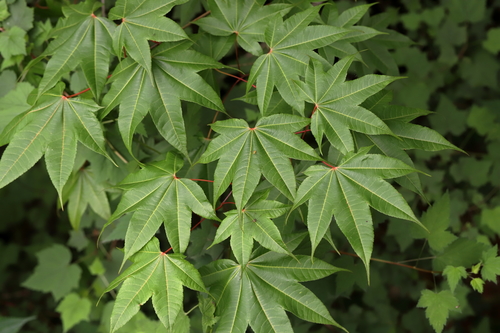
Acer pseudoplatanus
L.
Plane-tree maple

(c) Willow, some rights reserved (CC BY-SA)

(c) Willow, some rights reserved (CC BY-SA)

(c) Stephen James McWilliam, some rights reserved (CC BY)
What to Eat
Edible parts: Sap, Seeds, Leaves - flavour, Flowers - tea.
Sycamore is planted in parks for ornamental purposes, and sometimes as a street tree, for its tolerance of air pollution makes it suitable for use in urban plantings. Owing to its tolerance to wind, it has often been planted in coastal and exposed areas as a windbreak. It produces a hard-wearing, white or cream close-grained timber that turns golden with age. The wood can be worked and sawn in any direction and is used for making musical instruments, furniture, joinery, wood flooring and parquetry. Because it is non-staining, is used for kitchen utensils, wooden spoons, bowls, rolling pins and chopping boards. In Scotland it has traditionally been used for making fine boxes, sometimes in association with contrasting, dark-coloured laburnum wood. Occasionally, trees produce wood with a wavy grain, greatly increasing the value for decorative veneers. The wood is a medium weight for a hardwood, weighing 630 kg per cubic metre. It is a traditional wood for use in making the backs, necks and scrolls of violins. The wood is often marketed as rippled sycamore. Whistles can be made from straight twigs when the rising sap allows the bark to be separated, and these, and sycamore branches, are used in customs associated with early May in Cornwall. The wood is used for fuel, being easy to saw and to split with an axe, producing a hot flame and good embers when burnt. In Scotland, sycamores were once a favoured tree for hangings, because their lower branches rarely broke under the strain. Both male and female flowers produce abundant nectar, which makes a fragrant, delicately flavoured and pale-coloured honey. The nectar and copious dull yellow ochre pollen are collected by honeybees as food sources. The sap rises vigorously in the spring and like that of sugar maple can be tapped to provide a refreshing drink, as a source of sugar and to make syrup or beer.
Known Hazards
Where to Find It
It is a temperate plant. A plant native to Europe. It prefers deep fertile soil. It needs to be well drained soil and the plant does best in an open sunny position. It is frost resistant but damaged by drought. It can tolerate salty winds and grow near the coast. It has become naturalised in Tasmania. It suits hardiness zones 4-8. Kyneton Botanical Gardens. Tasmania Herbarium. Arboretum Tasmania.
Albania, Argentina, Australia, Balkans, Bosnia, Britain, Canada, Caucasus, Czech Republic, Estonia, Europe, Georgia, Greece, Luxembourg, Mediterranean, Middle East, North America, Poland, Romania, Slovakia, Slovenia, South America, Spain, Switzerland, Tasmania, Turkey, Türkiye, USA,
How to Identify
A shrub or small tree. It grows 5 m tall. There are prickles along the stem. The leaves are twice divided and there are 8-18 pairs of pinnae. There are up to 50 pairs of pinnules on each pinnae. The flowers are yellow. They are in large clusters at the ends of branches. The pods are flattened.
How to Grow
Grows well in heavy clay soils. Chlorosis can sometimes develop as a result of iron deficiency when the plants are grown in alkaline soils, but in general maples are not fussy as to soil pH. Dislikes wet soils. Grows better in the cooler areas of the country. Very wind-resistant, tolerating maritime exposure though it is often wind and salt pruned in very exposed areas. A fairly aggressive tree, it self-sows freely and inhibits the growth of nearby plants. It is often one of the first trees to colonize open land. It is fast growing and establishes rapidly. It can supplant native trees, at least in the short-term, though recent evidence suggests that in the long term it does not usually become the dominant tree in British woodlands and it is often recommended for planting in broad-leaved woods by the Forestry Commission, especially in windy areas. Plants are subject to sooty bark disease - this is not fatal and occurs most often in years that follow hot summers. There are many named forms that have been selected for their ornamental value. Trees take 25 years to come into bearing from seed. In garden design, as well as the above-ground architecture of a plant, root structure considerations help in choosing plants that work together for their optimal soil requirements including nutrients and water.
Propagation: Sow fresh seed immediately in a cold frame, usually germinating the following spring. For stored seed, soak 24 hours then stratify at 1-8°c for 2-4 months; keep seeds above 35% moisture. Harvest seed 'green' (fully developed but undried) and sow immediately for late-winter germination. Prick out seedlings into individual pots when large enough, growing to 20cm+ before planting out. Layering takes about 12 months. Take cuttings of young shoots in June or July with 2-3 leaf pairs plus one terminal bud pair; remove a thin bark slice at the base and use rooting hormone. Rooted cuttings must show new summer growth before potting up. Cultivars can be budded onto species rootstock; graft in September rather than February.
Medicinal Uses
The bark has mild astringent properties, used as a wash for skin problems and an eyewash for sore eyes. The inner bark containing sweet sap serves as a wound dressing.
Other Uses
Trees are fast-growing, making good windbreaks in exposed and maritime areas; commonly used in shelterbelt plantings. They typically self-sow freely and pioneer disused farmland and cleared woodlands, making them excellent pioneer species for woodland regeneration. Over 200+ years, native species gradually displace this species. Leaves packed around apples and root crops aid preservation. Wood is very hard, heavy, elastic, and easy to work, fairly insect-resistant, used for carving, small domestic items, and veneer. It makes excellent fuel and quality charcoal.
Wikipedia
Source ↗Sycamore Maple is a fast-growing deciduous tree reaching 30 m tall and 15 m wide. Flowers appear April to June with seeds ripening September to October. The tree is monoecious and bee-pollinated. It thrives in light sandy, medium loamy, and heavy clay soils, tolerating heavy clay and nutrient-poor soils while preferring well-drained conditions. It grows in semi-shade or full sun, prefers moist soil, tolerates maritime exposure, and is hardy to UK zone 5.
Production
It is a fast growing tree. Trees can take 25 years to come into bearing from seed. They make good windbreaks in seaside areas. Trees can live for 200 years.
Other Information
Children suck the sweet sap from the keys.
Notes
There are about 120-150 Acer species. This one can become invasive.
Names & Synonyms
Beli javor, Hegyi juhar, Javor, Javorfa, Maple, Mock plane, Nchkhali, ekerPurple Sycamore, Sycamore maple, Whistlewood
References (33)
- Biocyclopedia Edible Plant Species
- Bircher, A. G. & Bircher, W. H., 2000, Encyclopedia of Fruit Trees and Edible Flowering Plants in Egypt and the Subtropics. AUC Press. p 6
- Bodkin, F., 1991, Encyclopedia Botanica. Cornstalk publishing, p 42
- Brickell, C. (Ed.), 1999, The Royal Horticultural Society A-Z Encyclopedia of Garden Plants. Convent Garden Books. p 68
- Bussman, R. W., et al, 2016, A comparative ethnobotany of Khevsureti, Samtskhe-Javakheti, Tusheti, Svaneti, and Racha-Lechkhumi, Republic of Georgia (Sakartvelo), Caucasus. Journal of Ethnobiology and Ethnomedicine.
- Bussman, R. W. et al, 2017, Ethnobotany of Samtskhe-Javakheti, Sakartvelo (Republic of Georgia), Caucasus. Indian Journal of Traditional Knowledge Vol. 16(1) pp 7-24
- Bussman, R. W., et al, 2021, Unity in diversity—food plants and fungi of Sakartvelo (Republic of Georgia), Caucasus. Journal of Ethnobiology and Ethnomedicine (2021) 17:72 p 14
- Coombes, A.J., 2000, Trees. Dorling Kindersley Handbooks. p 99
- Cronin, L., 1989, The Concise Australian Flora. Reed. p 169
- Cundall, P., (ed.), 2004, Gardening Australia: flora: the gardener's bible. ABC Books. p 88
- Denes, A., et al, 2012, Wild plants used for food by Hungarian ethnic groups living inthe Carpathian Basin. Acta Societatis Botanicorum Poloniae 81 (4): 381-396
- Etherington, K., & Imwold, D., (Eds), 2001, Botanica's Trees & Shrubs. The illustrated A-Z of over 8500 trees and shrubs. Random House, Australia. p 68
- Facciola, S., 1998, Cornucopia 2: a Source Book of Edible Plants. Kampong Publications. p 1
- Farrar, J.L., 1995, Trees of the Northern United States and Canada. Iowa State University press/Ames p 153
- Harris, E & J., 1983, Field Guide to the Trees and Shrubs of Britain. Reader's Digest. p 128
- Harter, J.(Ed.), 1988, Plants. 2400 copyright free illustrations. Dover p 3.4, 3.7
- Hedrick, U.P., 1919, (Ed.), Sturtevant's edible plants of the world. p 22
- Lazarides, M. & Hince, B., 1993, Handbook of Economic Plants of Australia, CSIRO. p 8
- Little, E.L., 1980, National Audubon Society Field Guide to North American Trees. Alfred A. Knopf. p 576
- Lord, E.E., & Willis, J.H., 1999, Shrubs and Trees for Australian gardens. Lothian. p 45
- Łukasz Łuczaj and Wojciech M Szymański, 2007, Wild vascular plants gathered for consumption in the Polish countryside: a review. J Ethnobiol Ethnomedicine. 3: 17
- Lukasz, L., 2016, Wild Edible Plants Traditionally Used in Poland.
- Marinelli, J. (Ed), 2004, Plant. DK. p 443
- Morley, B.D., & Toelken, H.R., (Eds), 1983, Flowering Plants in Australia. Rigby. p 201
- Morley, B. & Everard, B., 1970, Wild Flowers of the World. Ebury press. Plate 19
- Plants for a Future database, The Field, Penpol, Lostwithiel, Cornwall, PL22 0NG, UK. http://www.scs.leeds.ac.uk/pfaf/
- Redzic, S. J., 2006, Wild Edible Plants and their Traditional Use in the Human Nutrition in Bosnia-Herzegovina. Ecology of Food and Nutrition, 45:189-232
- Schuler, S., (Ed.), 1977, Simon & Schuster's Guide to Trees. Simon & Schuster. No. 76
- Sfikas, G., 1984, Trees and shrubs of Greece. Efstathiadis Group. Athens. p 112
- Simkova, K. et al, 2014, Ethnobotanical review of wild edible plants used in the Czech Republic. Journal of Applied Botany and Food Quality 88, 49-67
- Sp. pl. 2:1054. 1753
- Svanberg, I. et al, 2012, Uses of tree saps in northern and eastern parts of Europe. Acta Societatis Botanicorum Poloniae 81 (4): 343-357
- Young, J., (Ed.), 2001, Botanica's Pocket Trees and Shrubs. Random House. p 62