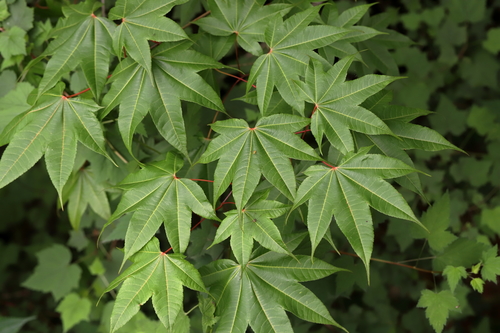
Acer rubrum
L.
Red maple

no rights reserved, uploaded by mefisher
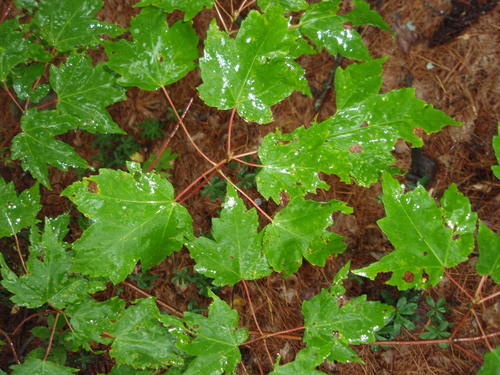
(c) Liv MW, some rights reserved (CC BY-NC-SA), uploaded by Liv MW

(c) Dcrjsr, some rights reserved (CC BY)
What to Eat
Edible parts: Sap, Seeds, Leaves, Bark
The sap contains sugar and can be drunk fresh or boiled down into a syrup used as a sweetener on many foods. This species yields only about half the quantity obtained from the sugar maple (A. saccharum), though it makes a good maple syrup. Harvest in late winter; the flow is best on warm sunny days following a frost, and the best production comes from cold-winter areas with continental climates. Self-sown seedlings gathered in early spring can be eaten fresh or dried for later use. The seeds are cooked — wings removed, then boiled and eaten hot; they are very small, about 5mm long, and produced in small clusters. The inner bark is dried, ground into a powder, and used as a thickener in soups or mixed with cereals when making bread.
Known Hazards
Where to Find It
It is a temperate plant. A native of north America. It requires deep fertile soils. It needs a sheltered position and is best in light shade. It is frost resistant but is damaged by drought. It can grow in acid soils. Often it grows in swamps and on moist soils. It suits hardiness zones 4-8. Arboretum Tasmania.
Australia, Britain, Canada, Europe, Middle East, North America, Russia, Tasmania, Turkey, Türkiye, USA,
How to Identify
A shrub or small tree. It grows 5 m tall. There are prickles along the stem. The leaves are twice divided and there are 8-18 pairs of pinnae. There are up to 50 pairs of pinnules on each pinnae. The flowers are yellow. They are in large clusters at the ends of branches. The pods are flattened.
How to Grow
Grows well in heavy clay soils. Dislikes chalk according to one report, whilst others say that it does less well on chalk, often becoming chlorotic as a result of iron deficiency. Prefers a sunny position but tolerates some shade. Tolerates atmospheric pollution. A fast-growing tree for the first 20 - 30years of its life, it may live for 75 - 100 years. Red maple is a bad companion plant, inhibiting the growth of nearby plants. A variable species with several sub-species, there are also many named varieties that have been selected for their ornamental value. This species is often confused with A. saccharinum.
Propagation: Seed is best sown as soon as it is ripe in spring in a cold frame, usually germinating immediately; by the end of summer the seedling will have formed a small tree with several pairs of leaves. Stored seed loses viability quickly. Pre-soak stored seed for 24 hours then stratify for 2–4 months at 1–8°C; germination can be slow. Prick seedlings out into individual pots and grow on until 20cm or more tall before planting out. Layering takes about 12 months and is successful with most species in this genus. For cuttings taken in June or July, use young shoots with 2–3 pairs of leaves plus one pair of buds at the base; remove a thin slice of bark at the base and use a rooting hormone. Rooted cuttings must put on new growth during summer before being potted up, or they are unlikely to survive winter.
Medicinal Uses
The bark has astringent properties and has been applied to sore eyes. An infusion of the bark has been used to treat cramps and dysentery.
Other Uses
Leaves packed around apples and rootcrops help preserve them. Boiling the inner bark yields a purple colour; mixed with lead sulphate this produces a black dye that can also serve as an ink, though another report describes the colour as dark blue. The wood is used to make basket splints. This species can establish itself in recently cleared areas and partially open woodlands, making it useful as a pioneer species to speed woodland regeneration. The wood is not strong, close-grained, hard, and very heavy at 38lb per cubic foot; some old specimens have an undulated grain that produces beautiful light-and-shade effects on polished surfaces. It is commonly used for furniture, turnery, and pulp.
Wikipedia
Source ↗Acer rubrum, the red maple, also known as swamp maple, water maple, or soft maple, is one of the most common and widespread deciduous trees of eastern and central North America. The U.S. Forest Service recognizes it as the most abundant native tree in eastern North America. The red maple ranges from southeastern Manitoba around the Lake of the Woods on the border with Ontario and Minnesota, east to Newfoundland, south to Florida, and southwest to East Texas. Many of its features, especially its leaves, are quite variable in form. At maturity, it often attains a height around 30 m (100 ft). Its flowers, petioles, twigs, and seeds are all red to varying degrees. Among these features, however, it is best known for its brilliant deep scarlet foliage in autumn. Over most of its range, red maple is adaptable to a very wide range of site conditions, perhaps more so than any other tree in eastern North America. It can be found growing in swamps, on poor, dry soils, and almost anywhere in between. It grows well from sea level to about 900 m (3,000 ft). Due to its attractive fall foliage and pleasing form, it is often used as a shade tree for landscapes. It is used commercially on a small scale for maple syrup production and for its medium to high quality lumber. It is the state tree of Rhode Island. The red maple can be considered weedy or even invasive in young, highly disturbed forests, especially frequently logged forests. In a mature or old-growth northern hardwood forest, red maple only has a sparse presence, while shade-tolerant trees such as sugar maples, beeches, and hemlocks thrive. By removing red maple from a young forest recovering from disturbance, the natural cycle of forest regeneration is altered, changing the diversity of the forest for centuries to come.
Production
Trees live for 100 years.
Notes
There are about 120-150 Acer species.
Names & Synonyms
Canadian Maple, Curled Maple, Scarlet maple, Swamp maple
References (26)
- Beckstrom-Sternberg, Stephen M., and James A. Duke. "The Foodplant Database." http://probe.nalusda.gov:8300/cgi-bin/browse/foodplantdb.(ACEDB version 4.0 - data version July 1994)
- Bircher, A. G. & Bircher, W. H., 2000, Encyclopedia of Fruit Trees and Edible Flowering Plants in Egypt and the Subtropics. AUC Press. p 6
- Bodkin, F., 1991, Encyclopedia Botanica. Cornstalk publishing, p 43
- Brickell, C. (Ed.), 1999, The Royal Horticultural Society A-Z Encyclopedia of Garden Plants. Convent Garden Books. p 68
- Coombes, A.J., 2000, Trees. Dorling Kindersley Handbooks. p 100
- Cundall, P., (ed.), 2004, Gardening Australia: flora: the gardener's bible. ABC Books. p 88
- Duke, J.A., 1992, Handbook of Edible Weeds. CRC Press. p 16
- Elias, T.S. & Dykeman P.A., 1990, Edible Wild Plants. A North American Field guide. Sterling, New York p 257
- Etherington, K., & Imwold, D., (Eds), 2001, Botanica's Trees & Shrubs. The illustrated A-Z of over 8500 trees and shrubs. Random House, Australia. p 69
- Facciola, S., 1998, Cornucopia 2: a Source Book of Edible Plants. Kampong Publications. p 1
- Farrar, J.L., 1995, Trees of the Northern United States and Canada. Iowa State University press/Ames p 140
- Grandtner, M. M., 2008, World Dictionary of Trees. Wood and Forest Science Department. Laval University, Quebec, Qc Canada. (Internet database http://www.WDT.QC.ca)
- Harris, E & J., 1983, Field Guide to the Trees and Shrubs of Britain. Reader's Digest. p 132
- Harter, J.(Ed.), 1988, Plants. 2400 copyright free illustrations. Dover p 3.2
- Hedrick, U.P., 1919, (Ed.), Sturtevant's edible plants of the world. p 22
- Kermath, B. M., et al, 2014, Food Plants in the Americas: A survey of the domesticated, cultivated and wild plants used for Human food in North, Central and South America and the Caribbean. On line draft. p 10
- Joyce, D., 1998, The Garden Plant Selector. Ryland, Peters and Small. p 106
- Little, E.L., 1980, National Audubon Society Field Guide to North American Trees. Alfred A. Knopf. p 577
- Lord, E.E., & Willis, J.H., 1999, Shrubs and Trees for Australian gardens. Lothian. p 45
- Lyle, S., 2006, Discovering fruit and nuts. Land Links. p 46
- MacKinnon, A., et al, 2009, Edible & Medicinal Plants of Canada. Lone Pine. p 66
- Plants for a Future database, The Field, Penpol, Lostwithiel, Cornwall, PL22 0NG, UK. http://www.scs.leeds.ac.uk/pfaf/
- Schuler, S., (Ed.), 1977, Simon & Schuster's Guide to Trees. Simon & Schuster. No. 78
- Sp. pl. 2:1055. 1753
- Toupal, R. S. & Hollenback, K., 2009, An Ethnobotany of Indiana Dunes National Lakeshore: Plant Uses of the Ojibwa People. Bureau of Applied research in Anthropology. University of Arizona
- Young, J., (Ed.), 2001, Botanica's Pocket Trees and Shrubs. Random House. p 63