Ostericum sieboldii
(C. B. Clarke) Ridley
Shan qin

(c) V.S. Volkotrub, some rights reserved (CC BY-NC), uploaded by V.S. Volkotrub
(c) onidiras-iNaturalist, some rights reserved (CC BY-NC)
What to Eat
Edible parts: Seedlings, Leaves, Vegetable
The young plants and seedlings are eaten as a spring vegetable.
Where to Find It
It is a temperate plant. It grows in forest ravines between 600-1,200 m altitude in north China.
Asia, China, Japan, Korea, Russia, Siberia,
How to Identify
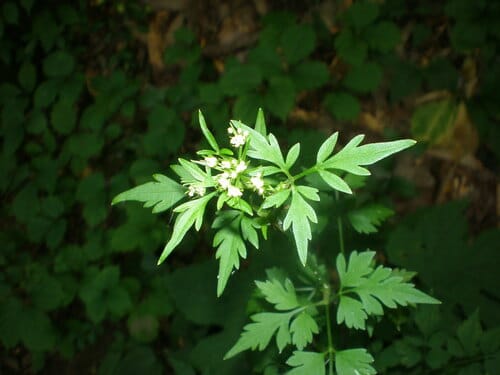
An erect herb. It keeps growing from year to year. It grows 1 m high. The stems are hollow and branched towards the ends. They have ridges. The leaves both at the base and along the stem are divided 3 times. They are on slender leaf stalks that form sheaths around the stem at the base. The last segments are oval and 3-12 cm long by 2-6 cm wide. They have teeth. The flowers are white and in compound heads 4-8 cm across made up of about 20 flowers. The fruit are 4-6 mm long by 4 mm wide and have ribs and wings.
References (2)
- Flora of China. www.eFloras.org
- Hu, Shiu-ying, 2005, Food Plants of China. The Chinese University Press. p 601