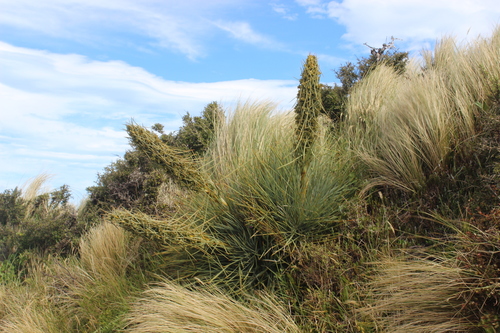
Ostericum viridiflorum
(Turczaninow) Kitagawa
Lu hua shan qin

iNaturalist · cc-by-nc
(c) V.S. Volkotrub, some rights reserved (CC BY-NC), uploaded by V.S. Volkotrub
(c) V.S. Volkotrub, some rights reserved (CC BY-NC), uploaded by V.S. Volkotrub

iNaturalist · cc-by-nc
(c) sergeyprokopenko, some rights reserved (CC BY-NC)
(c) sergeyprokopenko, some rights reserved (CC BY-NC)
What to Eat
Edible parts: Seedlings, Vegetable
Young plants and seedlings are eaten as a spring vegetable.
Where to Find It
It is a temperate plant. It grows in damp meadows and near streams in north China between 800-1,100 m altitude.
Asia, China, Russia, Siberia,
Countries: United Arab Emirates, Afghanistan, Armenia, Azerbaijan, Bangladesh, Bahrain, Brunei, Bhutan, China, Georgia, Indonesia, Israel, India, Iraq, Iran, Jordan, Japan, Kyrgyzstan, Cambodia, North Korea, South Korea, Kuwait, Kazakhstan, Laos, Lebanon, Sri Lanka, Myanmar, Mongolia, Maldives, Malaysia, Nepal, Oman, Philippines, Pakistan, Qatar, Russia, Saudi Arabia, Singapore, Syria, Thailand, Tajikistan, Timor-Leste, Turkmenistan, Turkey, Taiwan, Uzbekistan, Vietnam, Yemen
How to Identify
A herb. It grows 0.5-1 m tall. The roots are cone shaped. The stems are angled and purplish-green. They are hairy. The leaf stalks are angled and 10 cm long. The leaves are oval or triangle shaped and 10-15 cm long by 15-20 cm wide. They are twice divided. The leaflets are oblong and 4-7 cm long by 2-4 cm wide.
References (1)
- Flora of China. www.eFloras.org