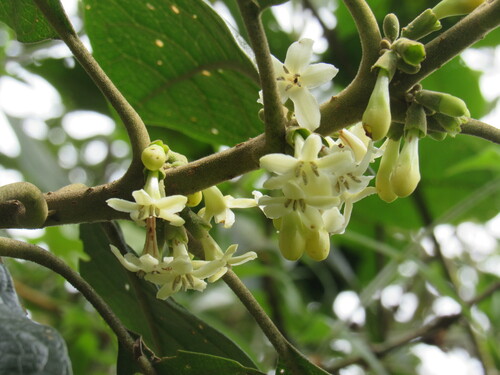
Clerodendrum paniculatum
L.
Pagoda flower

(c) atomiclauren, some rights reserved (CC BY-NC), uploaded by atomiclauren

(c) jeanmorehouse, some rights reserved (CC BY-NC)
What to Eat
Edible parts: Leaves
The leaves are eaten.
Where to Find It
It is a tropical plant. In southern China it grows in wet places between 100-500 m above sea level. At ECHO.
Andaman Is., Asia, Australia, Bangladesh, Cambodia, Central America, China, Costa Rica, Fiji, Honduras, Indochina, Indonesia, Laos, Nauru, Malaysia, Marianas, Myanmar, North America, Northeastern India, Pacific, Panama, Papua New Guinea, PNG, SE Asia, Sri Lanka, Taiwan, Thailand, Trinidad-Tobago, USA, Vietnam,
How to Identify
A herb. It keeps growing from year to year. It grows 1-2 m tall. The branches can be angular and hollow. The leaves are 4-15 cm long by 7-20 cm wide or larger. They are broadly oval and can have 3-7 lobes. The base is heart shaped. There can be teeth along the edge. The flowering shoots are in the axils of leaves or at the ends of branches. There are many flowers in a group 45 cm long. The fruit is fleshy and green to blue turning black when ripe.
How to Grow
Plants can be grown from seeds and cuttings.
Propagation: Seed - Softwood cuttings Cuttings of half-ripe wood Root cuttings Division of suckers
Medicinal Uses
An infusion of the leaves is drunk as a purgative. The leaves are used as a poultice for treating burns, wounds and ulcers. A poultice of the pounded leaves, combined with the leaves of Merremia vitifolia, is applied as a poultice on a distended stomach. The roots enter in prescriptions for afflictions as diverse as pulmonary problems, oedema, haematuria and rheumatism. In Thailand, various parts are used for their anti-inflammatory properties. The root is used as an antimalarial, carminative and against tuberculosis. The leaves are used for chest pain in general
Wikipedia
Source ↗Clerodendrum paniculatum, the pagoda flower, is a species of flowering plant in the genus Clerodendrum of the Mint Family (Lamiaceae). It is native to tropical Asia and Papuasia (southern China including Taiwan, Indochina, southern India, Bangladesh, Sri Lanka, Andaman & Nicobar Islands, Borneo, Sulawesi, Sumatra, Philippines, Bismarck Archipelago), Fiji, and French Polynesia. It is introduced in Central America. It is noted for its red flowers, arranged in a thyrsoid cyme up to 40 cm (16 in) long by 38 cm (15 in) wide, and very precisely formed.
Names & Synonyms
Bunga pagoda oranye, Haw kawr daw, Nomwan, Pan-letwah, Pan-po-detha, Panyin
References (7)
- Anderson, E. F., 1993, Plants and people of the Golden Triangle. Dioscorides Press. p 207
- Jiwajinda, S., et al, 2002, Suppressive Effects of Edible Thai Plants on Superoxide and Nitric Oxide Generation. Asian Pacific Journal of Cancer Prevention, Vol 3, 2002
- Johnson, N., 2002, Environmental Change in northern Thailand: Impact on Wild Edible Plant Availability. Ecology of Food and Nutrition, 41: 5, 373-399
- Kachenchart, B., et al, 2008, Phenology of Edible Plants at Sakaerat Forest. In Proceedings of the FORTROP II: Tropical Forestry Change in a Changing World. Bangkok, Thailand.
- Kew Plants of the World Online
- keys.trin.org.au
- Sukarya, D. G., (Ed.) 2013, 3,500 Plant Species of the Botanic Gardens of Indonesia. LIPI p 613