Calandrinia eremaea
Ewart
Parakeelya, Small purslane, Small or twining purslane

iNaturalist · cc-by-nc
(c) Remi Osborne, some rights reserved (CC BY-NC), uploaded by Remi Osborne
(c) Remi Osborne, some rights reserved (CC BY-NC), uploaded by Remi Osborne
iNaturalist · cc-by-nc
(c) Pete Woodall, some rights reserved (CC BY-NC)
(c) Pete Woodall, some rights reserved (CC BY-NC)
What to Eat
Edible parts: Seeds, Leaves, Roots
The roots are eaten raw or cooked, and the seeds and leaves are also edible.
Where to Find It
It is a temperate plant. It grows on sandy and gravelly soils. It can grow in arid places. Tasmania Herbarium.
Australia*, Tasmania,
Countries: Australia
How to Identify
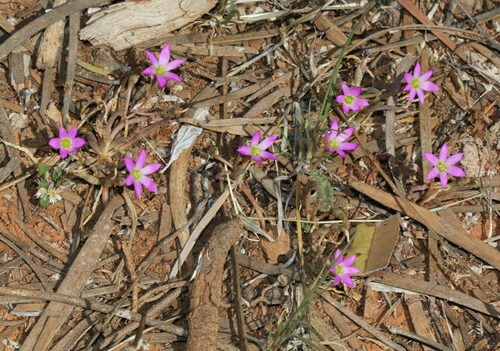
A succulent annual herb. It can be erect or lie along the ground. It grows 5-30 cm high. The leaves are succulent, fleshy and flattened. The flowers are white, pink or purple. The seed pod is 5 mm long and shaped like a spiral.
Notes
There are between 50-100 Calandrinia species. It has also been put in the family Portulacaceae.
References (14)
- Cancilla, D., 2018, Ethnobotanical and Ethnozoological Values Desktop Assessment - Eliwana Project. p 41
- Cherikoff V. & Isaacs, J., The Bush Food Handbook. How to gather, grow, process and cook Australian Wild Foods. Ti Tree Press, Australia p 189
- Dashorst, G.R.M., and Jessop, J.P., 1998, Plants of the Adelaide Plains & Hills. Botanic Gardens of Adelaide and State Herbarium. p 54
- Hunter, J. T. & Sheringham, P., 2006, Vegetation and Floristics of Melville Range Nature Reserve. A Report to the New South Wales Parks and Wildlife Service. p 165
- Hunter, J., 2012, Vegetation and Floristics of Gilwarny and Wingadee Nature Reserves. A Report to the New South Wales National Parks and Wildlife Service p 110
- Hunter, J., 2015, Vegetation and flora of Naree and Yantabulla. A Draft Report to the Bush Heritage Australia
- Hunter, J.T., 2017, Is there a relationship between contemporary high Aboriginal plant resource locations and mapped vegetation communities? Cunninghamia 17:27-34. The Royal Botanic Garden Sydney. ISSN 2200 - 405X
- Latz, P.K., 1996, Bushfires and Bushtucker: Aboriginal plant use in Central Australia. IAD Press Alice Springs p 134
- Lazarides, M. & Hince, B., 1993, Handbook of Economic Plants of Australia, CSIRO. p 42
- Lim, T. K., 2015, Edible Medicinal and Non Medicinal Plants. Volume 9, Modified Stems, Roots, Bulbs. Springer p 22
- McKerney, M. & White, H., 2011, Bush Tucker, Boomerangs & Bandages. Border River-Gwyder Catchment Management Authority p 181
- Paczkowska, G . & Chapman, A.R., 2000, The Western Australian Flora. A Descriptive Catalogue. Western Australian Herbarium. p 462
- Steenbeeke, Greg as part of the Plants Directory project. List of plant species from northern NSW that may be used as food plants p 13
- Tasmanian Herbarium Vascular Plants list p 46


