Briza maxima
L.
Giant quaking grass

(c) Murat Kurtel, some rights reserved (CC BY-NC), uploaded by Murat Kurtel
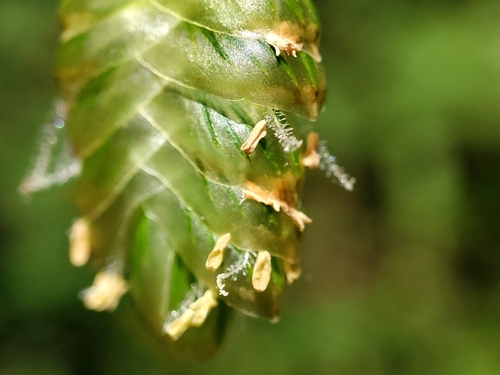
(c) Tuero, some rights reserved (CC BY-NC), uploaded by Tuero

(c) Elena López Valero, some rights reserved (CC BY-NC), uploaded by Elena López Valero
What to Eat
Edible parts: Seeds - spice
The seeds are crushed and cooked for use in porridge and bread. The young flowering spikes are eaten raw as a snack.
Where to Find It
It is a temperate plant. In Zimbabawe it grows between 1,600-1,710 m above sea level.
Africa, Argentina, Asia, Australia, Balkans, Bosnia, Brazil, Chile, China, East Africa, Europe, Mediterranean, North Africa, Sao Tome and Principe, Slovenia, South Africa, South America, Spain, Tasmania, Uruguay, Zimbabwe,
How to Identify
An annual grass. It grows 60 cm high. The flowering stalk usually has 3-8 large spikelets. They droop at the tip.
Wikipedia
Source ↗Briza maxima is a species of the grass genus Briza. It is native to Northern Africa, Western Asia and Southern Europe and is cultivated or naturalised in the British Isles, the Azores, Australasia, the western United States, Central and South America, and Hawaii. This species has a large number of common names, including big quaking grass, great quaking grass, greater quaking-grass, large quaking grass, blowfly grass, rattlesnake grass, shelly grass, rattle grass, and shell grass. It grows to a height of 60 cm. Their spikelets resemble those of the unrelated species Bromus briziformis. The seeds and leaves are edible.
Names & Synonyms
Majkine suze, Pana de cuco, Pendientes, Velika migalica
References (2)
- Gonzalez, J. A., et al, 2011, The consumption of wild and semi-domesticated edible plants in the Arribes del Duero (Salamanca-Zamora, Spain): an ananalysis of traditional knowledge. Genetic Resources and Crop Evolution 58:991-1006
- Redzic, S. J., 2006, Wild Edible Plants and their Traditional Use in the Human Nutrition in Bosnia-Herzegovina. Ecology of Food and Nutrition, 45:189-232


