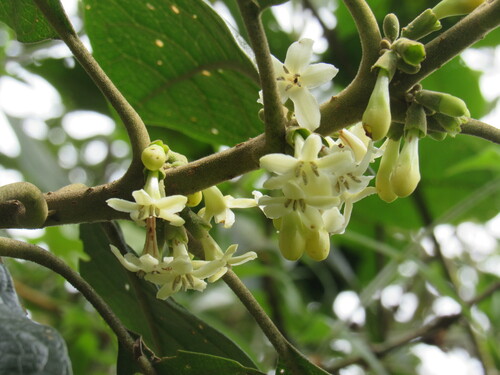
Lamium maculatum
L.
Spotted dead nettle

(c) AnneTanne, some rights reserved (CC BY-NC)
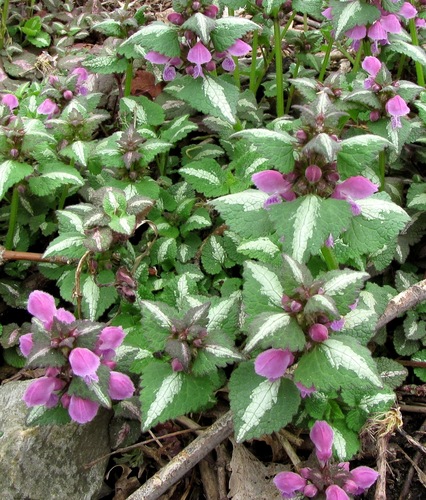
(c) Mike Leveille, some rights reserved (CC BY-NC), uploaded by Mike Leveille
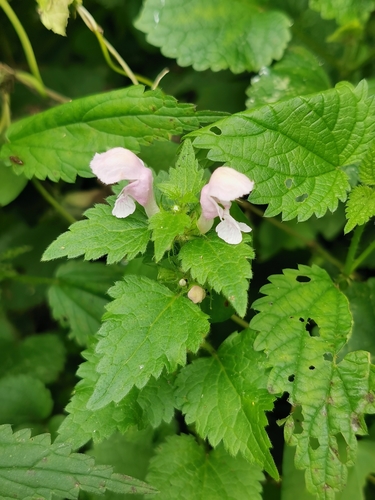
(c) Olha Bezsmertna, some rights reserved (CC BY-NC), uploaded by Olha Bezsmertna
What to Eat
Edible parts: Shoots, Flowers - nectar, Flowers, Leaves
The young shoots are cooked as a vegetable. The flowers are sucked for their nectar. The leaves and flowers are eaten raw in salads or cooked in stews and soups, finely chopped and added to mashed potatoes, and used for herbal teas.
Where to Find It
It is a Mediterranean plant. It grows on hill tops and valleys between 2,400-2,700 m above sea level.
Asia, Balkans, Bosnia, China, Europe, Hungary, Luxembourg, North America, Portugal, Russia, Slovenia, Spain, Turkey, Türkiye,
How to Identify
A herb. It keeps growing from year to year. The stems are 30-50 cm tall. They have some white hairs and are hollow. The leaves are 3-5 cm long by 2-3 cm wide. They are green with blue-silver mottling. The flowers are pink.
Wikipedia
Source ↗Lamium maculatum (also known as spotted dead-nettle, spotted henbit and purple dragon) is a species of flowering plant in the family Lamiaceae, native throughout Europe and temperate Asia (Lebanon, Syria, Turkey, western China).
Names & Synonyms
Benli balicak, Chupamieles, Lisasta mrtva kopriva, Mamatetas, Pjegava mrtva kopriva
References (13)
- Cerne, M., 1992, Wild Plants from Slovenia used as Vegetables. Acta Horticulturae 318
- Denes, A., et al, 2012, Wild plants used for food by Hungarian ethnic groups living in the Carpathian Basin. Acta Societatis Botanicorum Poloniae 81 (4): 381-396
- Ertug, F, Yenen Bitkiler. Resimli Türkiye Florası -I- Flora of Turkey - Ethnobotany supplement
- Gonzalez, J. A., et al, 2011, The consumption of wild and semi-domesticated edible plants in the Arribes del Duero (Salamanca-Zamora, Spain): an ananalysis of traditional knowledge. Genetic Resources and Crop Evolution 58:991-1006
- http://www.botanic-gardens-ljubljana.com/en/plants
- Jan, M., et al, 2018, Ethnobotanical Study of Plants Used By Ethnic People of Karbari Grant Village Dehradun, Uttarakhand. SERBD-International Journal of Multidisciplinary Sciences
- Menendez-Baceta, G., et al, 2012, Wild edible plants traditionally gathered in Gorbeialdea (Biscay, Basque Country) Genetic Resources and Crop Evolution 59:1329-1347
- Pardo-de-Santayana, M., et al, 2005, The gathering and consumption of wild edible plants in the Campoo (Cantabria, Spain). International Journal of Food Sciences and Nutrition. 56(7): 529-542
- Pardo-de-Santayana, M., et al, 2007, Traditional knowledge of wild edible plants used in the northwest of the Iberian Peninsula (Spain and Portugal): a comparative study. Journal of Ethnobiology and Ethnomedicine 2007, 3:27
- Redzic, S. J., 2006, Wild Edible Plants and their Traditional Use in the Human Nutrition in Bosnia-Herzegovina. Ecology of Food and Nutrition, 45:189-232
- Redzic, S., 2010, Use of Wild and Semi-Wild Edible Plants in Nutrition and Survival of People in 1430 Days of Siege of Sarajevo during the War in Bosnia and Herzegovina (1992–1995). Coll. Antropol 34 (2010) 2:551-570
- Tardio, J., et al, Ethnobotanical review of wild edible plants in Spain. Botanical J. Linnean Soc. 152 (2006), 27-71
- www.wildediblefood.com