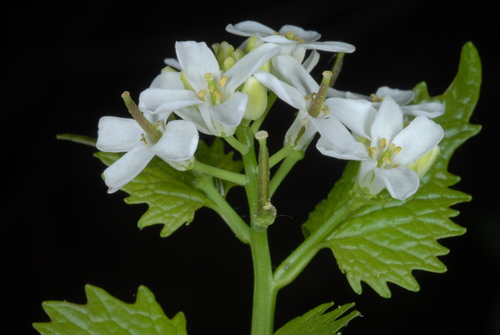
Rorippa sylvestris
(L.) Besser
Creeping yellowcress

(c) Aleksandr Ebel, some rights reserved (CC BY-NC), uploaded by Aleksandr Ebel
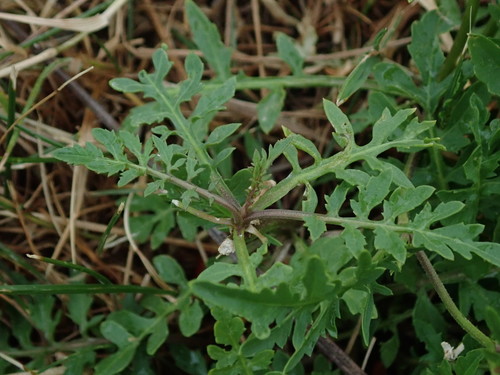
(c) Daniel Cahen, some rights reserved (CC BY), uploaded by Daniel Cahen
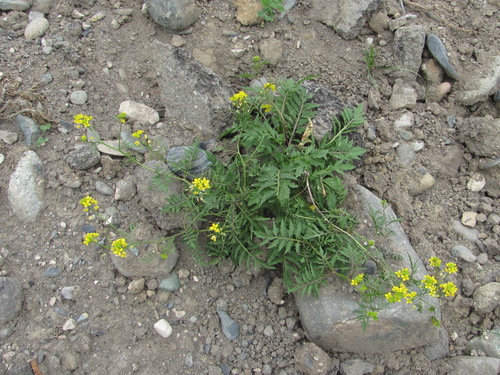
(c) Gennadiy Okatov, some rights reserved (CC BY-NC), uploaded by Gennadiy Okatov
What to Eat
Edible parts: Leaves
The young shoots are cooked and eaten; leaves are the primary edible portion.
Known Hazards
Where to Find It
It is a temperate plant. In Argentina it grows below 600 m above sea level.
Argentina, Australia, Balkans, Bosnia, Central Asia, Chile, China, Europe, India, Italy, Japan, Korea, Luxembourg, Mediterranean, North America, Norway, Russia, Scandinavia, Sicily, South America, Tajikistan, Tasmania, USA, Uzbekistan,
How to Identify
A herb. It keeps growing from year to year. It has rhizomes or underground stems and forms stands. It grows 20-50 cm high. The leaves are alternate. The leaves have leaflets or lobes along the stalk. There are 4-7 pairs of lobes. They have teeth along the edge. The flowers are yellow and 1 cm across. The fruit is a narrow slightly curved pod with many seeds.
Wikipedia
Source ↗Rorippa sylvestris (the creeping yellowcress, keek, or yellow fieldcress; syn. Radicula sylvestris (L.) Druce ) is an invasive species of plant in the United States, likely entering from Europe before 1818 from ballast water and spreading throughout North America through contaminated nursery seed stock.
Notes
It can be invasive.
Names & Synonyms
Repnica, Veikarse
References (6)
- Biscotti, N. et al, 2018, The traditional food use of wild vegetables in Apulia (Italy) in the light of Italian ethnobotanical literature. Italian Botanist 5:1-24
- Flora of China @ efloras.org Volume 8
- Girard, N. J., 2020, Sustainable Foraging of Wild Edible Plants in Norway. A Biocultural Approach. M. Sc. thesis Norwegian University. p 129
- Pasta, S., et al, 2020, An Updated Checklist of the Sicilian Native Edible Plants: Preserving the Traditional Ecological Knowledge of Century-Old Agro-Pastoral Landscapes. Frontiers in Plant Science. Volume 11|Article 388
- Redzic, S. J., 2006, Wild Edible Plants and their Traditional Use in the Human Nutrition in Bosnia-Herzegovina. Ecology of Food and Nutrition, 45:189-232
- Redzic, S., 2010, Use of Wild and Semi-Wild Edible Plants in Nutrition and Survival of People in 1430 Days of Siege of Sarajevo during the War in Bosnia and Herzegovina (1992–1995). Coll. Antropol 34 (2010) 2:551-570